By Dr. Gyan Pathak
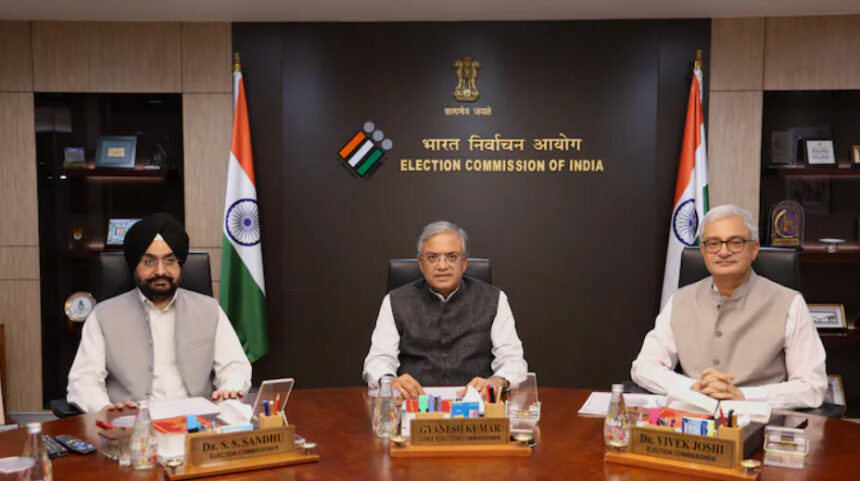
The proposed INDIA bloc meet — scheduled on September 30, 2026 in New Delhi against the Chief Election Commissioner’s (CEC’s) ‘illegal’ and ‘unauthorised’ actions as recorded by the two fellow Election Commissioners (ECs) — aims at not only taking a unified stand on demand of removal of the CEC and initiating criminal proceedings against him, but also ask for the launching of independent investigation against the alleged criminal conspiracy, involving Prime Minister Narendra Modi and Union Minister of Home Amit Shah, to disenfranchise Indian voters en masse. Thus, the significance of the September 30 INDIA bloc meet actually goes beyond mere political protest.
Though the Election Commission of India (ECI) in their clarification maintains that its decisions have legal sanction and were ultimately unanimous, the objections raised by the two ECs at least 14 times in the last ten months (as reported by the Indian Express on September 23) were actually not answered. The ECI clarification merely says that the Commission functions as a multi-member body, that internal notes are normal, and that decisions were ultimately unanimous. However, it did not directly answer the questions, such as — What happened to the 14 specific objections? Who authorised the July change to Form 6? If the Form 6 change was lawful, what was the legal provision? Who authorised appeals against voters whom judicial officers/EROs had included? Were the two ECs consulted before those appeals were filed? Who controls access to the electoral roll database? Who has the authority to alter or restrict the IT system? What happened in the Goa case involving 97 voters who the EROs had found eligible, but were nevertheless deleted from the final electoral roll? — and so on.
Moreover, the Indian Express follow-up investigation published on September 27, is equally noteworthy, since it pointed out that the nine decisions of the ECI had addressed only some of the concerns, but significant questions remained, including Form 6 and mass appeals in West Bengal. Therefore, the real issue now is not simply whether there was dissent (in reality the majority opinion), but whether the institutional procedures required by Article 324 and the 2023 Act were followed at each stage, and whether the ECI can produce documentary record demonstrating that they were.
In the meant time, an RTI answer has complicated the matter. The Election Commission of India (ECI) stated in an RTI response to activist Anjali Bhardwaj that the commission had “so far not taken any decision on initiating a Special Intensive Revision (SIR) across the country”. The answer was given when the decision of conducting SIR had already been taken on June 24, 2025. When asked for copies of any independent study or appraisal cited as the basis for the nationwide SIR rollout, the ECI stated that no such information or records exist in material form. Requests for file notings, internal approvals, and correspondence regarding the nationwide SIR decision yielded only a link to the ECI’s June 24, 2025 order, with the First Appellate Authority (Principal Secretary) noting that further details were unavailable. It has created political and institutional controversy, and the opposition is asking whether the decision was taken at the level of PM Narendra Modi and Union Home Minister Amit Shah and ECI Gyanesh Kumar had simply implemented it?
The ECI is being fully protected under the Modi government’s act of 2023 relating to CEC and other ECs appointment and service conditions. Section 16 of the Act prevents courts from entertaining or continuing civil or criminal proceedings against current or former members of the ECI for acts done in the discharge of their official duties. Nevertheless, taking illegal or unauthorised actions is not part of the discharge of official duties. A case has already filed in the Supreme Court of India seeking criminal investigation against CEC.
It is in this backdrop that the INDIA bloc meeting is being held, which could potentially turn the controversy surrounding CEC Gyanesh Kumar from a series of party-level protests into a coordinated parliamentary and political campaign over the institutional functioning of the ECI.
The meet could consolidate the opposition’s demand for Gyanesh Kumar’s removal. They will discuss a fresh impeachment motion against CEC, which will be third such attempt. The issue is clearly moving from political protests on the streets to formal parliamentary proceedings.
Nevertheless, the key issue is bigger than the CEC Gyanesh Kumar, since the Article 324 of the Constitution of India places electoral decision making collectively, which was violated by the CEC. Moreover, SIR makes the controversy electorally consequential. Now dispute has gone beyond the CEC’s administrative style of functioning. Opposition has argued that the changes to electoral rolls in the name of SIR affect citizen’s ability to vote. They are therefore demanding immediate halt/scrapping of the SIR and restoration of wrongly deleted names.
The September 30 INDIA bloc meet is likely to produce a common national programme or agenda against the present controversy which has been termed by the opposition as a major national crisis alleging that Modi-Shah-Gyanesh trio has conspired to hijack electoral democracy in India. (IPA Service)