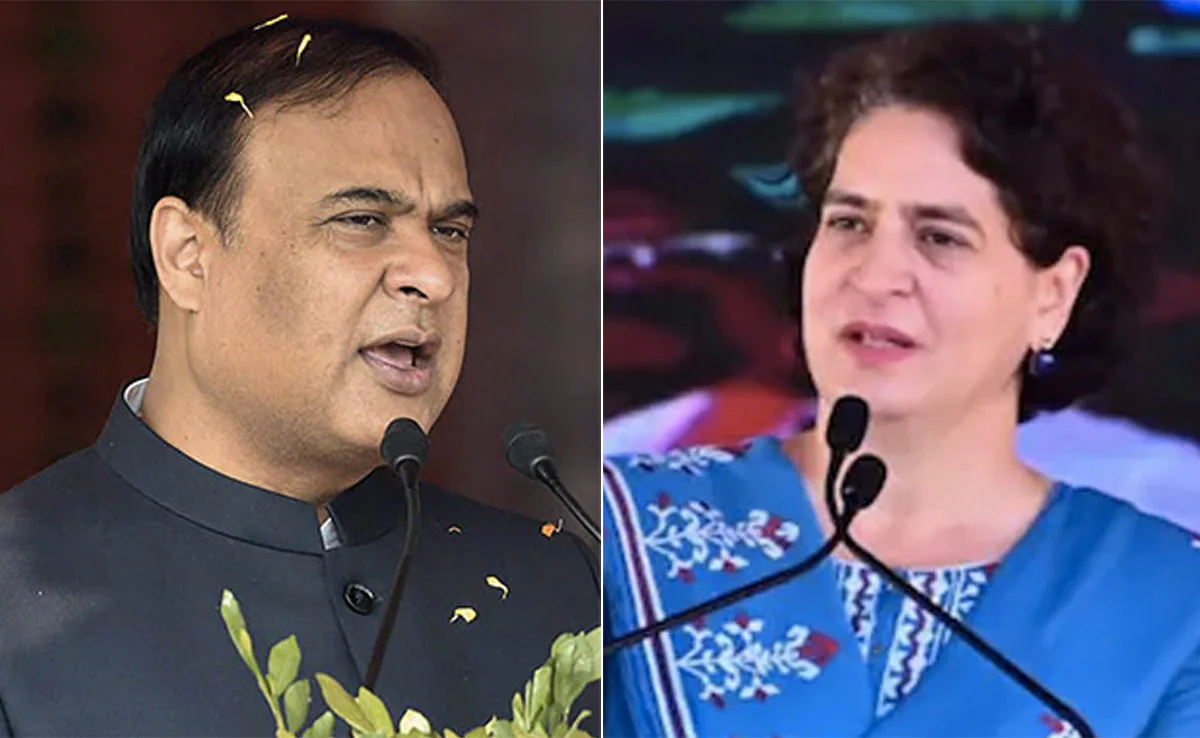
Assam chief minister Himanta Biswa Sarma has triggered a fresh political row by alleging that Rahul Gandhi did not want Priyanka Gandhi Vadra to play a role in Kerala and instead assigned her responsibilities linked to Assam to avoid unsettling the Congress leadership structure in the southern state.
Speaking to reporters on the sidelines of the World Economic Forum meeting in Davos, Sarma claimed that internal dynamics within the Congress shaped the decision-making around Priyanka Gandhi Vadra’s political deployment. He asserted that Rahul Gandhi was keen to preserve the existing balance of power in Kerala and therefore looked elsewhere when allocating responsibilities to his sister.
Sarma said he was drawing on his long association with the Congress to make the assessment, noting that he had spent more than two decades in the party before joining the Bharatiya Janata Party. According to him, Rahul Gandhi did not want to disturb what he described as the KC Venugopal axis in Kerala. He added that this, in his view, explained why Priyanka Gandhi Vadra was not given a direct role in the state despite her prominence within the party.
The Assam chief minister went further, pointing out that no sitting Congress Member of Parliament from Kerala had been entrusted with a comparable organisational role within the state. “What else explains this?” he asked, suggesting that internal considerations outweighed electoral strategy. His remarks, delivered outside India at an international forum, quickly reverberated through political circles back home.
Debate over Priyanka’s placement fuels Congress tensions as Sarma’s comments fed into a longer-running discussion about leadership choices within the opposition party. Priyanka Gandhi Vadra has held the position of Congress general secretary and has been a key campaigner in several Assembly elections, including in Uttar Pradesh, where she took a visible frontline role. Her political assignments have often been read as signals of the party’s evolving leadership calculus.
Kerala has traditionally been one of the Congress’s stronger states, governed in alternation with the Left Democratic Front. KC Venugopal, a senior Congress leader and close aide to Rahul Gandhi, has been widely regarded as a central figure in managing the party’s affairs in the state. Sarma’s assertion that Rahul Gandhi was reluctant to disrupt this arrangement places renewed attention on Venugopal’s influence within the organisation.
Leaders within the Congress have not publicly endorsed Sarma’s claims. Party figures have maintained that organisational responsibilities are allocated based on strategic needs rather than personal preferences. Some Congress leaders privately dismissed Sarma’s remarks as political provocation, noting his past association with the party and his current role as one of the BJP’s more outspoken chief ministers.
The context of Sarma’s comments is also politically significant. Assam has emerged as a key battleground between the BJP and the Congress in the northeast, with Sarma positioning himself as a leading strategist for the ruling party in the region. His remarks about Priyanka Gandhi Vadra’s role can be seen as part of a broader effort to question the Congress’s internal coherence and leadership choices ahead of future electoral contests.
Rahul Gandhi and Priyanka Gandhi Vadra have not responded directly to Sarma’s statements. In the past, Rahul Gandhi has spoken about the need for decentralised leadership and empowering state units, particularly in regions where the Congress faces stiff competition. Priyanka Gandhi Vadra, meanwhile, has focused her public messaging on organisational revival and outreach, without addressing speculation about where her political energies should be concentrated.
Political analysts note that Kerala’s Congress unit has often been sensitive to perceptions of external interference, given the state’s strong cadre structure and factional history. Any high-profile intervention by national leaders is closely scrutinised by local leaders, which lends some plausibility to arguments about caution in reshuffling roles. At the same time, critics of the Congress leadership argue that ambiguity over responsibilities can weaken the party’s ability to present a unified challenge to rivals.