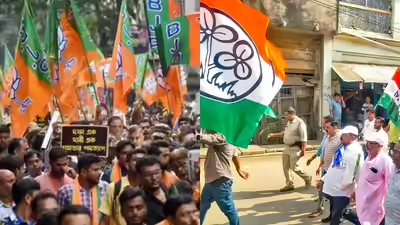
West Bengal is heading into the 2026 Assembly election with the sharpest two-party contest the state has seen in years, as the Bharatiya Janata Party presses its strongest challenge yet to Mamata Banerjee’s Trinamool Congress, though the ruling party still appears to retain the edge on the numbers available so far. Official results from the 2021 Assembly election gave the Trinamool Congress 48.02% of the vote against the BJP’s 37.97%, while the 2024 Lok Sabha vote in the state narrowed that gap, with the Trinamool Congress on about 46% and the BJP on about 39%, showing that the opposition has deepened its base without yet overtaking the ruling party statewide.
That narrowing is why the arithmetic is drawing such close attention. A modest shift in vote share in a first-past-the-post system can transform a contest if it occurs in the right places. Constituency-level analysis of the 2024 parliamentary vote mapped on to Assembly segments shows the Trinamool Congress leading in 192 of Bengal’s 294 Assembly segments, with the BJP ahead in 90 and Congress and the Left accounting for the remainder. That is a far slimmer cushion than the Trinamool Congress enjoyed after its landslide in 2021, and it suggests that if the BJP pulls a few additional points away from the ruling party in competitive seats, the map could tighten quickly.
Still, the claim that the BJP is on the brink of power needs qualification. The same segment-by-segment breakdown indicates that while the BJP has expanded, it remains short of a majority path unless it converts nearly all the seats where it is already ahead and then captures a large share of constituencies where the Trinamool Congress still leads narrowly. India Today’s constituency analysis identified 28 seats won by the Trinamool Congress in 2021 where the BJP was ahead on the 2024 Lok Sabha count, but it also showed the ruling party holding a substantial firewall in Kolkata, Howrah and South 24 Parganas. The BJP is closer than it was in earlier cycles, but the state is not yet pointing clearly to a transfer of power.
The BJP’s optimism rests on geography as much as headline vote share. It has built momentum in Purba Medinipur, parts of North Bengal, the Jhargram-Bankura belt and pockets along the Hooghly river towns. In Purba Medinipur alone, the BJP’s Assembly-segment lead surged in the 2024 parliamentary contest, strengthening the party’s case that its organisational push is no longer confined to a handful of northern districts. That expansion matters because Bengal elections are often decided not by uniform statewide swings, but by concentrated advances in districts where local leadership, cadre strength and communal or caste equations can shift several seats at once.
The Trinamool Congress, for its part, enters the campaign with advantages the BJP has still not fully neutralised. Mamata Banerjee remains the central political figure in the state, and the ruling party continues to benefit from a durable local machine, welfare delivery networks and entrenched urban and peri-urban support. The 2021 result, where the Trinamool Congress won 215 seats to the BJP’s 77, remains a reminder that Bengal’s Assembly voting pattern can differ sharply from parliamentary elections, where national leadership and broader ideological themes weigh more heavily. Even analysts tracking the BJP’s rise caution that the Lok Sabha result is a signal, not a forecast.
Another variable is the role of Congress and the Left in districts such as Murshidabad and Maldah. The 2024 parliamentary results showed pockets where the contest is not purely bipolar, and any three-cornered fight could alter the BJP’s chances in two opposite ways. A split in anti-BJP voting could help the party in some seats, but a stronger Congress presence in its own areas could also deny the BJP the direct one-on-one battle it wants with the Trinamool Congress. That is one reason both major parties are watching seat-level candidate selection and local alliances more closely than statewide rhetoric.
Campaign developments over the past week underline how high the stakes have become. Union Home Minister Amit Shah has publicly set an ambitious target for the BJP in Bengal and has campaigned alongside Suvendu Adhikari, while Mamata Banerjee has framed the election as a defence of Bengal’s social compact and political autonomy. The temperature of the contest has also been raised by clashes, accusations over voter rolls and rival claims of intimidation, all of which point to a polarised campaign in which turnout, booth management and micro-swings in marginal constituencies may decide the outcome.