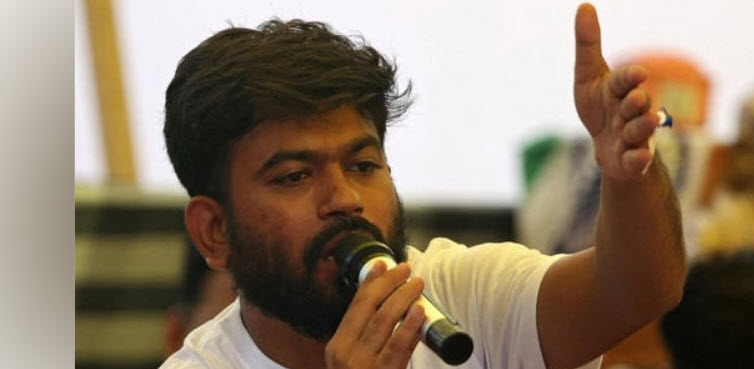
Dipke posted screenshots on X showing the CJP account as unavailable and displaying a “user not found” message. He accused Meta, the owner of Instagram, of removing the account and sharply criticised the action. The movement subsequently announced that it had successfully recovered the handle.
The circumstances behind the interruption were not immediately clear. There was no publicly available evidence establishing whether the account had been disabled by Meta, affected by a technical issue or became inaccessible for another reason. Meta had not publicly detailed the cause of the episode by Saturday morning.
CJP said its Instagram handle was taken down earlier in the day and accused its opponents of attempting to silence the organisation on Independence Day. The movement said it would not be intimidated and continued posting after the account became accessible again.
The Instagram page has become CJP’s principal communication channel and has accumulated more than 20 million followers since the movement emerged earlier this year. Its rapid digital expansion has helped turn what began largely as an online satirical campaign into a broader youth mobilisation focused on education, employment, examinations and government accountability.
Saturday’s disruption was not the first difficulty involving CJP’s online accounts. Dipke said in May that his personal Instagram account had been hacked and that the organisation had lost access to several digital platforms. He also said a backup Instagram account had been removed and CJP’s X account had been withheld in the country.
Those claims emerged as CJP’s following expanded sharply and its content increasingly moved from satire towards political mobilisation. The organisation attracted millions of young followers by using memes, videos and deliberately provocative imagery to highlight concerns about unemployment, examination irregularities and dissatisfaction with public institutions.
Instagram access has also become a politically sensitive issue for the movement. CJP’s account was temporarily restricted in July during a period of intense student protests before being restored. Government authorities subsequently reviewed action involving the account, with the full blocking of the handle reversed while allowing more targeted action against individual content where legally warranted.
The repeated interruptions have intensified debate over transparency in platform moderation. Social media companies routinely remove accounts or individual posts for violations of their policies and may also act on legally valid government requests. Critics argue that users should be given clear explanations when politically significant accounts disappear, particularly when such platforms function as major channels for public mobilisation.
CJP’s dependence on Instagram is unusually significant because its political influence has largely been built outside traditional organisational structures. The movement developed a national following within weeks and later organised demonstrations demanding action over weaknesses in the education and examination systems.
Its protests gained momentum during the campaign demanding accountability over examination failures and paper leaks. Large demonstrations in Delhi and other cities placed education policy and youth frustration at the centre of national political debate. The movement has continued to describe itself as a youth-driven platform rather than a conventional political party, despite adopting the word “Party” in its name and developing a growing organisational network.
The account disruption came as CJP prepared another phase of its grassroots activities. Dipke announced the launch of the “School Thik Karo” campaign from Santuk Pimpri village in Maharashtra’s Hingoli district on Saturday. The programme is intended to improve facilities and accountability at government schools in rural areas.
Dipke has asked village sarpanchs and residents to identify shortcomings in local schools and push for repairs and essential amenities. He said schools should have basic facilities including benches and safe drinking water and argued that communities should play a more direct role in demanding improvements.
CJP teams plan to take the campaign to villages in different parts of the country, encouraging residents to examine conditions at government schools and seek action from local authorities. The initiative represents a shift from large protest gatherings towards decentralised civic campaigns built around local grievances.
(IPA Service)