By Ashok Nilakantan Ayers
NEW YORK: September 24, 2026, the third day of the high-level General Debate of the 81st UN General Assembly, turned the UN podium into something of a geopolitical courtroom on Thursday, with Iran’s war with the United States and Israel, Gaza, terrorism, sovereignty and the credibility of the international system crowding out much of the UN’s development agenda.
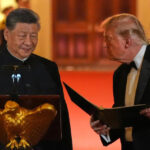
The contrast could hardly have been sharper. In Washington, US President Donald Trump was rolling out the red carpet for Chinese President Xi Jinping, seeking to stabilise a relationship dominated by trade, AI, Taiwan and Iran. In New York, Iran’s President Masoud Pezeshkian and Israeli Prime Minister Benjamin Netanyahu used the same international stage to present diametrically opposed accounts of the war.
The UN’s formal theme this year is “Restoring trust, managing transformation: A United Nations that delivers for all.” But Thursday’s proceedings exposed precisely how difficult that ambition has become. Pezeshkian said effectively that Iran will not “bend the knee”. Pezeshkian’s appearance was extraordinary since Iran is at war with the country hosting the General Assembly, i.e., USA.
Speaking a day after Trump told the UN that the United States could “annihilate” Iran, the Iranian president sought to reverse the narrative, portraying Iran as the victim rather than the aggressor. “We have been the victims of terrorism,” he told the Assembly, rejecting Trump’s description of Iran as the world’s leading sponsor of terrorism. He displayed photographs of the late Supreme Leader Ayatollah Ali Khamenei and children killed in the conflict, while insisting that Iran’s nuclear programme had peaceful purposes.
His central message was that Iran remained open to negotiations but would not negotiate under military coercion. “We are ready for dialogue and diplomacy and negotiations but without the language of force,” Pezeshkian said. The speech was therefore aimed at several audiences simultaneously: the American administration, European governments, the Arab world, the Global South and Iranians watching at home. It also provided the clearest possible indication that the UN has become one of the few remaining places where Tehran can speak directly to the international community while under extraordinary military and economic pressure.
For Netanyahu, it was about Israel’s war as self-defence. Twenty-four hours later, Netanyahu stood at the same podium and saw 77 country delegations stage a walkout before he started speaking. He responded by calling those who remained silent or left “moral cowards.” Supporters in the public gallery, meanwhile, cheered and chanted in Hebrew. The Israeli PM spoke to a near-empty auditorium, and delivered his message that was the opposite of Pezeshkian’s. He defended the US-Israeli military campaign against Iran, argued that destroying Iranian nuclear facilities was necessary for Israel’s survival and rejected accusations concerning Israel’s conduct in Gaza.
“Devastating Iran’s nuclear facilities was hard, was very hard to do,” Netanyahu said. “But for me, it was one of the easiest decisions I’ve ever had to make as prime minister,” arguing that otherwise “we’d all be dead.” Netanyahu also attacked Iran, Qatar, Turkey, European critics and New York Mayor Zohran Mamdani, while defending Israel’s military record and rejecting allegations of genocide.
The walkout was more than theatre. It demonstrated the growing diplomatic polarisation surrounding Israel’s conduct in Gaza and the widening gap between Washington’s support for Israel and the position of many UN members. Netanyahu was also speaking to a domestic audience. Israel faces elections later this year, and analysts quoted by Al Jazeera said his UN appearances have become an important means of presenting himself to Israelis as the country’s defender against international pressure.
The juxtaposition of the three positions—Trump’s on Tuesday, Pezeshkian’s on Wednesday and Netanyahu’s on Thursday—effectively transformed the General Assembly into a running argument over the future of the Middle East. Trump has threatened extreme military consequences for Iran while simultaneously saying that diplomacy remains possible. Pezeshkian says Iran is willing to negotiate but rejects negotiations under pressure. Netanyahu argues that military action against Iran is indispensable to prevent a nuclear threat.
The problem for the UN is that these positions leave little diplomatic middle ground. And yet diplomacy is precisely what many countries attending the Assembly are seeking. For countries dependent on Gulf energy, shipping through the Strait of Hormuz and stability in the Middle East, the war is not simply an ideological dispute. It is an economic-security problem.
That was evident in Bangladesh Prime Minister Tarique Rahman’s meeting with Pezeshkian. Dhaka sought Iranian cooperation over the movement of Bangladeshi vessels and containers through the Strait of Hormuz and raised the safety of Bangladeshi workers in the region.
The speeches provide the headlines, but the bilaterals are where the practical diplomacy is taking place.
EU Council President António Costa’s programme illustrates the scale of the parallel diplomacy. During the high-level week he met the leaders of Angola, Jordan, Australia, Kuwait, Senegal, Syria, Pakistan and Iran. Bangladesh and Pakistan also held bilateral talks, with Tarique Rahman and Shehbaz Sharif discussing bilateral relations, regional questions and areas of cooperation. Iran’s Pezeshkian has been particularly active on the margins of the Assembly, meeting foreign leaders as Tehran seeks diplomatic space amid the war. His meeting with Pakistan’s Shehbaz Sharif on Thursday focused on bilateral and regional issues.
Turkey’s Foreign Minister Hakan Fidan also held discussions with EU Commissioner for Migration Magnus Brunner, focusing on migration management, internal security coordination and bilateral cooperation. These meetings reveal another side of UNGA diplomacy: while the principal speeches are confrontational, governments continue to conduct highly practical negotiations over trade, migration, energy, shipping, refugees and regional security.
And China? China’s absence at presidential level from New York this week is conspicuous.
Xi Jinping is in Washington rather than at the UN, where Foreign Minister Wang Yi represents Beijing’s foreign-policy interests. That gives the Trump-Xi summit an importance beyond US-China relations. China remains a permanent member of the Security Council, and its position can be decisive on questions involving Iran, sanctions and international security.
The timing is therefore significant. While Wang works the diplomatic circuit in New York, Xi is discussing Iran directly with Trump in Washington. Iran is China’s major trading partner, and Beijing’s relationship with Tehran gives Xi potential diplomatic leverage that Washington cannot easily replicate. But Trump has so far indicated that he does not need Beijing to mediate the conflict.
Even as governments argue over war and sovereignty, the UN is attempting to return the international agenda to global problems—pandemics, climate change, development and sea-level rise—that cannot be solved by military power. The third day of UNGA 81 ultimately demonstrated two competing realities.
The first is that the UN remains the world’s indispensable diplomatic meeting place. Iran can speak to the world; Israel can answer; Bangladesh can raise the practical consequences of war; European leaders can meet Arab and Asian counterparts; and countries that rarely receive global attention can put their concerns on the record. The second is that the UN’s capacity to resolve the biggest conflicts remains severely constrained.
The General Assembly can provide the microphone. It cannot impose a settlement on Washington, Tehran or Jerusalem. That contradiction is increasingly central to the future of the institution.
As Guterres has argued, the world needs cooperation precisely when geopolitical rivalry is making cooperation harder. The UN’s high-level week is therefore becoming less a place where conflicts are solved than a place where the competing narratives are publicly tested—and where, behind the speeches, governments quietly search for the compromises that the cameras rarely see.
And nowhere is that contradiction more visible this year than in the distance between New York and Washington: the UN discussing how to restore trust, while Trump and Xi attempt to manage the world’s most consequential strategic rivalry—and while Iran and Israel use the same UN podium to argue over a war that threatens to redraw the geopolitical map of the Middle East. (IPA Service)