By Krishna Jha
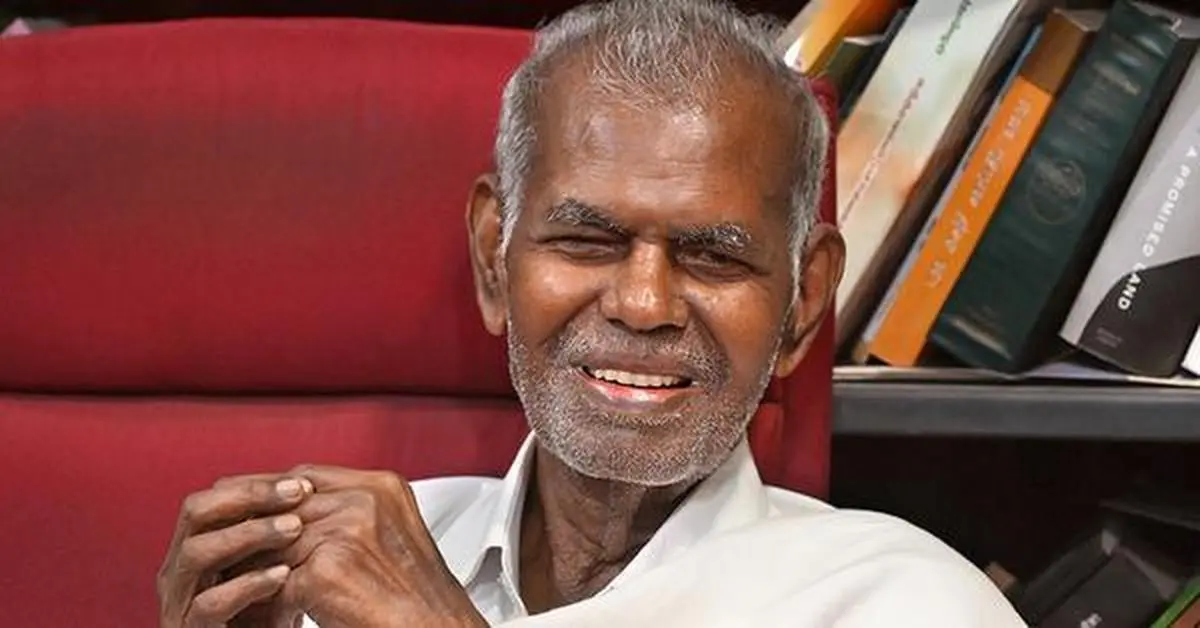
It was legendary peasant leader P. Srinivasa Rao who had said about the 23 – year old, who was yet to prove his worth, “…sturdy, village-bred R Nallakannu would evolve into an exceptional party worker”. His prophetic words stood all the vagaries of time. In little more than a century that he lived, never had Com Nallakannu compromised. The life that he had opted for at an early age of eighteen, was full of challenges, offered externally and internally, and he remained undeterred. He was born, had lived and finally departed as the party completed a century.
Nallakannu was born in a peasant family on December 26, 1925, in Srivaikuntam near Thoothukudi, to Ramasamy and Karuppayi Ammal and brought up as a young man who always struggled against injustice. His life as in the party was more than eighty years, and spent mostly fighting to strengthen the will to establish democracy in a country enslaved by the British colonialists. In his future planning, scientific socialism was the ultimate. It was not straight, as the hurdles were many, moving through uprisings against feudal and colonial atrocities, and finally against the forces of Right.
The enemy was formidable as they had compromised with imperialist forces. He had joined the public life in his youth itself with an awareness about social and economic inequality. He had realized very early that it was not through political independence alone, that the inequality could be removed from the society. Caste system was entrenched deep and could be uprooted only if the majority in the society join the struggle for the cause. Nallakannu was soon attracted towards the Swadeshi ideals of V. O. Chidambaram Pillai and also Subramania Bharathi. Finally he decided to accept Marxism. He also realised that it was the class forces, the agricultural labour, poor and marginalised farmers and workers slogging that would have to be organized. It was also early phase of trade union movement led by Thiru V Kalyansundaram. These were functional as the early trade unions organised in Harvey Mills, Thoothukudi among others.
Nallakannu did not waste time and started working among them. He included the southern districts as well. His strategy was to raise the demands of land redistribution, minimum wages, and finally the end of feudal exploitative practices. He was working following the steps taken up by Kisan Sabha founded and organized by Sahajanand Saraswati and others. Their central demand was “Land to the Tillers” that was taken up as a slogan for their campaigns. With each step forward, the efforts were to spread an awareness about class consciousness.
It was also the time when Communist influence had started getting stronger. The state power was not ignorant about that. The CPI became the target and was facing repression. Finally the party was banned. Repression was severe. After the CPI was declared illegal in 1948, Nallakannu went underground. Finally in Nellai Conspiracy Case, he was arrested on December 20, 1949 at the age of 23 and sentenced to lifetime imprisonment. In incarceration, facing inhuman torture, he prepared his course of immediate and long term goals.
He adopted Marxism as his lifetime creed and started getting ideological clarity. The roots were not unknown. The stories are quite popular. As early as at the age of five, Nallakannu saw the striking workers on a strike at a cotton mill, poorly clad, starving, but with a flame that could not be easily quenched. He also read the poems of Bharathiyar that inspired him to take up politics and work for the welfare of people. Ever since then, he stayed a people’s man till the end.
Nellai Communist Conspiracy Case (Tirunelveli case) was one of the major police action taken against the Communist leaders in Tirunelveli district of Tamil Nadu. It was part of a broader crack down in post independence days. Nallakannu was arrested for organizing a “land for tillers” agitation, which was framed as waging war against the state. He spent seven years of rigorous imprisonment and was released in 1956. The case is remembered in the history of communist movement as a period of intense repression and resistance.
There are several incidences that give a touch of his love for the humankind and absence of greed. In one incidence, on his 80th birthday, party presented him a car and Rs 1 crore. He returned both saying these belong to people only. The government of Tamil Nadu conferred on him ‘Thagaisaal Tamilar’ award, and a cash prize of Rs 15 lakh. He handed it back to the Chief Minister’s Relief Fund in which he added five thousand from his own account.
Com Nallakannu was a rare combination of ideological clarity with personal integrity and gentleness.
As state secretary of the CPI in Tamil Nadu for 13 years, he strengthened rural party structures and trade unions, leading agitations on agrarian distress, labour rights, price rise and public sector disinvestment. Although he contested elections — including the 1999 Coimbatore parliamentary constituency — he was never elected to legislative office.
Com Nallakannu believed in combining ideological firmness with personal gentleness. There was a time when four villagers were murdered in what was then V.O. Chidambaranar district, now Thoothukudi. One of the victims was his 84-year-old father-in-law, killed in his sleep. At a time when grief and anger could easily have overwhelmed him, Nallakannu chose to travel and join the peace march, without any trace of bitterness. (IPA Service)