By Rabindra Nath Sinha
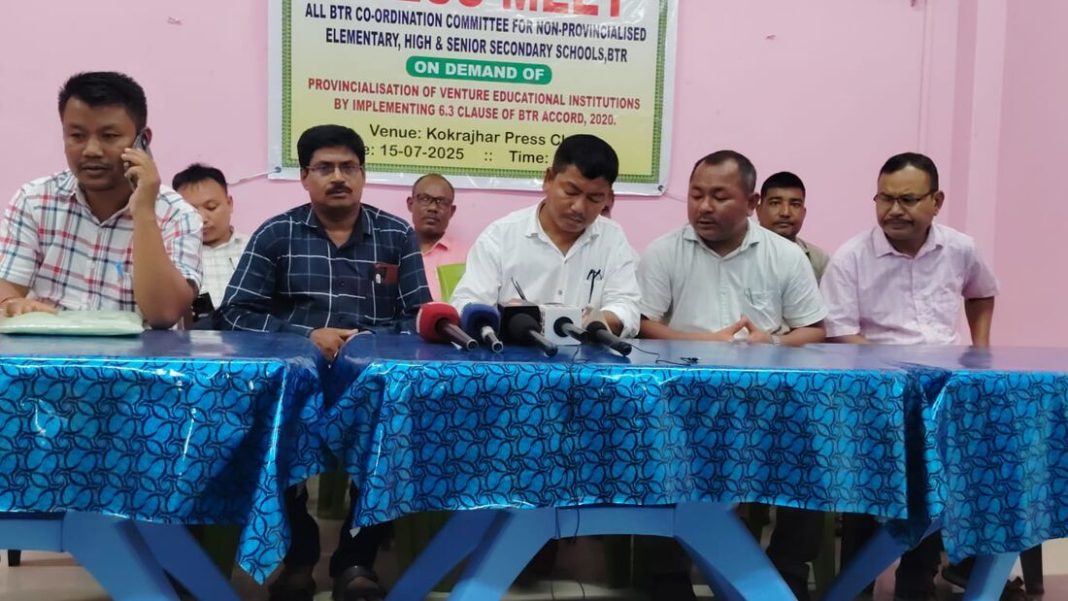
KOLKATA: The third and subsisting tripartite Bodo Peace Accord signed on January 27, 2020 provides under clause 6.3 for “provincialisation” of schools and colleges in the Bodoland Territorial Region (BTR), as also Bodo-medium schools outside BTR. [The accord rechristened what was then known as Bodoland Territorial Areas District – BTAD – as BTR]. Although the Accord refers in general terms to schools and colleges in the context of provincialisation, in reality, the reference is to private/venture schools and colleges, which exist “perhaps only in Assam” in the entire country. The lapse of six years since the memorandum of settlement (MoS) has been the cause of several big agitations by teaching and non-teaching staff. Assam watchers wonder whether the deep-rooted discontent will escalate into a political campaign, if provincialisation of venture schools and colleges is not concretised before long. Their apprehension of a political campaign stems from the fact Assembly elections are due in Assam between March and April next.
Venture institutions mark the initiative of residents years ago in localities and areas without any facility for education of their wards. They formed societies and assumed the responsibility of raising funds; but students were not required to pay fees. Teaching and non-teaching staff, however, were paid to the extent the collected funds permitted. Thus, provincialisation in Assam, especially in the context of education of children in Bodo families, means making the institutions part of the state system. Which means the state government has to be responsible for funding, regularising salaries, ensuring quality and implementing the Centre’s NEP 2020 and Right to Education Act. But, little visible has happened on the ground and the legislative initiative of 2017 and thereafter remain largely limited to pious intentions.
According to general secretary of United Bodo People’s Organisation, Pitambar Brahma, the intense discontent in the Bodo community and their taking recourse to the agitational path may be traced to the fact that the peace deal of January 27, 2020 clearly mentioned that the Assam government has to initiate measures taking into account “the special need and requirement”. The educational career of thousands of students in BTR and Bodo-medium schools outside BTR is at stake and, therefore, the inordinate delay in improving and upgrading the existing poor arrangement is deplorable, Brahma told IPA.
The issue figured in the Assam Assembly in the last week of November, when several MLAs pointed out that the prolonged conflict in the BTR areas had badly hampered development activity in every sector, including education. MLAs wanted to know about the progress of implementation of clause 6.3 of January 27, 2020 MoS. The position explained by Assam’s education minister Ranoj Pegu revealed the problems and dilemmas being faced by the government. Follow-up actions on a wide front is bound to be time-consuming, as required documents are not available in a large number of cases, and alternative routes have to be identified. Pegu argued the existing provincialisation law provides for its application to Sixth Schedule areas through official notification. The government is open to extending the law to Bodoland Territorial Council (BTC) areas, but practical challenges remain due to the absence of required documents in many schools, “largely because of the region’s troubled past”. The government is exploring alternative mechanisms and emphasised that BTC had the authority to enact its own provincialisation law for schools in the region.
The issue of Bodo-medium schools outside BTR was also raised by members. The minister informed that BTC is preparing a detailed report, which is to cover the situation in Bodo-medium schools outside BTC’s jurisdiction. But, the government has also to see that only those schools established before January 1, 2006 come under the purview of the existing law. Any move towards provincialisation has to align with the current legal framework “unless new legislation is introduced by BTC for its jurisdiction”. Published reports also indicate that the minister, after tabling The Assam Education (Provincialisation of Services of Teachers and Re-Organisation of Educational Institutions) (Amendment) Bill 2025 on Wednesday, November 26, 2025, said the passage of this Bill could facilitate provincialisation of venture schools and colleges if they could submit even one government document dated on or before January 1, 2006, which is the cut-off date. The intention is to carry forward the process initiated under the first Act of 2017 (with same nomenclature), provide clarity, remove ambiguities, tone up the education facility up to the degree level and prevent further setting up of venture educational institutions.
Time will show whether agitations on this count will continue or not. In this context, it deserves mention that the 125th Constitution (Amendment) Bill, 2019, whose objective is to vest more financial and administrative powers in the Sixth Schedule Councils under Articles 280 and 275 (1) (a) of the Constitution, is still pending. (IPA Service)