By P. Sreekumaran
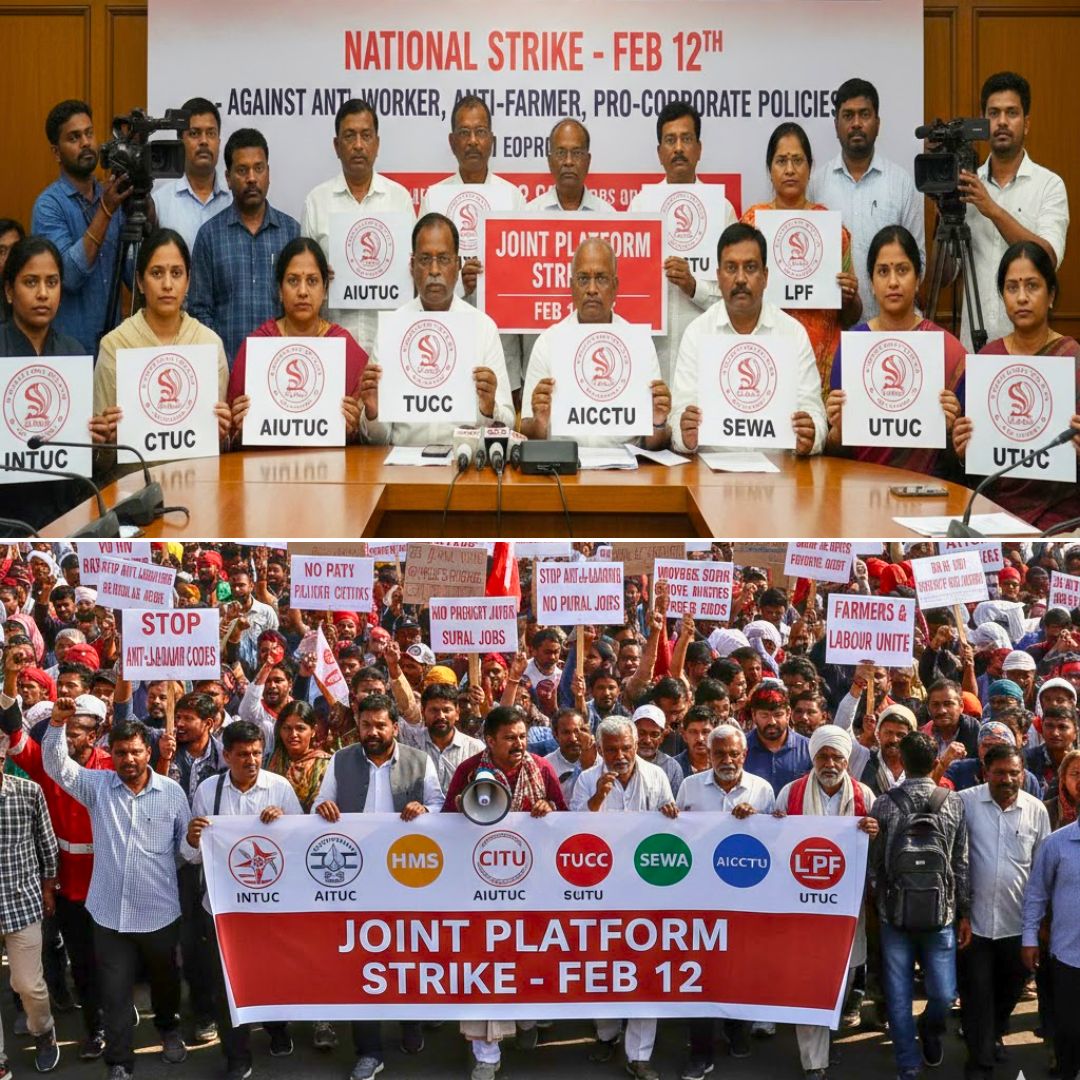
THIRUVANANTHAPURAM: The country will witness a 24-hour nationwide general strike from midnight on Wednesday, February 11, 2026. The nationwide shutdown, in protest against the implementation of the new four labour codes, has been called by 10 central trade unions, including the CITU, AITUC, INTUC, HMS, AIUTUC, TUCC, SEWA, AICCTU, LPF, and UTUC.
The strike will see the participation of agriculture workers, bank and insurance employees apart from the workers of coal, electricity and defence.
CITU general secretary Elamaram Karim said the February 12 strike will be the biggest shut down in the country. According to CITU, the labour codes will turn workers into “bonded labourers” under employers and push them back by nearly 100–150 years. The unions claim that these laws will exclude a large section of the workforce from the definition of ‘worker’, putting their livelihood and existence at risk. Trade unions argue that existing labour laws were achieved through decades of struggle and sacrifice against British rule, and scrapping them is an attack on the Constitution. They have alleged that the labour codes are part of a larger conspiracy to weaken constitutional safeguards.
AITUC General Secretary Amarjeet Kaur said the strike will impact nearly 600 districts across the country, with Odisha and Assam expected to witness complete shutdowns. The Samyukt Kisan Morcha and agricultural workers’ unions have extended full support, while students and youth groups have also joined mobilisation efforts.
Key demands include scrapping of four labour codes, withdrawal of proposed bills related to electricity, seeds and nuclear energy, and restoration of MGNREGA. Trade unions say preparations are complete across sectors in both rural and urban India.
The left parties led by the CPLI(M), CPI and others have extended full support for the strike which will send a powerful message to the Union Government, bent upon making the life of workers miserable. The strike is being organized against the murky backdrop of an anti-people Union Budget and a sell-out deal with the United States of America.
The CITU has decided to field 1,000 workers in 1,000 centres to express the sense of outrage against the anti-worker labour codes which will deprive the labour class of the hard-earned rights. The TUs have warned of stronger steps if the Union Government refuses to mend its ways and withdraw the new labour codes.
A notable feature of the general strike is the participation of farmers and agriculture workers who have unleashed their wrath against the Indo-US deal and the changes in the MGNREGA, which gives them an opportunity to lead a life of dignity. The last strike held in July 2025 saw the participation of 25 crore workers. The participation this time will be even better, according to the TU leaders, who are expecting 30 crore people to register their strong protest against the anti-labour, anti-farmer and pro-corporate policies of the Modi Government.
As usual, Kerala will lead from the front. The agricultural, industrial, and commercial sectors will come to a complete halt. Shops will remain closed. Given the anti-labour steps the Union Government has initiated, the strike will see the participation of the entire population, with Youth, Women and students playing a big role.
A notable absentee will be the Bharatiya Mazdoor Sangh (BMS), which is affiliated to the ruling BJP.
The four new labour codes will replace the existing 29 labour laws which recognized the rights of the labour class to some extent.
Labour laws came into existence in the country post-Independence. The laws were enacted on the recommendations of the first Labour Commission headed by Justice Gajendra Gadkar. The recommendations were in consonance with the directive principles of the Constitution. The Second Labour Commission, formed during the tenure of the Vajpayee-led Union Government, submitted proposals aimed at diluting the pro-labour recommendations on the first Commission. However, the efforts came to grief in view of the strong and united resistance offered by the trade unions.
Since 1991 which saw the advent of globalization, the Union Governments have enacted labour laws in line with the interests of the capitalists, global Multi-National Corporations and MNCs in the country. These anti-labour policies gained traction and speed with the assumption of power by the Modi Government in 2014.
The period thereafter saw the rights secured by the workers being taken away. Parliament passed the four new labour codes in 2019-20. Ironically, the “Code on Wages” introduced in 2019 was supported by the Congress! The Left parties and the DMK, however, opposed it. The Opposition boycotted Parliament when the other three codes were introduced in the House.
In the aftermath of the new labour codes, formation of trade unions has become difficult. The right to collective bargaining is in danger. To cite an instance, the trade union formed by the workers of Samsung company in Tamil Nadu was denied recognition. It was only after the workers launched an over-two-month-long struggle that the trade union secured registration. (IPA Service)