


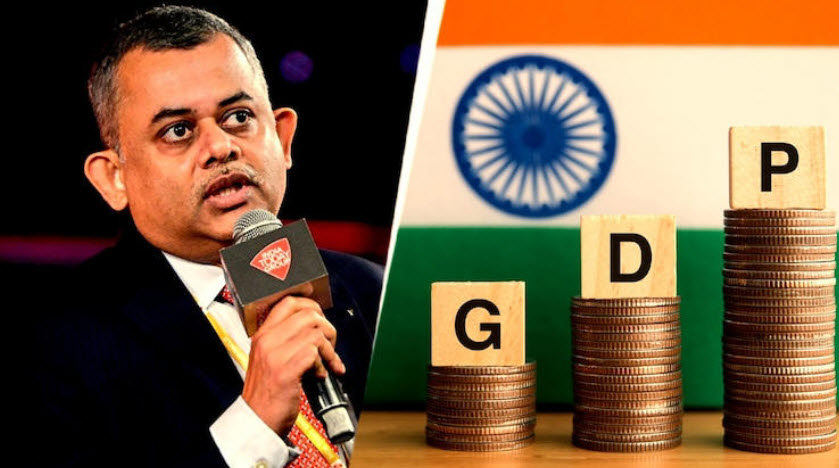
World Bank Executive Director Neelkanth Mishra has rejected the claim that India’s April-June economic growth was only 2.6 per cent rather than the officially reported 7.8 per cent, calling the calculation “obviously wrong” and saying it mixed figures from different statistical series.
Mishra, who represents Bangladesh, Bhutan, India and Sri Lanka at the World Bank and previously served as chief economist at Axis Bank, said he was shocked by what he described as “ill-educated and egregiously wrong claims” surrounding the quarterly data. He said the new GDP series, introduced in February with 2022-23 as the base year, had materially improved the methodology and that the downward revision in the comparison base had been known since March.
His intervention followed criticism from former finance secretary Subhash Chandra Garg, who argued that nominal GDP for the April-June quarter of 2025-26 had originally been estimated at about ₹86 lakh crore but was subsequently placed near ₹80 lakh crore. Garg said that comparing this year’s nominal GDP of about ₹88.3 lakh crore with the earlier ₹86 lakh crore estimate would imply growth of roughly 2.6 per cent.
The Ministry of Statistics and Programme Implementation has rejected that comparison, saying the ₹86.05 lakh crore figure belonged to the old national accounts series based on 2011-12 prices, while the ₹80 lakh crore figure was calculated under the new 2022-23 base-year series. Officials said figures from the two series cannot validly be combined to derive a growth rate.
Statistics Secretary Saurabh Garg said the revisions reflected both additional data and methodological changes rather than any attempt to depress the previous year’s base. The ministry said the new series incorporates updated sources, including a new Index of Industrial Production and more granular price measures.
A research note from State Bank of India’s research department likewise said the controversy arose from comparing incompatible series, arguing that the rebasing exercise had been disclosed and that the revised estimates should be assessed within a consistent statistical framework.
The government’s official estimate showed real gross domestic product expanding 7.8 per cent year on year in the April-June quarter of 2026-27. That was above the Reserve Bank of India’s 7 per cent forecast and faster than the 6.9 per cent growth recorded for the same quarter a year earlier under the revised series, though slower than the revised 8.6 per cent expansion in January-March.
Saurabh Garg said the new framework increased the number of price deflators used in GDP calculations to more than 300 from about 180, partly through the adoption of a producer price index in place of broader wholesale-price measures. He also said quarterly revisions over the previous three years had moved both upward and downward, arguing against claims of a systematic effort to lower earlier estimates.
Mishra said the credibility of the growth estimate could also be tested against indicators of activity that were difficult to reconcile with a 2.6 per cent expansion. He pointed to strong vehicle dispatches, faster tax collections, improving credit growth and robust construction indicators as evidence that economic momentum remained firm.
He said personal vehicle dispatches had grown sharply, two-wheeler sales were expanding by more than 20 per cent and commercial vehicle dispatches by more than 40 per cent. Mishra also cited evidence of investment activity, while acknowledging that some slack remained in the economy and that it could take several quarters of above-trend growth to absorb it.
The dispute has centred partly on the distinction between nominal and real GDP. Nominal GDP measures output at current prices, while the 7.8 per cent headline rate measures real growth after adjusting for price changes. Official data put nominal GDP growth in the April-June quarter at about 10.3 per cent, implying an aggregate GDP deflator increase of roughly 2.3 per cent.







