By Krishna Jha
When Bhagat Singh was incarcerated after scattering leaflets with the program of Hindustan Socialist Republican Association in the Central Assembly and to wake up the leaders and masses throwing bomb, he was arrested in full knowledge that end was getting closer. The officer leading him to court was cautioning him. The reply was, “It was only the body that goes, not the ideas, they keep alive.” Bhagat Singh himself is no more, but he lives even now, not only in memory, but in every breath, along with those fighting for people.
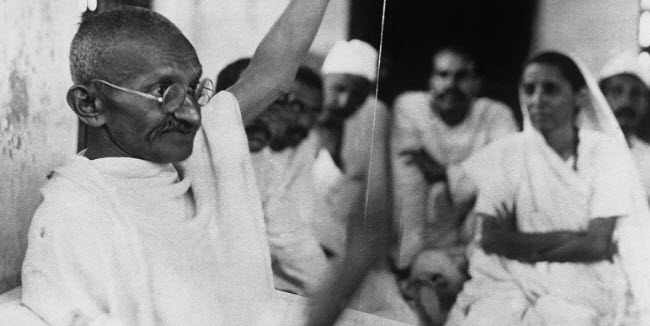
Mahatma Gandhi was also someone treading the same path, though far apart. Similarity was in his love for his country, its people, and then finally facing bullets. Born 157 years back, in 1869, his birth anniversary is celebrated every year on October 2, when he was born. He was assassinated on January 30, 1948, but he still remains the guiding force to fight against the communal-fascist Hindutva forces.
Gandhiji studied in local school in captive India, and then he left for London for higher education to study Law. He kept growing in the shadows of captive India along with the nationhood as it evolved. He propagated that Independence would not be complete without getting rid of colonial bondages and establishing secular democracy in India. In the preamble of the Constitution, the words like sovereign, democratic, Republic were placed as they were significant in the context of collective resolve and collective spirit of the national movement that he led. And these were the principles for which he died.
Condoling the martyrdom of Gandhiji, S A Dange in the Bombay Assembly of which he was a member, had said:“He was not murdered because he was a saint, he was also not murdered because he intervened in the political affairs of the country in his own way. His intervention in the political conditions of this country on the crucial point of Hindu-Muslim unity was not liked by communal reactionaries. He was guilty of this one single sin and for that particular sin he was murdered, not because he preached peace, love and brotherhood in the abstract. He preached love between landlord and tenants, among the kisans, but kisans did not kill him. No worker, no peasant, no communist killed him. It was the princes, landlords and capitalists, who conspired to kill him.”
For Gandhiji, nothing was absolute, not even truth with which he kept experimenting all his life. It was a fact that Gandhiji did not agree with the role of class struggle, nor the class analysis of society, but basically he believed in social transformation. Gandhiji believed in substantial reduction in rent and revenue, abolition of feudal dues against agricultural and forced labour. The Congress ministries passed legislations to protect tenant’s rights and expropriation by the moneylenders. Most of the demands were suggested by the Left. The politics of the Left and Workers’ Peasants movement impressed even the Congress Rightists though they did not support socialism. The entire movement adopted a positive stance towards supporting the reform of the land system, abolition of landlordism and restoring of land belonging to the tiller.
It may be said that the entire ideological theme of the national movement was guided by Gandhiji as he moved towards radicalism. He was beginning to oppose private property and proposed radicalization of trusteeship. When in 1942 Louis Fischer, a journalist, asked him about the trusteeship theme, Gandhiji said he would prefer to go against the trustees, and if need be, he would join any open demonstration against them whom he once supported. Answering Louis Fischer’s question as to what was his “programme for the improvement of the lot of the peasantry”, Gandhiji said that “the peasants would take the land. We would not have to tell them to take it. They would take it.” And when Fischer asked whether landlords would be compensated, he replied: “No, that would be fiscally impossible.”
Elaborating it further, Gandhiji said, “In the villages, the peasants would stop paying taxes…Their next step will be to seize the land.” When Fischer asked whether the seizure of land would involve violence, Gandhiji replied: “There may be violence, but then again the landlords may cooperate… They might cooperate by fleeing.”
Gandhiji was highly against capitalism, and landlordism. He was opposed to discrimination based on caste, supported women’s liberation. He always in his writings came out in support of down trodden, oppressed and exploited.
The course of Gandhi’s life reveals that by the time he was killed he had comprehensively countered the project of Hindu Rashtra and the virulent idea fuelling it, forcing its proponent organizations—Rashtriya Swayamsevak Sangh (RSS) and Hindu Mahasabha—to the margins of Indian politics. It was largely due to Gandhi’s own immense moral power and his all-out efforts as the supreme leader of the anti-British struggle that in a short span after Independence, the validity of the vision of a secular and democratic nation seemed beyond question. It rose above the turmoil of the time and became the unifying principle of the post-Independence India.
The assassination of Gandhi was an act that sought to derail the secular project of Independent India. The putative resolution posited by Godse can now be seen as benighted and even self-defeating in light of the popular outrage and enduring disgust at Gandhi’s murder. But the disputants that engendered the assassination remained at large. They continued to exist and, after the Sangh’s capture of power through its electoral wing, the Bharatiya Janata Party, they have been threatening the very foundation of the secular democracy that Mahatma Gandhi had fought for and given his life for.
The rot that the BJP government has wrought in the system is not just about the election rigging by controlling the Election Commission of India. It is much more than that. It threatens the entire democracy. The relevance of Mahatma Gandhi could not have been more than what it is today – in our collective fight to save the secular democracy. (IPA Service)