By Tirthankar Mitra
A lifelong crusader at home and abroad for the rights of the economically challenged and unrepresented Jesse Jackson is no more. His was a voice respected in US whose citizen he was and far beyond the contours of American borders.
For the issues he championed were universal in their appeal. They ranged from voting rights to job opportunities to education and health care. Having started his journey as an unknown Black activist, Jackson had a baptism which can be stated to be literally by fire. Walking in the shadow of the legendary Martin Luther King Junior, Jackson was a floor below the balcony where King was assassinated.
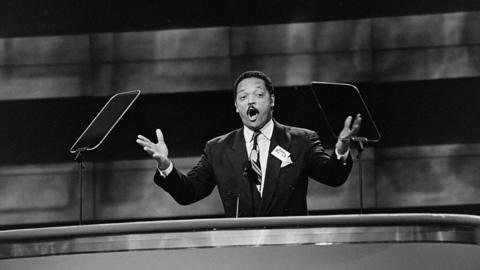
There was no looking back after he publicly positioned himself as King’s successor. And as long as his voice was not hushed, it continued to be the voice of the marginalized. And when Jackson declared “I am Somebody” in a poem, he was reaching out to people of all colours. “I may be poor, but I am Somebody, I may be young , but I am Somebody, I may be on welfare, but I am Somebody” he intoned.
These words came from within. For separation from other children for the colour of his skin, he utilised all he had to eradicate the divide. Indeed Jackson had the bringing up of s civil rights activist. Living under Jim Crow segregation laws, he was taught to go to the back of the bus and use separate water fountains.
Yet in 1969, New York Times noted that Jackson was one of the few black activists preaching racial reconciliation. He was reportedly seeking to form a coalition with whites to approach what was considered racial problems as economic and class problems.
His was an approach which took leave of adversarial relations. He founded People United to Save Humanity (PUSH) but later changed its name to People United to Serve Humanity. If the abbreviation remained unchanged the new name sought to work for the people, leaving the saving part to the divine.
“Even if we win, it is relief not victory.’ Jackson told marchers in Minneapolis before the officer whose knee kept George Floyd from breathing was convicted. “They are still killing our people .Stop the violence, save the children. Keep hope alive ‘ his words made hopes soar but kept the feet of the activist was firmly on the ground.
Jackson knew the odds were stacked high against his cause. That his why instead of making fiery speeches, his words of wisdom promoted his followers to positive activism. Jesse Jackson made political power a reality rather than an aspiration. Through the power of his language and morality it contained, he became a political force on his own in a racially ambiguous era.
Jackson knew this era and the people inhabiting it. “My constituency is the desperate, the damned, the disinherited, the disrespected and the despised “he said. Expanding his work, be launched a presidential campaign in 1984. He again launched a ptrdudentisl.bid in 1988, but never held office.
But he remained deeply influential. He was widely regarded as the most influential Aftucan-American of his era. His country and. its powers that be acknowledged by its powers that be. In 1983, Jackson travelled to Syria to secure the release of a American pilot shot down over that country.
After a dramatic personal appeal to Syrian President, Hafez–al-Assad, his mission was accomplished. In 1984, he negotiated the release of 22 Americans held in Cuba. Honoured at home and feted abroad, Jackson lived to see a black man living in White House – Barack Obama. One wholeheartedly agrees with what his family posted online “We shared him with the world, and in return the world became part of our extended family.” (IPA Service)