By Anjan Roy
Clearly under massive pressure to bring the war to a close and on honourable terms, Iran has utilised the United Nations General Assembly session in New York to turn the tables on the United States.
The American blockade of the Strait of Hormuz and any exit for the Iranians into the broader Indian Ocean sea routes is strangling the country’s economy. As such, the country is under severe economic strain due to American sanctions on sale of its oil, and the freezing if all its overseas assets running into billions of dollars.
Iran is at the cusp of a total economic collapse if the American blockade on movements of Iranian vessels from out of the country continue. Iran is understandably offering an immediate truce to America. That could be a lifeline though to the beleaguered, imperious and haughty American president.
At the same time, Iranian attacks on Gulf Arab states and the havoc its proxies in the Middle East were wrecking on oil-exporting countries of the region had created extensive bad blood.
Until now, Iran was mostly like a pariah state which was bombarding Gulf Arab states randomly, blocking the Hormuz Strait which was a major life line or global oil trade and disrupting flow of oil and energy products throughout the world.
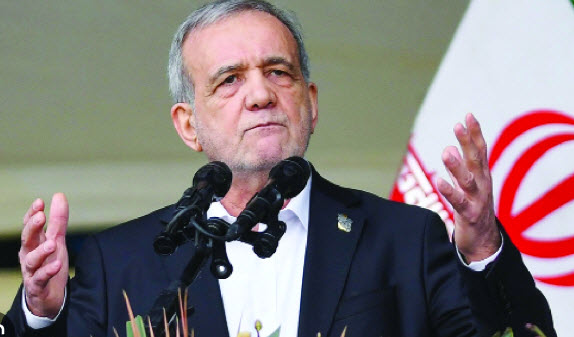
But the statements from its president, Mahmoud Pezeshkian, and the bilateral talks the Iranian foreign minister, Syed Abbas Araghchi, held on the sidelines of UNGA, has helped convey the Iranian point of view to the global leaders.
Iran has offered a truce and reopening of the critical Hormuz Strait in a week’s time if its terms for an understanding were accepted by the United States. Iran stated that all its terms for the end of hostilities were already contained in the June Memorandum of Understanding.
President Pezeshkian stated that the truce would have to be honourable and not under any threat. He emphasised Iran would not bow down to threat and force, which would have played extremely well for his domestic listeners back home in Tehran.
Pezeshkian and Araghchi, were severely criticised by the hardliners of Iranian Revolutionary Guards Corps for opening dialogue with American diplomatic negotiators.
Earlier, during the UNGA session, Donald Trump, US president, had threatened Iran with annihilation unless the country chose to come to some agreement. As usual, Trump’s brash statement did not cut much ice with the global diplomatic circuits, rather helped him win some domestic brownie points.
Instead, Iranian team to the UN and its preparations for the UNGA were deft and won the objectives. These were to convey Iran’s point of view to the entire world and also gain some confidence of the rest of the world that it was a responsible country under capricious attack.
Nonetheless, if there was one clear winner in the diplomatic Olympics that is the UN General Assembly session, the verdict would be for the small Himalayan country — Nepal. Its young prime minster Balen Shah stated the case for his country with such simple elegance that the entire UNGA and the international diplomatic community had to sit up and hear his message.
He simply stated Nepal was being made to bear the brunt of the wild policies of the developed countries creating an environmental cataclysm. The humongous tolls of the recent glacial collapse-caused floods in the Himalayas in which Nepal paid the ultimate price in terms of scores of poor Nepalese losing their lives, was too immediate to be ignored.
The massive floods from the Himalayan rivers, which are believed to be linked to the process of climate change, were a measure of the nature’s revenge in case its balance was tampered. There are reports that China is building huge dams over these Himalayan rivers, creating large dams in ecologically sensitive regions, are disturbing the entire eco system of the upper Himalayan regions.
Nepal insisted that the international community should consider their implications of their actions. They should also compensate Nepal for the massive losses that the country suffered from the flash floods. His simple message could hardly be ignored by the leaders assembled for the UNGA.
The head of the state of one country which could have directly contributed to the Nepal flash floods, China, was absent from the entire proceedings. There are rumours about the state of his health which were further vindicated by some awkward moments during his state visit to Washington at the same time when UNGA was being held in New York. Xi was absent throughout the UNGA and did not bother to hear the adverse consequences of China’s pursuit of megalomaniac dreams of greatness. (IPA Service)