By Raju Kumar
Amid India’s aspirations to become a developed nation, manual scavenging has still not been completely eliminated, even 79 years after Independence. At the same time, people continue to lose their lives while manually cleaning sewers and septic tanks under hazardous conditions. This is despite manual scavenging being prohibited by law and the Supreme Court issuing directions to make sewer and septic tank cleaning safe and mechanised.
The government says that a recent survey conducted across all districts of the country did not find anyone engaged in manual scavenging. However, the Safai Karmachari Andolan (SKA) claims that people are still manually cleaning human excreta from dry latrines in at least 46 districts of Uttar Pradesh, Madhya Pradesh, Bihar and Jammu and Kashmir.
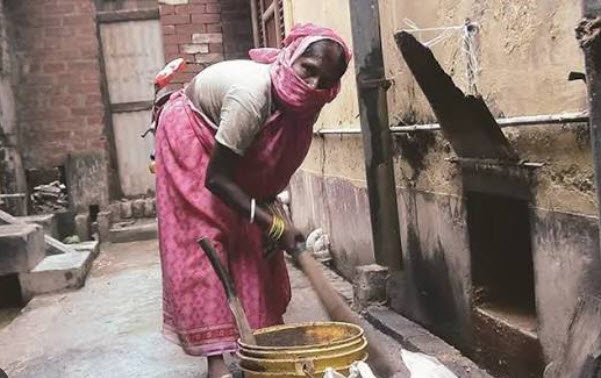
This contradiction was highlighted again through testimonies at the launch of the Safai Karmachari Andolan’s ‘India @ 80: End Manual Scavenging’ campaign in Delhi. People from different states spoke about how they continue to clean dry latrines even today. Seventy-year-old Musi Devi from Sitapur in Uttar Pradesh said she had spent almost her entire life doing this work and was still called upon to clean toilets. Responding to such testimonies, former Supreme Court judge Justice Sudhanshu Dhulia referred to his own judicial experience and said that one of the biggest problems had been the denial by government authorities that the practice even existed.
Former Supreme Court judge Justice Madan B. Lokur has also described the authorities’ denial of the problem as a matter of serious concern. He has said that eliminating dry latrines wherever they still exist should be a priority and should form an important part of the Swachh Bharat Mission. Former Patna High Court judge Justice Anjana Prakash has pointed out that the problem cannot be eliminated merely through legislation. Both the government and society, she said, need to change the caste-based mindset that allows the practice to persist.
A central law to eliminate manual scavenging was enacted in 1993. A more comprehensive law followed in 2013, prohibiting manual scavenging and making the employment of people for such work a punishable offence. Government surveys conducted in 2013 and again in 2018 identified 58,098 manual scavengers across the country. But if people are still reporting that they manually clean human excreta from dry latrines, the question is not merely whether laws exist, but whether they are being effectively implemented and whether government surveys are able to capture the reality on the ground.
Bezwada Wilson, national convenor of the Safai Karmachari Andolan, has been raising the issue for more than three decades. He says much has changed over these years, but the manual cleaning of dry latrines continues. Based on the evidence available with the organisation, he has called on the government to conduct a fresh survey and take action to eliminate the practice.
Another serious dimension of the problem is the deaths that occur during the cleaning of sewers and septic tanks. According to government data, 332 sanitation workers died while cleaning sewers and septic tanks in 18 states and Union Territories between January 2021 and June 2026. Official data treats manual scavenging and hazardous cleaning of sewers and septic tanks as separate categories. The government says that no new cases of manual scavenging have been found, while deaths during sewer and septic tank cleaning are recorded separately.
Organisations working for the rights of sanitation workers have questioned this distinction. They argue that sending a person into a sewer or septic tank to clean human excreta is part of the same dehumanising system and that these deaths cannot be separated from the broader issue of manual scavenging merely on the basis of different definitions.
The Supreme Court took a strong view of these continuing deaths while hearing Dr Balram Singh v. Union of India on July 27, 2026. A bench of Justices Aravind Kumar and Vipul M. Pancholi expressed serious concern that deaths were continuing despite the Court’s directions. Parliamentary data placed before the Court showed 54 deaths in 2024 and 46 in 2025. The Supreme Court issued show-cause notices to the Chief Secretaries of five states, asking why contempt proceedings should not be initiated for failure to comply with its directions. The Court also made it clear that states could not escape accountability by shifting responsibility to contractors.
In its October 2023 judgment, the Supreme Court had already issued a series of directions aimed at ending hazardous cleaning of sewers and septic tanks. These included compensation of Rs 30 lakh to the family in case of a death during sewer cleaning.
The government also launched the National Action for Mechanised Sanitation Ecosystem, or NAMASTE scheme, in 2023-24. The scheme seeks to replace hazardous manual cleaning with mechanised sanitation and improve the safety of sanitation workers. Yet the continuing deaths show that the challenge goes beyond designing schemes to ensuring their effective implementation on the ground.
As India approaches eight decades of Independence, the question is not merely how many manual scavengers are recorded in government data or how many districts have declared themselves free of the practice. The government needs to engage with sanitation workers and organisations working on the issue to establish the actual situation and take concrete action wherever the practice persists. Compensation for deaths is necessary, but the larger goal must be to ensure that no sanitation worker has to enter a sewer and lose their life. For that, mechanised cleaning of sewers and septic tanks needs to be fully implemented on the ground. (IPA Service)