By Arun Srivastava
Having lost hope in judicial intervention to force the CEC Gyanesh Kumar to look to the ground and do justice to 64 lakh disadvantaged people, which is likely to shoot to 1 crore by the time elections are held, who have been consciously deprived of their right to vote, by placing them in the category of logical discrepancy, West Bengal chief minister Mamata Banerjee has finally decided to resort to Dharna on March 6 to protest against “deliberate and inhumane” deletions of the names of the genuine voters and appeal to the conscience of the perpetrators of bigotry.
But with CEC adopting an obstinate attitude and interested to ensure her defeat in the ensuing assembly election, it is really an utopian matrix how far Gandhian mode of arousing conscience will make him accountable and abide by the legal and constitutional norms and provisions. Dharna functions as a check on power, but Gyanesh treats himself above law and judiciary, which is why he has the mettle to mislead the judiciary and disobey its directives.
There is no doubt that Bengal’s 2026 Assembly election has become a crucial test of Amit Shah’s political strategy and Mamata’s popularity. It is an open secret that the massive voter roll revision is being carried out leading to the huge deletion, many from minority-dominated areas, only to ensure TMC defeat. The dirty politics that is being played by Modi and Shah, , and the manner in which they plan to win election by reshaping the electoral map by disenfranchising vulnerable communities, would impair not only the electoral politics but common political perception and practice, for ever.
Though Muslims have been at the target by the saffron camp, the Hindu Dalit Matuas, are the worst victims of their dirty game. Notwithstanding saffron leaders assuring them of getting the citizenship, they are facing the threat of being disenfranchised and subsequently losing identity and citizenship. As questions grow over citizenship and voting rights, the battle for Bengal is increasingly turning into a struggle over the very meaning of democracy and belonging.
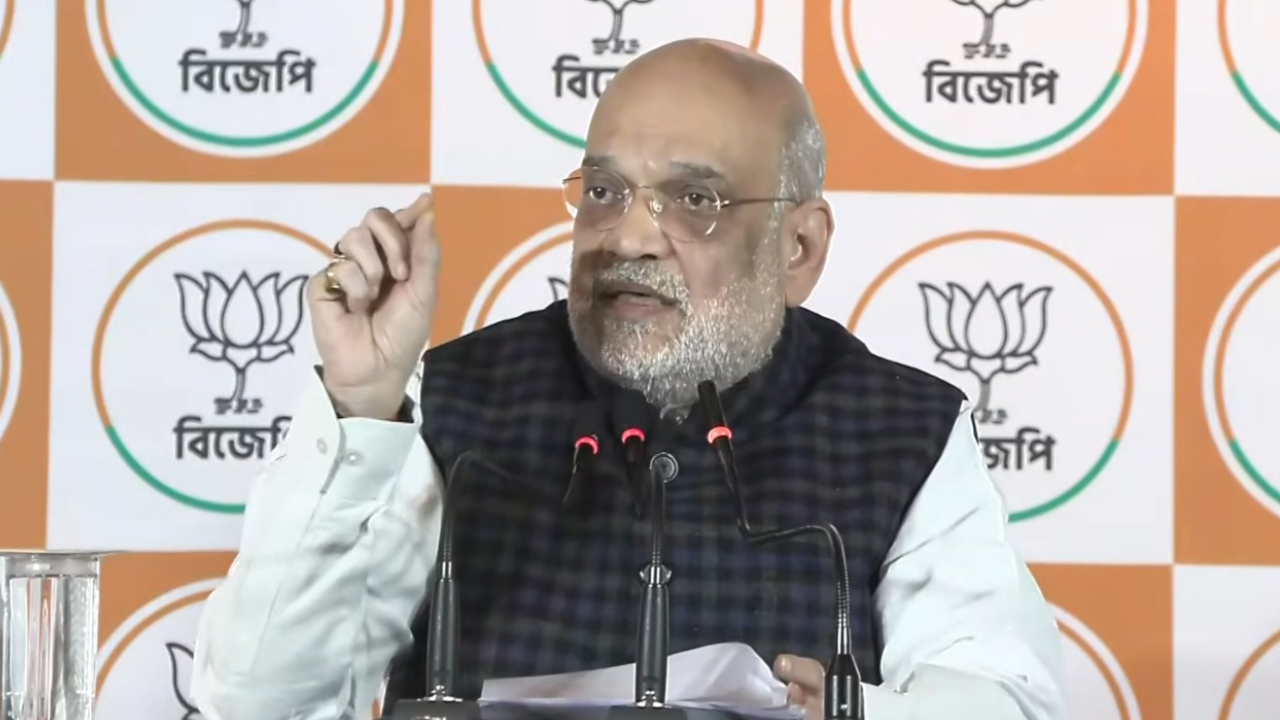
With hand that bestows boons on their heads, the Hindus of Bengal must not get afraid of losing their voting rights. This is the specific call from Home Minister Amit Shah to Matuas, the Dalit Hindus, who constitute at least 40 per cent of the total Matua population, but have been relegated to the category of logical discrepancy. Though his assurance counters both the eligibility criteria and norms laid down by the ECI for exercising right to vote, he has been emphatic that no power could deter them.
Speaking about the large-scale voter deletions in her own constituency Mamata Banerjee said “In Bhabanipur, there were 2.06 lakh voters earlier. They deleted 44,000 names during the draft roll and now further deletions of 2,000 were done. With 14,000 under adjudication, where are the voters then”. She alleged that names of genuine voters were deleted, despite submitting documents. “Around 1.20 crore people are likely to lose their right to vote and there will be huge deletions in the final Bengal-SIR rolls. This has made me sad,” Banerjee said and alleged that there is a ‘nexus’ between the poll panel and the BJP to disenfranchise genuine voters and help the BJP win the upcoming assembly elections.
Justifying his punctuation Shah on February 2 addressing the BJP’s Poriborton Yatra in South 24 Parganas district, declared that “only names of infiltrators are being deleted now” and they would be “pushed out of the state” once the party comes to power with a full majority in West Bengal. The question, which the BJP leader prefers to ignore is; why as the home minister he did not initiate action against Bengal government or against Mamata Banerjee for turning Bengal into a “swarg (heaven) for infiltrators” and also forcing the border state’s security to compromise because the ruling dispensation allowed illegal immigration. His second accusation is more serious: How could a state government or the chief minister of a state force the state’s security to compromise? His not taking action simply reinforces his utter incompetence or lack of security vision and determination to act.
If EC can allow the Hindus to vote, why cannot it allow others who are categorised under logical discrepancy to vote? A logical discrepancy refers to a data inconsistency or contradiction identified by automated systems when comparing information across different datasets. These are flagged when records violate established criteria, such as unreasonable age differences between relatives, mismatched names, or invalid mapping to previous records.
Right now, 63.60 lakh voters are ‘under ‘adjudication’. It is feared that by the time the SIR process is completed the number of deleted voters would shoot up more. These 63.60 are suspect in the eyes of the ECI and awaiting verification for being genuine. ECI officials maintain that deletions were primarily on account of death, migration, duplication and untraceability. Since finally these people have been identified, one presumes that there should not further addition to this list !!
With a large number of the under-adjudication voters coming from minority belts, Trinamool Congress faces a serious electoral blow. Even if the judicial officers assigned to settle the under-adjudication cases work overtime they would not be able to dispose of more than half of the 60 lakhs persons before the last day for filing nominations – also the deadline for voter inclusions. Right now, each of the 501 judicial officers was disposing of about 225 cases a day. At this rate, completing the 63.60 lakh cases would take 53 days.
There is no denying that façade of logical discrepancy has been created to help BJP electorally. TMC has a support base of nearly 40per cent ever since its formation. BJP has managed to have a core support base of around 10 per cent. In 2016 assembly vote TMC had got 44.97 per cent vote while BJP got 10 per cent. The first major increase in BJP’s support base took place in 2019 Lok Sabha elections. While TMC received 43.37 per cent, vote share of BJP shot to 40 per cent. The swing was based on the electoral perception that there is no alternative to Modi. But in 2021 BJP vote share declined to 38 per cent and TMC registered an increase of 3 per cent. It shot to 48 per cent.
Election results of 2021 make it clear that BJP could not hold its vote share of 40per cent which it received in the 2019 Lok Sabha elections. That year in assembly elections BJP could win 77 seats. It was second in 215 seats. BJP had lost nearly 32 sets by a small margin of 4 per cent. It lost around 30 seats by a margin of 5 to 10 per cent. The deletion of the voters purely aims at filling this gap on these 62 seats. By deleting the names SIR will ensure to cover the winning margin of the TMC in last election. If on an average 1000 winning votes are deleted, the exercise will help BJP win at least 50 to 60 seats. This addition in BJP seats would mean, equal number of reduction of TMC seats. Amit Shah is engaged in the highest order of psychological war fare. It is for Mamata how she succeeds in countering this strategy of Shah.
Most of the voters under adjudication are from minority-dominated areas. If close to 30 lakh cases remain pending before the polls, these voters will not be able to vote. This will be a blow to TMC. More than that, it would be virtual denial of right to vote for these people. During an earlier hearing on SIR exercise being carried out in West Bengal, the CJI Justice Surya Kant had made a very important observation: every problem has a solution. But it does not appear that the apex court has come to find a solution to the contentious issue of execution of SIR in Bengal in a judicious manner. It is the desire of Modi-Shah combine to delete the Muslims which is being put into operation in Bengal by the CEC Gyanesh Kumar.
Bestowed with the reputation of shifting the goalpost frequently and subverting the Constitutional implications in a systematic manner, to suit the needs of his political bosses, Kumar has laid down some arbitrary guidelines for the eligibility of being a voter. Kumar tried to impress upon the apex court that the criterion for being eligible to vote could not be changed, while Mamata Banerjee argued to include Aadhaar and admission card as the eligibility documents. Persistent argument made the court to accept Aadhaar and admission card as the proof.
But realising that Mamata had succeeded in her mission to outwit the ECI, Gyanesh was prompt to use a new weapon “ logical discrepancy” to deny the anti-BJP voters, Dalit, OBC, poor and Muslims their right to vote. The EROs and officials entrusted with preparing a right and true voter list have placed nearly 60.60 lakh voters in the category of logical discrepancy. Most of the voters who find their names in the discrepancy lists are either Muslims or Hindu Matuas, a Dalit class who migrated to India after Independence and settled in various parts of the state.
Many Matua community members face disenfranchisement due to deletions from electoral rolls. With decisive influence in over 50 assembly seats across south Bengal and north Bengal, the exercise has revived anxieties over identity, documentation and belonging. The Matuas, followers of a 19th-century reformist movement that challenged caste hierarchies, began migrating from East Pakistan in the 1950s. Today, they form nearly 17 per cent of West Bengal’s population and constitute the state’s largest Scheduled Caste group. Recognised as a pivotal refugee vote bank, they were once courted by the Left, later by the TMC, and since 2019 have tilted significantly towards the BJP after the party foregrounded the citizenship plank. So far more than 50 per cent of the Matuas have been omitted from the voter list. The citizenship certificates issued so far in Matua belts are “minuscule” compared to an estimated one crore eligible applicants. (IPA Service)