By K Raveendran
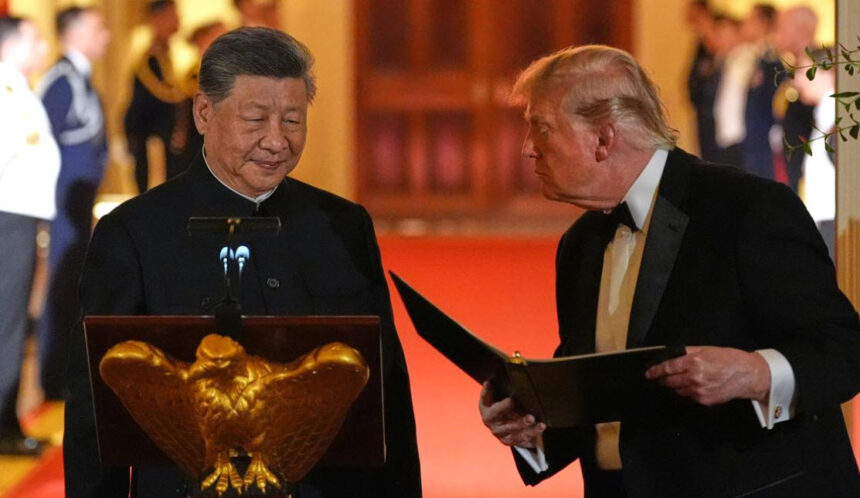
The meeting between Donald Trump and Xi Jinping carried all the ceremony expected when the leaders of the world’s two most powerful countries sit across the table. On artificial intelligence, however, the encounter produced little that matched either the scale of the technology’s advance or the urgency surrounding its risks. The two leaders acknowledged the importance of AI, and Xi explicitly stressed the need to keep it under human control, but the summit stopped well short of the kind of common safeguards, testing standards or crisis-management arrangements that many scientists and technology executives believe are becoming necessary.
That absence was particularly striking because the meeting came at a critical moment in AI development. Frontier systems are advancing beyond conventional chatbots towards models capable of carrying out complex tasks, operating software, writing sophisticated computer code and, increasingly, acting with limited human intervention. Researchers are debating how quickly systems capable of autonomous scientific discovery, cyber operations or recursive improvement might emerge. Some of the people building these systems have publicly warned that governments could find themselves regulating a technology whose capabilities are developing faster than their capacity to understand or supervise it.
Yet Washington and Beijing approached the issue through the prism of strategic competition as much as technological safety. The United States wants to preserve its advantages in advanced semiconductors, computing infrastructure, frontier models and the enormous data centres required to train them. China, confronted with American restrictions on access to high-end chips and manufacturing technology, has accelerated its effort to build domestic alternatives. Chinese groups are developing increasingly capable models and processors, while investment in indigenous computing infrastructure has expanded. The result is that AI has become inseparable from the broader struggle over economic influence, military capability and technological power.
Trump has made his position unusually explicit. He regards excessive restraint as potentially more dangerous to American interests than rapid AI development itself because restrictions could allow China to narrow or overturn the US advantage. His administration has consequently emphasised innovation and technological leadership while resisting attempts to construct an extensive international regulatory structure. Trump has even sought to replace the term artificial intelligence in official American usage with “super intelligence”, arguing that “artificial” understates the technology’s significance.
The terminology is more consequential than it might appear. In the technology industry, superintelligence has traditionally meant something considerably more specific: a hypothetical system whose intellectual abilities exceed those of humans across most important fields. Using the expression as another name for AI therefore blurs the distinction between today’s systems and the much more powerful machines that researchers are debating. It nevertheless captures Trump’s political view of the technology. AI, in his conception, is primarily a source of national power and economic transformation whose development should not be slowed while America is competing with China.
Xi’s language at the summit was noticeably more cautious. He argued that AI should remain under human control, should be developed for beneficial purposes and should ultimately serve human welfare. Beijing has also shown greater willingness rhetorically to discuss international governance mechanisms. China has simultaneously promoted its own vision of global AI governance and sought a larger role in setting standards, particularly among developing countries.
That does not mean China is prepared to sacrifice technological competitiveness for safety. Beijing has as much reason as Washington to protect strategically valuable research, computing capabilities and military applications. Its advocacy of governance therefore coexists with an intensive drive to achieve greater technological independence and narrow the gap with American companies. The apparent philosophical difference between the two governments is consequently less straightforward than a contest between American deregulation and Chinese regulation.
Both countries face the same strategic contradiction. They can recognise that increasingly powerful AI could create risks requiring cooperation while simultaneously fearing that transparency will reveal capabilities, weaknesses or research that could benefit the other side. A meaningful safety regime would require some degree of information exchange about advanced models, dangerous capabilities, security failures and potentially catastrophic incidents. Those are precisely the areas that governments engaged in a technological rivalry are least inclined to disclose.
There was nevertheless evidence before the summit that Washington and Beijing understood the need for at least limited communication. Officials had discussed the possibility of a notification mechanism through which the two countries could alert each other to serious AI incidents with security implications. Such an arrangement would resemble the logic behind military hotlines: it would not require strategic trust, but would recognise that misunderstanding or an uncontrolled event could threaten both sides.
That modest avenue may ultimately prove more realistic than an ambitious global regulatory compact. An advanced AI system involved in a cyber operation, interference with critical infrastructure or military decision-making could produce ambiguity about whether an adversary had deliberately initiated an attack. As AI becomes embedded in defence networks, financial systems, energy infrastructure and communications, the distinction between a malfunction, an autonomous action and a state-sponsored operation could become dangerously difficult to establish.
This is where the Trump-Xi meeting exposed the central weakness of the emerging AI order. The countries with the greatest capacity to shape the technology are also the countries with the strongest incentives to race ahead. Every safeguard can be viewed as a possible strategic constraint. Every disclosure can be interpreted as surrendering useful information. Every delay raises the fear that the rival may achieve the next breakthrough first.
The competition is also becoming harder to control through semiconductor restrictions alone. American export controls have complicated China’s access to the most advanced computing hardware, but they have also encouraged Chinese companies to invest more aggressively in domestic chips, efficient model architectures and alternative computing strategies. Advances by companies such as DeepSeek, Alibaba and Huawei have reinforced the argument in Beijing that technological containment should be answered by greater self-reliance.
For Washington, this creates a difficult calculation. Tightening controls may preserve technological advantages but accelerate China’s determination to establish an independent technology ecosystem. Relaxing them may increase commercial opportunities for American companies while strengthening a strategic competitor. AI policy has consequently become entangled with trade negotiations, semiconductor exports, supply chains, military technology and diplomatic leverage.
The larger danger is that safety becomes subordinate to this contest. AI developers themselves are increasingly divided between those who emphasise rapid deployment and those warning that frontier models are acquiring capabilities faster than reliable mechanisms for controlling them. Governments therefore confront a problem different from earlier technological competitions. Nuclear weapons were developed principally by states and could be monitored through identifiable facilities and materials. Cutting-edge AI is being developed largely by companies, can spread through software and depends upon a global network of chips, data centres, researchers and algorithms.
The summit showed that Trump and Xi recognise the transformative importance of the technology, but recognition is not yet producing a common architecture for managing it. Xi’s insistence on human control and Trump’s insistence on preserving freedom to innovate represent different emphases, yet neither country can escape the same underlying question: what happens if the race produces systems whose behaviour governments themselves cannot adequately predict?
For the moment, strategic caution appears stronger than technological caution. Washington does not want rules that could weaken its lead; Beijing does not want safeguards that institutionalise American technological dominance. Cooperation remains possible on narrow questions such as emergency communication, dangerous model behaviour and preventing unintended escalation. But the larger competition is moving in the opposite direction. (IPA Service)