
By Nilotpal Basu
Though a truism, rulers all over have still not come around to reconcile with the fact that ‘you can fool some people all of the time, and all people some time, but you cannot fool all the people all the time’. Narendra Modi obviously is one such ruler. His overconfidence to get away with murder flows from mastery over distraction, bluff and bluster over a protracted period of time.
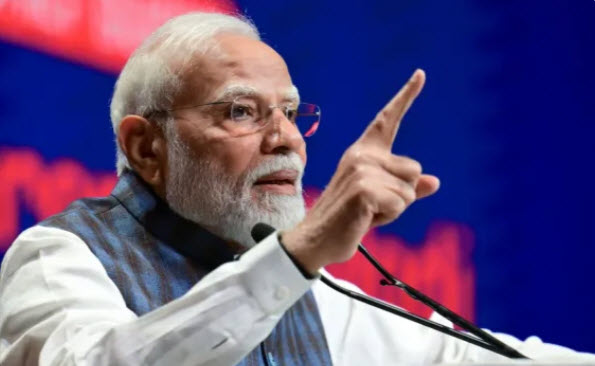
That is why the Prime Minister on November 19, 2026, tore into the manufacturing sector, companies’ failure to increase employment and wages, the trend of exporters sending their best-quality items out of the country, and industry’s lack of preparedness to exploit benefits unleashed by Free Trade Agreements (FTAs). Sticking to the topic of trade, the Prime Minister also pulled up the assembled leaders for not being prepared enough to take advantage of the various FTAs that India was entering into, calling it a “historic opportunity”.
“In the past few years, India has entered into trade agreements with several countries around the world,” Mr. Modi said. “Have you people at FICCI ever sat down and thought about this?….When a free trade agreement is signed with the world’s major economies, it means that the doors have been opened …. I still have to come to you and tell you what to do?”
Modi, however, did not forget to assert the World Bank’s recognition of India’s poverty reduction efforts regardless of the statistical flawed approach that Peoples Democracy has elaborately exposed. But why did the PM have to embark on this new mission to take people for a ride with this show of manufactured outrage against the Indian corporates?
These recent Modi remarks at the FICCI meeting, questioning corporate India over its failure to increase investment, generate employment and raise workers’ salaries despite successive tax concessions and incentives, constitute an important admission of the failure of his government’s economic policies. His acknowledgement vindicates the fact that corporate tax concessions and incentives do not automatically translate into productive investment, employment generation or improvement in workers’ living standards.
The economic data betray this contradiction. Corporate profits reached 4.8 per cent of GDP in FY 2023–24, a 15-year high, growing by 22.3 per cent, while employment grew by only 1.5 per cent. Employee expenses of listed companies grew by just 13 per cent, against 17 per cent in the previous year. More recently, the NITI Aayog’s November 2026 assessment of the 14 PLI schemes revealed that, by March 2026, they had achieved 76 per cent of their investment target and 64 per cent of their production target, but only 28 per cent of their employment target. Against a target of approximately 30.18 lakh jobs, only 8.49 lakh had been generated.
The 2019 corporate tax reduction alone involved an estimated annual revenue loss of Rs.1.45 lakh crore. Meanwhile, banks wrote off Rs.7.41 lakh crore in loans to large industries and services between 2014–15 and 2022–23. Under the Insolvency and Bankruptcy Code, creditors have realised only around 33 per cent of admitted claims in resolved corporate insolvency cases.
The government’s unabashed promotion of corporate interest is also affecting rural areas. Tax waiver for corporates has severely hamstrung the capacity for public investment in schemes like MGNREGA Official data as on August 9 shows that only 7.67 crore person-days were generated under the VB-GRAMG scheme in July 2026, which is 49.94 per cent lower as compared to 15.33 crore person-days generated under the MGNREGS in the same month last year.
With rural employment under the ambitious VB-GRAM-G scheme “falling sharply” in its first month, the restoration of MGNREGA is the way to go to redress inequality and rural unemployment.
The level of unsustainable inequality and horrific unemployment is fuelling frustration and insecurity to a degree which is directly forcing the young people -the GenZ – as never before in course of his twelve-year regime. The magnitude of anger is so palpable that the regime’s dirty tricks department and the BJP IT cell is visibly failing in its divisive designs and playing up communal and other identity politics driven disruptions.
What is emerging is a profound collective call for accountability. With the public sector systematically dismantled in key social sectors like education and health and profiteering of private corporates failing to deliver affordable access, collective assertion is raging. This question of accountability has led to the ouster of the education minister.
But where the regime has started looking distinctly vulnerable is the apparent inability to thwart and arrest the momentum of opposition despite the use of the most draconian tools of repression, to a point where these are failing to deter people. The regime is further exposing itself by trying to do away with constitutionally assigned right to protest.
The sense of despair of PM Modi is so palpable with the emerging global mood. Ultra-right authoritarian strongmen are falling by the wayside. Orban in Hungary and Vucic in Serbia are prime examples. Flavio Bolsonaro had to flee Brazil following electoral defeat. Even Donald Trump is on an increasingly sticky wicket following the midterm election in US. The SIR exposes and subsequent revelations on 2024 elections have made the very credibility and legitimacy of the Modi government increasingly untenable.
So, what would Modi do. He has to do what he knows best- bluff, bluster and carefully crafted optical simulation of ‘corporate bashing’, a Shakespearian ‘sound and fury signifying nothing’! The FICCI event was the best possible setting for enacting that drama.
But times have changed. Twelve years is too much of a time for the people to fall for the bait! In fact, not just twelve years as PM, but another thirteen as the Chief Minister of Gujarat has seen the full blossoming of ‘corporate cronyism’ and the full-fledged consolidation of government- corporate nexus during the much hyped twenty-five years of service ‘for the people’; people of course is euphemism for special cronies like Gautam Adani. The narrative of Gujarat model which was brazen transfer of public assets and resources to corporates has now blossomed at the national scale as ‘Viksit Bharat’! Does the PM expect that his fake narrative is there for ever? (IPA Service)