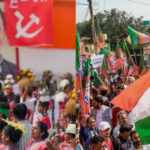
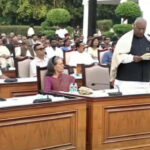
Dipke met Banerjee on Saturday, amid growing questions about the youth movement’s relationship with Opposition parties and whether its expanding public profile could eventually lead to electoral politics. He insisted that the CJP would preserve its independent identity rather than formally participate in the demonstration at Ramlila Maidan.
“We support the protest tomorrow, we stand in solidarity, but the Cockroach Janta Party is an independent organisation; it is a neutral platform, and we want to keep it that way,” Dipke told reporters after the meeting.
His clarification drew a distinction between supporting a political cause and joining a party-led mobilisation. The INDIA bloc’s Sunday rally is intended to challenge the Election Commission over the Special Intensive Revision of electoral rolls and allegations of voter exclusion. Those allegations remain contested and do not themselves establish wrongdoing.
Dipke said his organisation would back groups campaigning against what Opposition parties describe as vote theft, regardless of their political affiliation. His position leaves room for cooperation on particular demands without committing the CJP to an electoral alliance or an Opposition platform.
Banerjee welcomed the activists’ support and praised their role in protests questioning the electoral roll revision exercise. She said the Trinamool Congress had supported their activities and acknowledged the difficulties faced by campaign organisers. She also invited Dipke and other CJP members to organise programmes in West Bengal.
Asked whether the activists would hold an event in Kolkata, Banerjee left the decision to them. No date or programme was announced during the exchange, and the invitation did not amount to an agreement on a joint political campaign.
Dipke explained that his meeting with Banerjee was primarily intended to thank her for backing the CJP’s earlier agitation over the NEET examination controversy at Jantar Mantar. He also acknowledged her support when fellow organisers Saurav Das and Ashutosh Ranka were arrested by Delhi Police.
The encounter followed preparations for a Diwali gathering in Delhi organised by CJP co-convenor Saurav Das. Invitations were extended to Opposition figures including Trinamool Congress parliamentarian Derek O’Brien and Communist Party of India (Marxist) MP John Brittas. Aam Aadmi Party MP Sanjay Singh was also among those expected to attend.
Dipke and Ranka were expected at the gathering, but invitations and anticipated attendance should not be mistaken for confirmation of participation or evidence of negotiations over a political alliance. A social occasion involving activists and elected representatives does not, by itself, establish a common electoral strategy.
Questions about the CJP’s future have persisted since its student-led demonstrations brought Dipke national attention. The movement, whose name is deliberately satirical, emerged around demands for accountability over examination irregularities and subsequently widened its agenda to unemployment, education and public institutions.
At an organisational meeting in Chhatrapati Sambhajinagar in August, Dipke said the CJP intended to function as a pressure group rather than establish a political party. He outlined plans for nationwide public engagement, including discussions with young people about their priorities and concerns.
He also identified recruitment examinations, the circumstances of gig workers and ethanol-blended petrol as subjects for future campaigns. These priorities indicated an attempt to move beyond the examination dispute while maintaining a public advocacy role.
Dipke has previously acknowledged working with the Aam Aadmi Party but denied that the CJP operates under its direction. He has described the movement as independent of established political organisations, notwithstanding support it has received from Opposition leaders during demonstrations.
The distinction has become more significant as the organisation has engaged with electoral issues. Support for protests against the voter roll revision has brought the CJP closer to positions taken by several Opposition parties, while its founder continues to reject formal participation in their programmes.
The proposed demonstrations concern the electoral roll revision, an issue on which Opposition parties have demanded greater scrutiny of the Election Commission’s procedures and decisions affecting voters nationwide.
On October 20, Dipke asked supporters to spend the festive period with their families and announced that the organisation would not stage further protests before Diwali. Separately, CJP organisers have considered venues in Delhi, including Ramlila Maidan, for another phase of demonstrations after the festival.