By Ashok Ayers
NEW DELHI/NEW YORK: The 81st UN General Assembly closed its general debate on Monday having asked a question in its own theme, “Restoring trust, managing transformation,” and answered it in the negative. Six days of speeches produced little that looked like trust. The great powers used the podium to argue over wars in Iran, Ukraine and Gaza, while the institution counted down the last 100 days of António Guterres.
Donald Trump’s address on opening day leaned toward the midterms six weeks away. He defended the Iran war, floated annihilating the country, asked members to help isolate Tehran, and thanked the Security Council for backing his Gaza plan. He also claimed a Council resolution on Iranian shipping attacks drew more co-sponsors than any in history. It drew 136, but a June resolution on crimes against peacekeepers drew 153.
Iran’s Masoud Pezeshkian answered from the same rostrum. He held up a portrait of the slain Supreme Leader, vowed Iran would never bend the knee, and still said Tehran was open to diplomacy.
Beijing sent no Xi Jinping. He was in Washington for a summit with Trump, and Vice President Han Zheng delivered the usual case for development and multilateralism, with no direct mention of Taiwan. Without naming the US, Han said Gulf states’ sovereignty must be respected and urged the “relevant country” to stop threatening Cuba. He also marked 55 years since the Assembly seated the People’s Republic. Sergey Lavrov, speaking for Moscow hours later, echoed the demand to lift the “siege” of Cuba. Vladimir Putin, like Xi, stayed home.
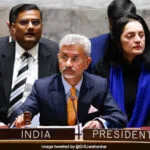
Prime Minister Narendra Modi did not travel. External Affairs Minister S. Jaishankar carried India’s message on Saturday. He called Pakistan a “serial practitioner of terrorism,” said India would exercise its right to defend itself, and backed a two-state solution for Palestine. He also raised the safety of seafarers and argued that every nation has a right to shape its own AI ecosystem. On the sidelines he called the choice between BRICS and the UN a false one. It was a speech aimed as much at Islamabad’s podium as at the hall.
Kyiv and Paris. Volodymyr Zelensky called Putin “patient zero” for the spread of war. Russian forces struck his party’s headquarters in Kyiv while he spoke, Kyiv officials said. He asked for more pressure on Moscow and proposed an energy ceasefire.
Emmanuel Macron gave what was billed as his last address to the Assembly as president. His term ends on May 17, 2027. His most heartfelt passage was on Gaza, where he said the continuing aid blockage should shame everyone, “Shame on all of us.” He also pledged more air-defense interceptors for Ukraine ahead of winter and warned that the “law of the jungle” is spreading.
Berlin, Rome and the eastern flank. Germany and Italy sent their foreign ministers, not their heads of government. Johann Wadephul spoke for Germany and Antonio Tajani, as deputy prime minister, for Italy. Wadephul’s address covered Russia’s war, AI, UN reform and global security. The sharper warnings came from the eastern flank. Latvia’s Edgars Rinkēvičs said before his speech that he would use it to highlight cyberattacks and sabotage. He said NATO has agreed that hybrid attacks could in principle trigger Article 5, though Latvia deliberately avoids commenting on that. Poland, Romania, the Czech Republic, Slovakia, Serbia, Bulgaria and the Baltic presidents all took the rostrum, and Ukraine’s security was the common thread.
From South Asia, Pakistan’s Shehbaz Sharif offered a line for the record, “war is a choice, but peace is a far better choice.” He thanked Trump for the May 2025 ceasefire with India and pressed Kashmir self-determination. He also warned that any attempt to divert Pakistan’s share of Indus waters would be treated as an act of war, and said Pakistan had brought Washington and Tehran to one room in Islamabad. The warning prompted Jaishankar’s reply the next day.
Bangladesh’s Tarique Rahman, at the rostrum for the first time since taking office in February, spoke in Bangla for 21 minutes. He presented a “3-R” plan of recovery, restoration and reconstruction. He also backed Palestinian statehood and arms control. Nepal’s Balen Shah, the former rapper turned prime minister, was the surprise. He argued that Nepal emits under 0.1 percent of the world’s greenhouse gases yet pays disproportionately for climate change, and he pressed the money question directly.
Countdown to Guterres’s farewell thus began. In his last high-level week, the Secretary-General framed inequality, climate and AI as one story. He called it “the story of power,” told members the 2030 development goals would be missed, and got a standing ovation.
The rhetoric then moved into the Assembly’s six Main Committees: disarmament and security, economic and financial, social and humanitarian, special political and decolonization, budget, and legal. Their draft resolutions are normally negotiated from October and adopted in plenary by December. Apart from the budget, those resolutions are recommendations, not binding law. On Tuesday, the President of the Assembly convenes a high-level plenary meeting marking the International Day for the Total Elimination of Nuclear Weapons. That meeting is a commemoration, not a special session, and it works from an existing resolution, A/RES/80/49. United Nations
Guterres’s term ends on December 31, and the choice of his successor falls in the coming weeks. Seven candidates remain after Michelle Bachelet dropped out. In the Security Council’s straw poll on September 18, Costa Rica’s Rebeca Grynspan led with nine “encourage” votes and five “discourage.” Guyana’s Carolyn Rodrigues Birkett followed with eight and six. Uganda’s Olara Otunnu had five “encourage” votes, and Argentina’s Rafael Grossi, Senegal’s Macky Sall, Ecuador’s María Fernanda Espinosa and her compatriot Ivonne A-Baki trailed. Sall, a former president, drew nine “discourage” votes. A-Baki drew ten and no “encourage.”
The permanent five decide this race, and their ballots are still hidden. The next anonymous poll is set for September 29, with a colour-coded poll that distinguishes the P5 likely in October. The New York Times reported growing US opposition to Rodrigues Birkett over a “genocide” remark on Gaza, which she disputes. Lavrov has said the next chief must be “neutral, independent.”
As for Macron, he is in no one’s field. He has not been nominated, and his term runs to May 2027, well past the appointment window. Guterres himself was a former prime minister, so ex-leaders can win. But this year’s only former head of state still in the race is Sall, and he is the weakest bet on the board.
Grynspan is the frontrunner, but five discouraging votes in the Council are enough to end her run. The person chosen will inherit a budget crisis, a US that questions the UN’s purpose, and Security Council gridlock, none of which this week’s speeches eased. (IPA Service)