By T N Ashok
External Affairs Minister S. Jaishankar’s appearance at the 81st UN General Assembly has generated substantial coverage in Indian media, while the response in the United States and Europe has been more selective and issue-driven. The distinction matters: Indian coverage has treated the speech and Jaishankar’s preceding diplomatic marathon as a coherent assertion of India’s global role; Western media have generally absorbed individual elements — terrorism and Pakistan, maritime security, Russia sanctions, the Middle East, UN reform and India-US relations — rather than presenting the entire sequence as one strategic narrative.
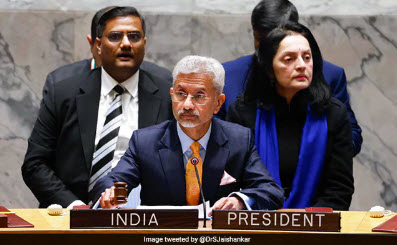
Jaishankar’s September 26 General Debate speech became a major news event in India, received extensive attention across the national media, with terrorism and Pakistan becoming the dominant headline. The Indian Express distilled the speech into three principal messages: terrorism/Pakistan, security of commercial shipping and seafarers, and India’s role in the Global South. It highlighted Jaishankar’s description of the previous day’s speaker as a “serial practitioner of terrorism,” his warning that attempts to normalise terrorism “will not stand”, and his assertion that India’s right to defend itself would be exercised.
India Today, Times of India, Hindustan Times and Mint likewise gave the Pakistan/terrorism component prominent treatment. Mint, for example, framed the address around seven takeaways encompassing terrorism, Gulf conflicts, Ukraine, West Asia, economic competition and the Global South. Television and video media amplified the confrontation further. NDTV carried video prominently on both Jaishankar’s UNGA response and his earlier exchange with a Pakistani journalist. The latter episode — Jaishankar responding to a Pakistani journalist, “A terrorist country is asking me that question?” — became a substantial social-media and television clip in India. Indian Express, India Today, NDTV and Hindustan Times all carried it prominently.
So, in Indian media terms, there has unquestionably been traction. But it is important to distinguish between traction for the speech as a diplomatic document and traction for the Pakistan confrontation. The latter has generated the largest immediate headlines.
Jaishankar used the UNGA week to construct several overlapping diplomatic coalitions.
The G4 — India, Brazil, Germany and Japan — jointly pressed for reform of the Security Council, arguing that both permanent and non-permanent membership must be expanded and that the present Council does not adequately represent today’s geopolitical realities. Germany and Japan themselves published official accounts of the meeting.
The V4 — Poland, Hungary, Slovakia and the Czech Republic — produced another significant development: support for India’s permanent membership of the Security Council. Indian media described this as an important diplomatic development and noted the creation of an annual V4-India foreign-ministers meeting and business forum.
The Global South/L69 outreach supplied another dimension. Jaishankar argued that the Global South is “in the front row of crises, but in the back row of decision-making.” Indian Express gave that formulation considerable prominence.
And the P4M — Partners for Multilateralism, International Law, Peace & Prosperity — meeting placed India alongside European and other partners in an explicit defence of multilateralism.
At the EU’s own audiovisual service, Jaishankar’s intervention at the summit was recorded alongside European Council President António Costa and EU leaders. His message there was strikingly consistent with his UNGA address: geopolitical competition is weakening international cooperation; multilateralism needs stronger institutions; international law must be observed; supply chains need resilience; and reform of global governance is overdue.
That gives the week’s diplomacy a discernible architecture: from G4 to UNSC reform; V4 towards European support; L69/Global South for developing-country representation; P4M/EU for multilateralism in international law; bilateral diplomacy for implementation and strategic relationships; and, finally, UNGA speech for India’s public articulation of the whole approach.
Jaishankar’s meeting with US Secretary of State Marco Rubio has received more substantive attention in the US/Indian diplomatic press than the UNGA speech itself. The US State Department’s readout said Rubio and Jaishankar reaffirmed the importance of the US-India strategic partnership and discussed the Middle East, the Indo-Pacific and possible sanctions affecting countries trading economically with Russia and Iran.
Indian Express reported that Jaishankar explicitly raised India’s concerns about the Russia sanctions legislation with Rubio, at a particularly sensitive moment in US-India relations. This is important because it shows the limits of the “anti-Western” interpretation that can sometimes arise from India’s Global South rhetoric. At the same time that Jaishankar was arguing for reform of Western-dominated institutions, he was negotiating directly with Washington over energy security, Russia, Iran, Ukraine and the bilateral relationship. That is a more complicated diplomatic picture than simply “India versus the West.”
The American media environment has been dominated by Trump, Iran, Israel/Gaza, Ukraine, China, the future of the UN and the US-European relationship.
Reuters’ assessment of UNGA 81, for example, centred on the broader question of whether the United Nations can remain relevant amid geopolitical fragmentation, US funding reductions, wars and institutional reform. AP’s coverage similarly presented UNGA as a gathering confronting Iran, Gaza, Ukraine, Sudan, climate change, economic disruption and AI, with UN reform itself becoming a major issue. Consequently, Jaishankar’s speech has not displaced the principal American UNGA storylines.
Where it has penetrated US coverage, the emphasis is likely to be on India’s relationship with Russia, the Russia-sanctions problem, India-US relations, Pakistan, terrorism and maritime security, rather than on the complete G4-V4-L69-P4M architecture. That is not necessarily a measure of diplomatic impact; it reflects the way American news organisations select stories for a domestic audience.
British coverage has also concentrated heavily on the wars and Britain’s own diplomatic position. The UNGA has been dominated in UK-related reporting by the new British government’s relationship with Washington, Ukraine, the Middle East, the Strait of Hormuz and Britain’s role in European security.
The broader international reporting does, however, place India inside the emerging debate over maritime security. During the same UNGA week, France sought Indian cooperation on freedom of navigation in the Strait of Hormuz and Bab el-Mandeb. French Foreign Minister Jean-Noël Barrot and Jaishankar discussed maritime security as well as reform of the international system. This is potentially more consequential than a headline about a speech: it places India in discussions concerning European economic and energy security.
The European response is particularly interesting. Germany’s Foreign Office formally published the G4 statement, recording the participation of German Foreign Minister Johann Wadephul with Jaishankar, Brazil’s Mauro Vieira and Japan’s Toshimitsu Motegi. The German government explicitly described Security Council reform as more necessary than ever.
Japan’s Foreign Ministry likewise published the G4 meeting and stressed the need to expand both permanent and non-permanent categories of Security Council membership. In France, the more immediate diplomatic interest has been India’s role in maritime security and multilateral reform. The France-India discussion on Hormuz and Bab el-Mandeb is especially notable because those waterways affect European as well as Asian economic security. French media coverage of UNGA itself has understandably been dominated by Israel/Gaza, Iran, Ukraine, Trump and the Middle East rather than by India’s foreign minister. Le Monde’s UN live coverage, for instance, has focused heavily on those questions.
Italian coverage similarly operates through the larger European security story. ANSA has been reporting India’s energy-security concerns in the context of American sanctions against Russia and Iran, highlighting Delhi’s insistence that it must protect the energy needs of its 1.4 billion people. That provides an important backdrop to Jaishankar’s conversation with Rubio: India’s Russia policy is not merely a diplomatic disagreement; it is intertwined with European energy markets, sanctions, shipping and the wider war economy.
Germany, France and Italy therefore encounter Jaishankar’s UNGA diplomacy through somewhat different lenses, but increasingly through issues that directly affect Europe.
The evidence so far suggests three different levels of traction.
First — very high Indian media traction: The Pakistan/terrorism exchange and the UNGA speech have become major news and television material. The “serial practitioner of terrorism” formulation is particularly prominent.
Second — significant diplomatic/institutional traction: G4, V4, Global South/L69, P4M, EU and bilateral meetings have created a much broader record than the speech alone. Germany, Japan and the EU have themselves documented important parts of this programme.
Third — selective Western media traction: US, British and continental European media have not, at least so far, made Jaishankar the central character of UNGA 81. Their attention is driven primarily by the wars, Trump, Iran, Gaza, Ukraine, China and the future of the UN. But India’s role surfaces where it intersects with those issues — Russia sanctions, energy security, maritime routes, terrorism, Global South representation and Security Council reform.
The interesting development is therefore not simply whether Jaishankar’s speech “made headlines.” It is that India has spent the entire UNGA week constructing several negotiating circles around itself rather than relying on a single platform.
G4 gives it the institutional-reform coalition. V4 adds Central European support. L69 and Global South diplomacy provide developing-country legitimacy. P4M connects India to the European multilateralist camp. The Rubio meeting keeps Washington engaged. France brings maritime and strategic cooperation. And the UNGA speech puts India’s positions on terrorism, shipping, Ukraine, West Asia, development and multilateral reform before the entire membership.
That is why the diplomatic footprint of Jaishankar’s UNGA visit is substantially broader than the headlines generated by the Pakistan confrontation. The emerging international story is potentially larger: India attempting to position itself simultaneously as a voice of the Global South, a claimant to a reformed Security Council, a strategic partner of Europe and the United States, and an independent actor unwilling to subordinate its energy and security interests to any single bloc.
Whether that translates into actual movement on Security Council reform or other UN decisions is a separate question — and one that will only become clearer as the 81st session moves toward its concluding days. (IPA Service)