


By Nitya Chakraborty
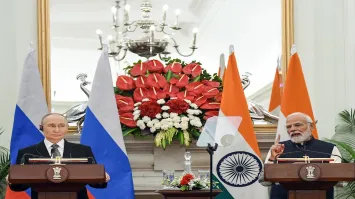
The India-Russia joint statement issued on December 5 after two days of talks between President Vladimir Putin and the Indian Prime Minister Narendra Modi is more a vindication of India’s renewed exercise of its geopolitical status defying the pressure from the USA and the other western powers rather than a document on expanding economic collaboration.
The timing of the visit and the consequent nature of ceremonial welcome to the President Putin in the Delhi airport tarmac on December 4 evening by the Indian PM defying the normal protocol have all the elements of a cautious but determined Narendra Modi to opt for an independent course in diplomacy giving no credence to the continuous warning by the western powers, especially the USA.
Just on the eve of the Putin visit to India beginning December 4, an unusual development took place on December 1 when three envoys of Germany, France and Britain based in New Delhi wrote jointly a piece in The Times of India highly critical of the Russian President and in fact wrote “ As President Putin stalls and delays on the serious peace talks, we will continue to step up our military and non-military support to Ukraine so that it can rightly defend its people, its land and its sovereignty”. The joint piece was nothing but a blatant interference by this European troika to put pressure on the Indian PM in his talks with President Putin.
To the great discomfiture of the European troika and Washington DC where the Trump officials were monitoring every posture of the Indian PM in his dealings with the Russian President, it was a great comfort for Indians to see our Prime Minister behaving with caution but dignity caring little for the western pressure to go slow with the Russians. The trade deal with the USA is at its last stage, the deal with the European Union is also pending ready for finalization in the next few months. Nothing worked for the West. Prime Minister talked to the Russian President with full confidence representing the leader of the 1.44 billion people, the largest populated country of the world with a robust economy to emerge as the third largest by 2027-28 after the United States and China.
That way, the visit of Russian President Vladimir Putin for the 23rd India-Russia Annual Summit is more than a routine bilateral visit. It is a powerful signal from India of its own strength to assert its strategic autonomy in respect of the bigger global powers. The US does not respect India’s strategic autonomy. This has been repeatedly mentioned by the US secretary of state Marco Rubio in the context of sanctions against India. As regards Russia, this part of autonomy for India has been continuing since the days of Soviet Union. In the latest New Delhi summit both Narendra Modi and Putin underlined that aspect and that was a very positive aspect of the Indian diplomacy at this stage.
In the economy and trade sphere, President Putin’s assurance of uninterrupted oil supplies to India is a guarantee which can bolster India’s bargaining power with other exporters including the US which is putting pressure on India to import more oil products at the cost of Russian exports. Indian agencies have already reduced supplies from the Russian sources after the US sanctions. The private companies like Reliance may abide fully by the US sanctions but the Indian public sector companies have the flexibility of choice and that will be widened as a result of the Russian assurance. India has the option to choose its source of imports of oil, the basket will be larger.
As per the joint statement, the two leaders reaffirmed their shared ambition to expand bilateral trade in a balanced and sustainable manner, including by increasing India’s exports to Russia, strengthening industrial cooperation, forging new technological and investment partnerships, especially in advanced high-technology areas and finding new avenues and forms of cooperation.
Both leaders underlined the importance of an open, inclusive, transparent and non-discriminatory multilateral trade system with the World Trade Organization at its core. Both Sides emphasised that addressing tariff and non-tariff trade barriers, removing bottlenecks in logistics, promoting connectivity, ensuring smooth payment mechanisms, finding mutually acceptable solutions for issues of insurance and reinsurance and regular interaction between the businesses of the two countries are among the key elements for timely achievement of the revised bilateral trade target of USD 100 billion by 2030.
Further, Russia and India have agreed to continue jointly developing systems of bilateral settlements through use of the national currencies in order to ensure the uninterrupted maintenance of bilateral trade. Additionally, the Sides have agreed to continue their consultations on enabling the interoperability of the national payment systems, financial messaging systems, as well as central bank digital currency platforms.
The fact is that this target of reaching US$ 100 billion by2030 has been under discussion for long but the follow up measures as suggested earlier have not been taken due to a number of factors. The Indian focus during Modi regime was on the US market and US investments, the Russian market was ignored for long. That has to be corrected by both sides. The Delhi summit should act as a game changer in respect of assessing the importance of India-Russia relationship. Otherwise, the same stagnation in trade and investment will remain despite all the declarations and agreements.
For Indian Government, it is the time to strategically make optimum utilization of the gains of the visit in the coming talks with the United States and the European Union. China has already welcomed Modi’s talks with Putin. There can be a good possibility of India-China- Russia partnership emerging based on strategic autonomy for each. In sum, Indian diplomacy has a big opportunity to emerge stronger after the latest India-Russia summit and Prime Minister Narendra Modi, with his enhanced status, has to see that these diplomatic gains are not frittered away again. (IPA Service)


