By Daniel Finn
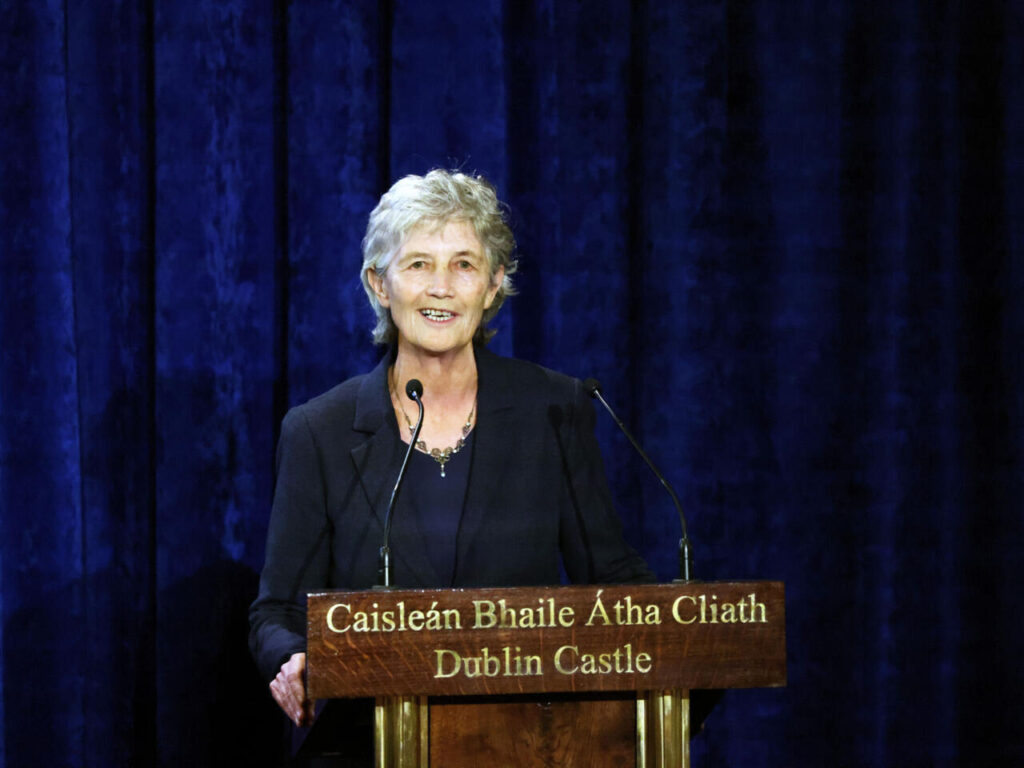
NEW YORK: Ireland’s new president, Catherine Connolly who recorded a landslide victory in October 25 Presidential elections in Ireland, is an outspoken left-winger who champions the rights of the Palestinians and opposes Europe’s militarization drive. Her resounding victory came as a huge shock to the conservative political establishment.
Ireland’s presidential election was a resounding victory for the Left. Catherine Connolly, a left-wing independent backed by parties representing every shade of Irish left politics, from pale pink and light green to deep red, won 63.4 percent of the vote. This was more than twice the level of support for her main opponent, Heather Humphreys of the center-right Fine Gael party.
Fianna Fáil, Fine Gael’s traditional rival and now coalition partner, also had a candidate on the ballot paper, Jim Gavin (although Gavin called off his hapless campaign before reaching the finishing line). The combined vote share for Humphreys and Gavin was less than 37 percent — a truly woeful performance for the parties that dominated Irish politics before the crash of 2008.
The Irish presidency is not an executive role with serious heft: an outspoken president can have a real impact on the terms of public debate, but they do not have the power to carry out reforms or decide upon government policy. While we shouldn’t lose sight of those limitations, it’s clear that Connolly’s triumph at the polls is an important advance for the Irish left that will put its forces in a stronger position for the years to come.
Before going into the dynamics of the campaign, we need to discuss the turnout for the election and the number of spoiled votes, both of which have been used by some commentators in recent days to belittle the significance of Connolly’s achievement. Less than half of those eligible cast a vote in the election, and nearly 13 percent of those votes were spoiled. The turnout figure was by no means unusual, but the rate of spoilage was.
Connolly’s triumph at the polls is an important advance for the Irish left that will put its forces in a stronger position for the years to come.
There have been five contested elections for the presidency since the modern history of the office began with the victory of Mary Robinson, a liberal feminist, over candidates from Fianna Fáil and Fine Gael in 1990. Three of those elections had a turnout figure below 50 percent, and the average participation rate was 51.5 percent. The turnout this year — 45.8 percent — was higher than it was for the last election in 2018.
If no candidate gets more than 50 percent of first preferences, the lowest-placed candidate is eliminated, and their second-preference votes are distributed; the process continues until there is a winner. Apart from Connolly, there has only been one other candidate since 1990 who won the presidency without needing transfers: her predecessor, Michael D. Higgins, when he was running as an incumbent in 2018. She would still have won the 2011 election, which had a turnout of 56 percent, on the first count with the same number of votes.
Since 1990, the highest percentage for a successful candidate, even after second-preference votes were taken into account, was 57 percent for Higgins in 2011. Connolly smashed that record with first preferences alone, winning almost as many votes as Fianna Fáil and Fine Gael put together in last year’s general election. By any meaningful standard, this was a very impressive victory.
In contrast with the turnout level, the high proportion of spoiled votes is a real departure from past experience, since the figure was about 1 percent in previous elections. The only organized force campaigning for voters to spoil their ballots was the far right, disgruntled at its inability to put a candidate in the race. We’ll discuss the impact of this political bloc on the campaign, and what it might augur for the future, in more detail below.
Born in 1957, Connolly is another illustration of the fact that you don’t have to be a twenty- or thirty-something candidate to enthuse young voters if they like your ideas and political record. She comes from a working-class family in Galway, the main city of Ireland’s western region, and grew up in one of its council housing estates. Her father worked as a carpenter in the Galway shipyard; her mother died suddenly when she was still a child.
After finishing school, Connolly qualified as a psychologist before passing the exams to practice as a barrister in her thirties. She became a full-time politician at a relatively late stage in her career: having served as a local councilor, she first won a seat in the Dáil, Ireland’s national parliament, at the age of fifty-eight in 2016. Neither Connolly nor her campaign put too much stress on her origin story, which would surely have been placed front and center if she was running for a party of the center or the radical right. When you’re not planning to screw over your class in the style of J. D. Vance, you don’t have to make such a fuss about where you came from.
When you’re not planning to screw over your class in the style of J. D. Vance, you don’t have to make such a fuss about where you came from.
In political terms, Connolly has a few things in common with the man she will be replacing. Like Higgins, she has a background in the Galway Labour Party, although Connolly broke with Labour before she was elected to the Dáil. Like Higgins, she resisted the pressure to embrace neoliberalism and austerity in the name of “realism” that has had such a damaging impact on center-left parties, in Ireland as elsewhere. And like Higgins, she has a strong interest in international affairs and a record of challenging the Western foreign policy consensus.
Connolly faced much more hostility from the Irish commentariat than Higgins did at the time of his first presidential campaign back in 2011. In part, this reflected the frustration of many Irish opinion-formers with the record of Higgins himself as a two-term president. They looked back wistfully at his main rival in 2011, a businessman and minor celebrity named Seán Gallagher, and dreamed of what might have been. Instead of having to engage with another speech by Higgins about the perils of free-market capitalism or the urgency of the climate crisis, they could have been documenting the rise of Ireland’s answer to Silvio Berlusconi or Donald Trump.
Higgins was also more of a political insider than Connolly. He served as a cabinet minister in the 1990s and remained a member of the Labour Party until he ran for the presidency. Connolly clearly belonged to the new left-wing forces that displaced Labour during the Great Recession when its ministers presided over years of punitive austerity. Those forces included parties like Sinn Féin, the Social Democrats, and People Before Profit, as well as left-independent Teachta Dálas (TDs) like Connolly. That was where the center of gravity in the broad-left alliance that supported Connolly clearly lay, with Labour now reduced to the status of a minor party.
But the main factor behind the antagonism toward Connolly was the change in the international climate since Higgins was first elected. Fianna Fáil, Fine Gael, and their allies in the media want to push Ireland firmly into the Western military bloc, if not as a formal member of NATO then certainly as one of its satellites. They saw the presidential election as an opportunity to move toward this goal. To their immense chagrin, it ended up creating a new obstacle in the form of Connolly’s successful campaign.
Fine Gael initially wanted to run Mairead McGuinness as its presidential candidate, before she ruled herself out for health reasons this summer. McGuinness had two decades of experience as a member of the European Parliament and the European Commission under her belt, and she was expected to bring that experience to bear on the office.
To their great frustration, the conservative parties found that none of their broadsides seemed to damage Connolly. One line of attack concerned her views on Palestine. In September, the BBC asked her to comment on Keir Starmer’s assertion that Hamas could play no part in a future Palestinian government. She insisted that it was not Starmer’s call to make: “I would be very wary of telling a sovereign people how to run their country. The Palestinians must decide in a democratic way who they want to lead their country.”
In another interview, Connolly pointed out that Hamas had won the last elections held in the occupied territories and was part of Palestinian civil society. Strangely, the interviewer asked her if she would have said that the Irish Republican Army was “part of the fabric of the Catholic people of the North,” as if there would be anything controversial about saying that it was. Sinn Féin received between 30 and 40 percent of the nationalist vote in the North when it gave unconditional support to the IRA campaign. Since the peace process began, nationalist voters have repeatedly elected Sinn Féin candidates with an acknowledged record of IRA membership and activism, from Martin McGuinness to Gerry Kelly and Martina Anderson.
The same interviewer asked Connolly if Hamas forces had committed war crimes on October 7, and she agreed that they had: “What they did was absolutely unacceptable. Both sides have committed war crimes, and hopefully both sides will be held to account.” She also said Israel was “acting as a terrorist state.” Martin appeared to think that such comments were self-evidently disqualifying for a candidate and directed a indignant tirade against Connolly, declaring that Hamas “cannot be part of Gaza’s future.” Simon Harris added his voice to the chorus.
Martin has never issued any statements to the effect that Likud can have no role in the future government of Israel. The idea that Hamas is beyond the pale while Likud is not may well be taken for granted at the EU summits that Martin frequents, but many of his fellow citizens who have watched a genocide unfold in real time for the past two years would beg to differ. Connolly refused to back down and the controversy had no impact on public opinion, with her support continuing to rise.
There was also an attempt to stoke up a row because Connolly had sought to hire Ursula Ní Shionnain, a member of a republican group who served time for a firearms offense, to work for her in the Dáil. Martin’s expressions of outrage about the matter rang hollow when another Fianna Fáil politician, Eamon Ó Cuív, gave Connolly his unambiguous support: “If Catherine showed a lack of judgement, I did equally, because she asked me about [Ní Shionnain] and I said that I was personally satisfied that she had moved on.” Once again, Connolly stood her ground and went on the offensive by asking how and why the information about Ní Shionnain — which was not on the public record — had been leaked to the press.
Connolly’s opponents were clearly hoping to divide the broad-left alliance that assembled behind her campaign.
Connolly’s opponents were clearly hoping to divide the broad-left alliance that assembled behind her campaign. The Labour and Green parties, both of which have served in government as junior partners of the center right over the last decade, seemed more likely to break ranks than Sinn Féin, the Social Democrats, or People Before Profit. However, the only notable figure to speak out against Connolly was Labour’s former leader Alan Kelly, a man whose overweening self-confidence notoriously exceeds his talent as a politician.
The five-party alliance certainly played a vital part in Connolly’s success, and that unity wasn’t forged on the basis of the lowest common denominator. Connolly didn’t abandon or water down any of her main positions to get Labour or the Greens on board, so those parties ended up shifting away from their former allies in Fine Gael and Fianna Fáil for the duration of the campaign. Whether that means they will move left in a more permanent fashion is a very different question of course.
Some of the main figures behind the vote-spoiling effort are also well acquainted with the finer things in life. They include Declan Ganley, a businessman with strong ties to the US military-industrial complex. Republican apparatchiks such as Karl Rove and Mike Pompeo have joined the board of Ganley’s firm, Rivada Networks, along with former generals from Britain and the United States.
According to the Sunday Times, Rivada’s main project is the creation of “an unhackable satellite communications array for use by governments and militaries, called the OuterNet.” Ganley has a fairly high public profile in Ireland because of his role in European referendum campaigns and his failed bid to become an MEP. He also had ambitions for the presidency earlier in the year that did not bear fruit.
Another prominent spoiler, Eddie Hobbs, has a background as a celebrity money expert who used to present television shows on Ireland’s national broadcaster RTÉ. His reputation still hasn’t recovered from his association with an investment fund that lost 90 percent of its money by plunging into the riskier end of the Detroit property market during the Great Recession. Hobbs now peddles a different variety of snake oil on his YouTube channel, with guests like the self-professed “raging antisemite” and white nationalist Keith Woods (a particular favorite of Elon Musk).
Ireland’s far right is still a minoritarian force that has not achieved the same level of support as its counterparts in other West European countries.
It’s depressing to see anyone from Ireland’s working-class communities pulled into the slipstream of grifters like this and the wider ecosystem of political entrepreneurs looking to monetize hate. At the same time, we should keep things in perspective. The total number of spoiled votes was about 214,000. Even if we assume that everyone who spoiled their vote is ideologically aligned with the hard right, this is only slightly higher than the number of votes cast for Independent Ireland, Aontú, and smaller groups on their right flank in last year’s general election (and nearly 50,000 fewer votes than those forces won in the European election a few months earlier).
The emergence of a consolidated bloc of opinion to the right of Fine Gael and Fianna Fáil over the past few years is a real problem. Far-right talking points and conspiracy theories are circulating much more widely than they did before the pandemic, and a hard core of neofascist agitators have proved able to incite violent disturbances on several occasions, most recently outside a hotel in Dublin’s Citywest area where asylum seekers are being housed. We should take the danger that all of this poses very seriously. But whether it manifests itself in the streets or at the ballot box, Ireland’s far right is still a minoritarian force that has not achieved the same level of support as its counterparts in other West European countries.
Indeed, one factor behind the groundswell of support for Connolly is bound to have been a desire to shift the focus of political debate away from incessant scaremongering about immigration and supposed threats to “Irish culture” (which on closer inspection appears to be indistinguishable from the very worst forms of Anglo-American culture, with nothing distinctively Irish about it). The Irish far-right has managed to hog the mic in the last couple of years, with more than a little help from its transatlantic pals, but that doesn’t mean its partisans speak for “the Irish people,” as they incessantly claim.
In her victory speech, Connolly spoke for the part of Irish society that wants to spend the coming years discussing issues that really matter instead of paranoid, conspiracist drek:
I will be a president who listens, reflects, who speaks when necessary, and a voice for peace. A voice that builds on our policy of neutrality. A voice that articulates the existential threat posed by climate change. . . . Together, we can shape a new republic together that values everybody, that values and champions diversity, and that takes confidence in our own identity, our Irish language, our English language, and the new people who have come to our country. I will be an inclusive president for all of you.
The way that Connolly expresses herself while saying things like this — confident and articulate, without being aggressive or bombastic — is also part of her appeal at a time when dysfunctional caricatures of masculinity, from Trump to McGregor, are clogging up the landscape. The decade so far hasn’t been oversaturated with good news for the Left, in Ireland as in many other countries. But Connolly’s victory is unambiguously something to be cheerful about, and it contains the seeds of future victories, if they receive the right nurturing. (IPA Service)
Courtesy: Jacobin
 Overconfident US Forced To Compromise With China On Trade