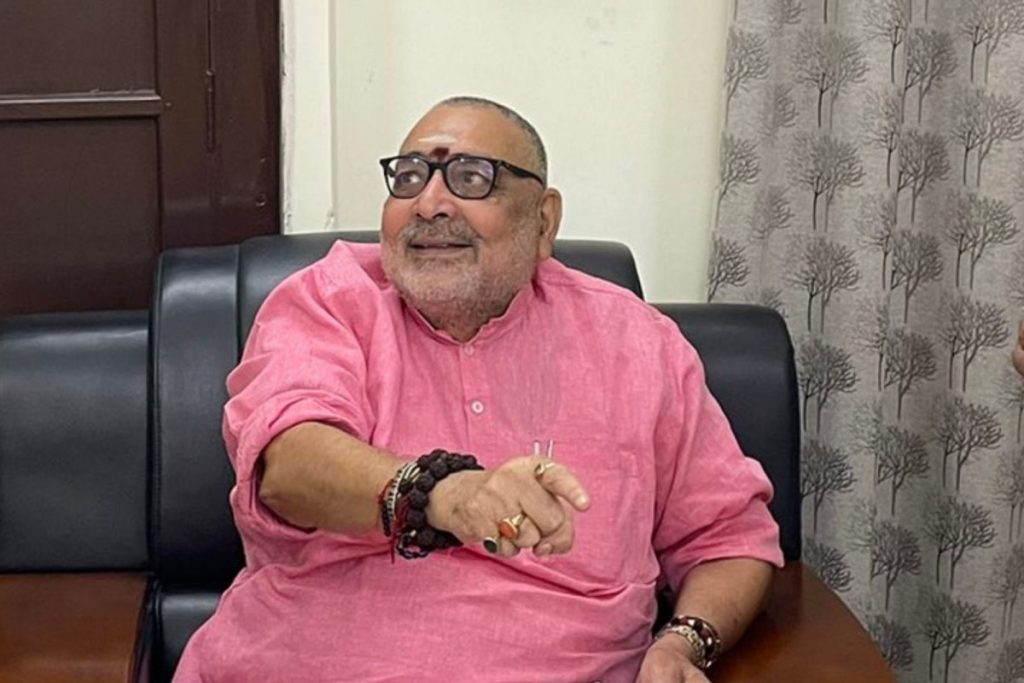
A statement by Union Minister Giriraj Singh that he does not want the votes of “namak harams” has ignited a fresh political storm, placing the ruling alliance’s outreach to minority voters under intense scrutiny. Singh, who is also a Member of Parliament for Begusarai, made the remarks during a campaign rally in Arwal district of Bihar, ahead of the state assembly elections. He shared an exchange he claimed to have had with a Muslim cleric, then added: “Moulvi saheb, we do not need the votes of namak harams.”
The minister’s address took place at a public meeting to launch election campaigns for the National Democratic Alliance candidates in the constituencies of Arwal and Kurtha. According to his narration, he asked a cleric whether he held an Ayushman Bharat health card and whether there had been any Hindu-Muslim conflict in his area; both replies were affirmative to equity. When asked if he had voted for the BJP, the cleric admitted “yes” but declined to swear on God that he would do so again. Singh said this refusal rendered the person a “namak haram”.
Singh defended his remarks by arguing that government welfare schemes—rations, housing, sanitation, gas cylinders—had been provided to both Hindus and Muslims without discrimination. He contrasted this with what he portrayed as the community’s reluctance to support his party, stating: “The NDA government works for every section of society, but Muslims do not vote for the BJP.”
The reaction from political quarters has been robust. The Rashtriya Janata Dal described Singh’s remarks as part of a calculated strategy to polarise voters along religious lines and demanded his removal from the Union Cabinet. Its spokesperson stated: “Prime Minister Narendra Modi should immediately dismiss people like Singh from his Cabinet.” Meanwhile, the alliance partner Janata Dal ) adopted a more measured tone. Its state spokesperson, Neeraj Kumar, affirmed that welfare measures had not been discriminatory but added that the terminology used by Singh was “free to his choice”.
Observers note the timing of the comments is significant. The Bihar assembly elections are scheduled in two phases on November 6 and November 11, with the result due on November 14. The remarks add to a pattern of communal messaging by members of Singh’s party ahead of the polls, prompting criticism that development issues such as unemployment, inflation and education are being eclipsed by identity-centred narratives.
Analysts say Singh’s approach taps into a longstanding dynamic where the BJP — seeking to secure Hindu votes — signals to minority communities that their dissent may carry electoral consequences. Such statements risk alienating Muslim voters, who account for around 17 per cent of Bihar’s electorate, and may further push them towards opposition platforms such as AIMIM, which recently announced a slate of candidates in the state.
On the ground in Arwal, BJP-NDA campaigners attempt to emphasise infrastructure development, scheme implementation and governance achievements. However, Singh’s language threatens to steer the narrative back to religion, making it harder to sustain a message of inclusive growth. Opposition leaders have already pledged to leverage the controversy in their campaign messaging, arguing it underscores what they call the BJP’s divisive electoral strategy. Singh’s defenders say his remarks simply highlighted the expectation of loyalty from beneficiaries of government welfare and denied communal intent. The minister said he meant to commend welfare coverage, not disparage a community.
 JMM pulls out of Bihar polls, flags alliance breach