By Dr. Gyan Pathak
When the workers of India were on general strike on February 12 and protesting against the four controversial labour codes and demanding their withdrawal, the Union Government got the Industrial Relations Code (Amendment) Bill 2026 passed in both the Houses of Parliament by voice votes. This signals a very contentious Industrial Relations to begin from April 1, 2026, the day from which the four controversial labour codes will be rolled out for full implementation, as has already been announced by the Union Minister of Labour and Employment.
The opposition unsuccessfully opposed the bill and labelled it “anti-labour” as it had labeled the four labour codes – The Code on Wages, 2019; The Industrial Relations Code, 2020; The Code on Social Security, 2020; and The Occupational Safety, Health and Working Conditions Code, 2020. The Industrial Relations Code (Amendment) Bill 2026 is a clarificatory amendment to the Industrial Relations Code 2020. It was introduced in the Lok Sabha on February 11, by the Union Minister of Labour and Employment Dr Mansukh Mandaviya.
The primary aim of the amendment is to remove ambiguity and provide clear legal certainty about the repeal of older labour laws that were subsumed under the Industrial Relations Code 2020. It should be recalled that all the four codes were brought in the parliament in hurry without discussion in the Indian Labour Conference, the highest tripartite body of the country on labour issues, and the Central Trade Unions, and thereby ridden with several faults. The ambiguity in the Industrial Relations Code 2020 has to be amended because under the original code, certain labour laws were repealed automatically, but legal experts and the government believed this needed explicit reinforcement to prevent future challenged in courts. This amendment is the first in labour codes since their passage in the parliament.
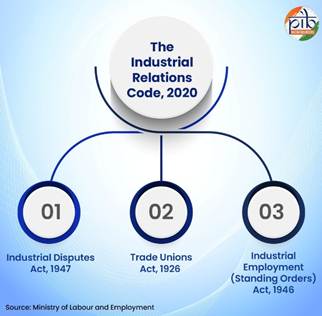
The Industrial Relations Code 2020 repealed three major legacy statutes: Trade Unions Act 1926, Industrial Employment (Standing Orders) Act 1946, and Industrial Disputes Act 1947. These were repealed when the four labour codes came into force after they were notified by the Union Government on November 2025.
Now the amendment explicitly confirms that these legacy Acts stand repealed from the date notified under the code. In ensures that the repeal was by stature itself and not perceived as executive direction. It also reinforces the savings provisions to preserve continuity of actions and rights under even under the old laws.
The Bill substitutes the existing wording in Section 104 of the Industrial Relations Code, 2020 with language that makes it unambiguously clear that the three legacy labour enactments are repealed as statutory consequence. The text also specifies the repeal date and removes any basis for arguing that the executive, rather than Parliament, effected it. This is mainly a clarificatory, not substantive, change. No new substantive rights or duties have been created, and it just reinforces legal certainty. The passage of this legislation will mean different things for Workers Unions, Businesses and Employers, and the political and opposition response.
As for workers and Unions are concerned, the amendment reduces the likelihood of legal disputes about the status and applicability of the older labour laws. It confirms that transitional protections, dispute resolution frameworks, union recognition etc, will fall under the Industrial Relations Code 2020. Though the government officials argued that this also supports implementation of labour protections like minimum wages and appointment letters, though these are feature of the labour codes already in force.
It is significant for businesses and employers since it provides clearer legal footing reducing risk of litigation over interpretation of repeal. It reinforces the unified framework provided by the four labour codes, which aim to simplify compliance and regulation.
Political parties in the ruling NDA have describer the amendment as necessary for clarity and legal certainty, however, opposition MPs criticised it as anti-labour arguing that the broader labour codes weaken workers’ rights.
The opposition has accused the PM Narendra Modi led government of favouring industrialists over workers while drafting the Industrial Relations Code. BJP and its allies, on the other hand, strongly defended the codes and the amendment bill as “historic labour reform” for the welfare of the workforce.
Leader of the Opposition in the Rajya Sabha and the Congress President Mallikarjun Kharge said in the Upper House that the four labour codes are a way to steal the rights of workers and the government has joined hands with the corporates to strangle labourers by threatening job security and increasing working hours.
Congress leader Jairam Ramesh said that the most significant change being brought about by the amendment is going to enable “ease of firing” and there is “no ease of hiring”. He said that we are amending the law retrospectively which was passed six year ago, which reflect a complete failure of the government.
Ten Central Trade Unions (CTUs) have expressed strong opposition to all the codes, including the Industrial Relations Code, 2020, and its subsequent amendment, labelling them as “anti-worker” and “pro-employer”. They have demanded withdrawal of the codes against which they have organised 5 all India general strikes so far since their passage in the Parliament. The largest and most intensified all India Strike was of February 12. CTUs have threatened multiple day general strike if Modi government starts rolling out full implementation of the codes from April 1, 2026. They have threatened unprecedented level of resistance to the implementation of labour codes. (IPA Service)