By Nilakantan A
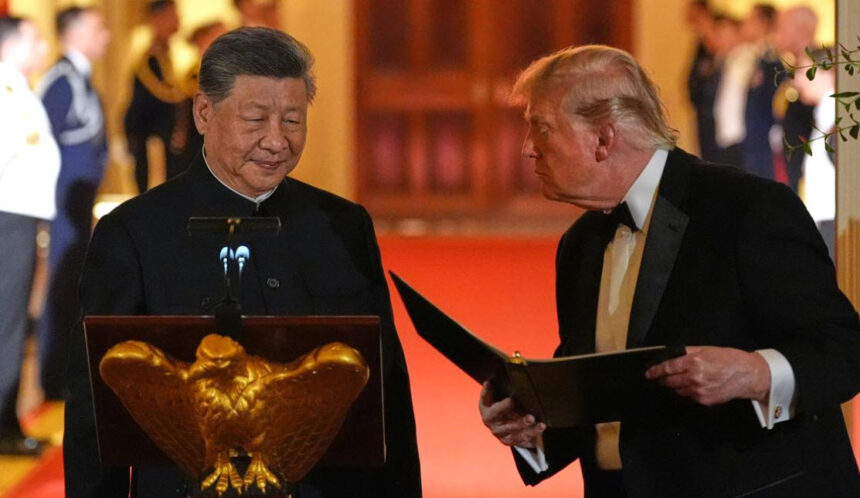
WASHINGTON: The Trump–Xi meeting was more than a diplomatic encounter. It became a test of how three media environments—the United States, Europe and China—understood power, bargaining and political theatre.
In the account presented in the US, President Donald Trump went out of his way to court Chinese leader Xi Jinping, hoping to secure concessions, particularly on rare earths. Yet the meeting produced no apparent Chinese commitment on that central issue. The offer of two giant pandas, rather than a substantive concession, became an emblem of the gap between ceremony and outcome.
American, European and Chinese coverage can be compared through three questions: who appeared to hold the leverage, what counted as success, and how the pandas were made to signify the result.
US coverage has been sharply critical of Trump’s approach, portraying his efforts to flatter and accommodate Xi as excessive and strategically ineffective. The criticism is not simply that Trump was cordial. Diplomacy often requires warmth. Rather, it is that the public display of deference appeared to precede any clear, reciprocal gain.
From this perspective, the meeting exposed a mismatch between Trump’s performance and its results. He appeared to invest heavily in personal rapport, while Xi offered no visible concession on the issue Washington most wanted to advance.
If rare earths were a key objective, the absence of an agreement or firm commitment made the encounter look less like successful deal-making and more like an unbalanced courtship.
The pandas sharpened that criticism. They could be presented as a friendly gesture, but in a US reading sceptical of the meeting, they were a token substitute for the economic or strategic concessions Trump sought. The contrast—two photogenic animals in place of progress on a critical supply-chain issue—invited ridicule. The pandas thus became a shorthand for a summit heavy on pageantry but light on deliverables.
This framing also reflects a broader American concern: that personal diplomacy can become a liability when it is not backed by bargaining leverage. Trump’s supporters might argue that a cordial meeting preserves channels and creates room for future negotiations. But critical coverage asks what the United States received in return for the warmth on display.
European media coverage is likely to place the encounter in a wider context of transatlantic relations, strategic competition and economic dependence. Rather than focusing only on whether Trump personally impressed Xi, European analysis tends to ask what the meeting signals about the balance of power between Washington and Beijing—and about the reliability of US policy.
If Trump appeared to court Xi without securing concessions, European commentators could read the episode as evidence that spectacle cannot overcome structural realities. China’s importance in rare-earth supply chains gives Beijing leverage; a presidential visit, however lavish, does not automatically diminish it. The meeting may therefore be seen as a reminder that critical-mineral dependence requires long-term industrial and diplomatic strategy, not just leader-to-leader chemistry.
The pandas also carry a different resonance in Europe. They can be treated as a familiar instrument of Chinese soft power: charming, highly visible and politically useful, but not equivalent to a binding policy change. In this reading, the gesture is neither necessarily an insult nor a concession. Its significance lies in how it helps create an image of goodwill while leaving the underlying dispute unresolved.
European coverage may therefore be more measured than the sharpest US commentary. It can acknowledge the diplomatic value of keeping dialogue open while still judging the summit by its concrete outcomes. The key concern is credibility: if Washington publicly signals eagerness for a deal but returns without one, allies may question both the effectiveness of the approach and the consistency of US strategy.
Chinese state-aligned media would be expected to frame the meeting differently. Its emphasis is more likely to fall on the importance of dialogue, mutual respect and the leaders’ ability to manage differences. A cordial reception and the panda gesture can be presented as signs of friendship and cultural exchange, rather than as evidence that China yielded nothing.
This framing shifts attention away from the question of whether Washington obtained rare-earth concessions. Instead, it highlights the meeting itself as a diplomatic achievement: the two leaders spoke, tensions were managed, and the relationship remained open.
The pandas fit neatly into this narrative. They communicate warmth and goodwill without requiring China to make a costly economic commitment.
That distinction matters. In the American critical reading, the pandas look inadequate because they are measured against Trump’s stated or implied objectives. In the Chinese reading, they may be valuable precisely because they are symbolic: they allow Beijing to project generosity while preserving its negotiating position. What Washington may regard as a failed transaction can be presented in China as a successful exercise in diplomacy and image-making.
The meeting’s meaning depends on the standard by which it is judged. US critics judge it by reciprocity: Trump appeared to give more than he got. European coverage is more likely to stress the structural limits of personal diplomacy and the strategic importance of reducing dependence on Chinese rare earths.
Chinese coverage can frame the encounter as a stabilising exchange in which cordiality itself counts as progress. The two pandas capture these competing interpretations. They may be a friendly diplomatic gesture, a tool of soft power, or—when set against the absence of substantive concessions—a quietly humiliating substitute for the deal Trump wanted.
Calling them a “shrouded insult” is a powerful political interpretation, but not an objective fact: the insult lies in the contrast between the scale of Trump’s courtship and the limited visible return.
Ultimately, the meeting’s success cannot be measured by photographs, compliments or symbolic gifts alone. If the central aim was to secure meaningful concessions on rare earths, the absence of a clear commitment supports the American criticism that Trump’s approach failed to deliver. The pandas may have softened the optics, but they did not resolve the underlying imbalance. (IPA Service)