


By Dr. Gyan Pathak
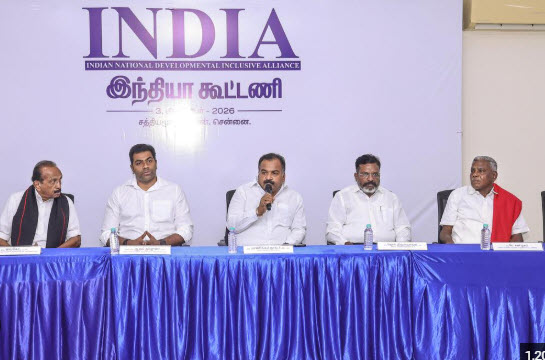
Tamil Nadu politics is undergoing a great churning. Tamilaga Vettri Kazhagam (TVK) led by CM Chandrasekaran Joseph Vijay has formally joined the INDIA bloc on October 3, 2026. It is indeed the biggest strategic shift in Tamil Nadu politics in recent times, which the Tamil Nadu Congress Committee president Manickam Tagore called historic. DMK, on the other hand, distances farther away from Rahul Gandhi and Congress.
These two political developments in the states mark a profound reversal of political arrangement in Tamil Nadu for decades. The other political developments, such as Left supporting the CM Vijay led government but contesting Madurantakam and Dharapuram by-elections against the TVK and talks of possible movement of PMK towards TVK, suggest that the ruling Secular Social Justice Victory Alliance is yet to consolidate its position.
All these remind us about the four political faultlines that need to be watched closely before the general elections of 2029, which are – Stalin-Rahul relationship, Vijay-Congress relationship, Vijay-VCK-Left relationship, and AIADMK-BJP relationship.
Currently, Congress is putting too much hope on TVK. TNCC president Manickam Tagore has said that the entry of TVK into the INDIA bloc in Tamil Nadu would significantly strengthen the anti-BJP front in the state. He even claimed that TVK’s inclusion would bolster the collective opposition in Tamil Nadu.
Not only that, INDIA bloc constituents had decided to hold district-level demonstrations across the state on October 13 and 14, demanding the immediate resignation of CEC Gyanesh Kumar over electoral roll irregularities. Those will culminate into a major protest on October 15 with top leaders from all seven – Congress, TVK, CPI(M), CPI, VCK, MDMK and IUML – constituent parties of INDIA bloc in the state, while alliance MPs participated in MPs October 6 March in New Delhi on October 6.
Here is an important point to note that TVK has no MP and therefore it did not participate in the October 6 March to ECI. It should be noted that though October 6 March to ECI was the march of MPs, several others youth organisations and people had also joined them. In this context, TVK’s absence is interpreted as CM Vijay’s cautious and restricted approach regarding the nationwide anti-CEC protests, though TVK leaders had attended the initial consultative strategy meetings in New Delhi. TVK is still silent on the extreme demands of the Congress, such as cancellation of all recent elections and immediately returning to paper ballots. It is understandable because TVK has come to power after 2026 Tamil Nadu elections. TNCC has announced that TVK will instead participate in alliance’s state-level demonstrations.
DMK has also skipped the October 6 MPs March to ECI. DMK was part of INDIA bloc until the June 2026 state election results were out. TVK had won 107 seats, Congress not only supported Vijay to form its government, but also joined it. DMK leader M K Stalin criticized the Congress and its leader Rahul Gandhi for ditching his party. DMK then announced its non-participation in INDIA bloc programmes and stopped participating. DMK was also absent in the October 3 INDIA bloc meeting in which TVK joined. When asked about DMK’s absence, Manickam Tagore rejected suggestions of any internal rift and said, “The INDIA bloc is a collective struggle against the policies of the RSS, BJP, Amit Shah, and Modi, which are detrimental to Indian democracy,” adding that the DMK leadership continued to be actively engaged with the national platform.
The changing political realignment suggests that Tamil Nadu politics is entering a three-cornered political restructuring, but with unusual features. The new Congress-TVK relationship has pulled the INDIA bloc in the state into CM Vijay’s orbit. Formerly it was in under the DMK’s leadership in the state. DMK is now increasingly treating Congress and Rahul Gandhi as estranged ally with increasing political bitterness.
Nevertheless, given the current great issues relating to ECI, SIR and proposed delimitation of parliamentary constituencies in the country, non-BJP political parties of Tamil Nadu will need to oppose unitedly. If in West Bengal, Mamata TMC, Left Front, and Congress can electorally go on their own but united at the national level under INDIA bloc, there is no reason that Tamil Nadu parties including DMK and TVK can not do it at the national level. However, for this, the Congress, TVK, and DMK will need careful approach to defeat BJP-RSS agenda in the country.
At the national level Congress still needs a broader INDIA bloc platform, but the problem is that Tamil Nadu Congress is now part of Vijay’s government, and that has pushed DMK outside the INDIA bloc in the state. However, one can’t ignore the de facto position of both the Congress and the DMK at the national level where they are part of the same national opposition ecosystem. This creates a political complexity, since DMK has lost incentive for supporting Rahul Gandhi as natural national leader as against PM Narendra Modi, though DMK may also not support PM Modi.
Vijay in the meantime is at something different political structure from Jayalalithaa (AIADMK) or M Karunanidhi (DMK). He is attempting to construct a new Dravidian-centrist coalition. He is also avoiding to become a controversial leader. INDIA bloc entry will give him national opposition connection without requiring him to surrender his Tamil Nadu dream, which is very strong.
DMK’s problem in the state is not therefore the Congress, but the rising influence of the Vijay led TVK. The political allies with TVK at present may shift their loyalties to whichever party – DMK or TVK – emerges stronger in the state. TVK led ally is yet to consolidate in terms of contesting elections, since we have recently seen how Left and TVK contested byelections against each other. Though, TVK has bigger tent now, but keeping all its allies under it will not be easy in coming days.
Both the TVK led alliance and DMK will be contesting for anti-BJP political space in Tamil Nadu in the 2029 elections. Congress dependence on TVK may increase. However, AIADMK-BJP relationship has also become more complicated after 2026 assembly elections. At one point, AIADMK itself explored supporting a TVK government, which failed, but exposed internal differences in AIADMK, and in AIADMK-BJP alliance. Moreover, AIADMK’s immediate concern is to preserved its Dravidian plus OBC political base that has given sign to move towards TVK. Even in the October 6 byelection on Madurantakam and Dharapuram, AIADMK and BJP did not contest together.
Tamil Nadu politics is thus emanating signals for some great structural political shifts before the 2029 Lok Sabha elections. (IPA Service)


