By Ashok N Ayers
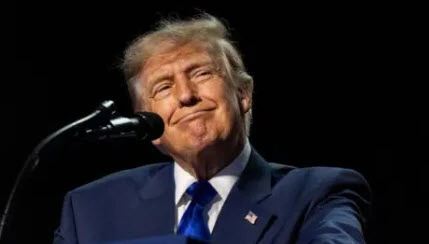
Donald Trump has discovered perhaps the oldest trick in electoral politics: promise voters money.
With 53 days to go before America votes in the November 3 midterm elections, the president has offered every adult American a startling proposition — vote Republican, retain Republican control of the House and Senate, and receive a $5,000 “Trump dividend”.
It is a promise large enough to dominate the political conversation and vague enough to leave almost every important question unanswered.
Who qualifies? How will the money be distributed? When will it arrive? Will Congress have to authorize it? Where will the money come from? And, most importantly, can the United States afford it?
Trump supplied few answers when he made the announcement at the Republican Party’s midterm convention in Dallas. He presented the payment as a dividend, comparing the United States with a successful company distributing money to its shareholders. He said the money would have to be spent in America. But there was no detailed legislation, no financing plan and no explanation of how such an extraordinary expenditure could be accommodated within the federal budget.
The arithmetic alone is staggering. Depending on eligibility, estimates put the cost at roughly $1.2 trillion to $1.35 trillion. That is not loose change in Washington. It is comparable to, or greater than, half of the annual federal budget deficit. Even the lower estimate would represent an extraordinary addition to federal borrowing if the money were not financed by equivalent revenue or spending cuts.
And America is hardly sitting on a mountain of surplus cash. The gross national debt crossed $40 trillion in September. The U.S. government is already running a deficit of roughly $1.8 trillion a year, while long-term Treasury yields are approaching 5 percent. The fiscal room for a new trillion-dollar cash distribution is therefore extremely limited.
The irony is striking. Trump came back to Washington promising fiscal discipline and economic strength. Yet his administration is now presiding over a debt burden that has moved beyond $40 trillion while proposing another enormous expenditure.
The political logic, however, is easier to understand.
Republicans are facing an increasingly difficult electoral environment. Trump’s approval rating has fallen to about 33 percent in a recent Financial Times/Focaldata poll, its lowest level in that survey. Democrats have opened a significant lead in the generic congressional ballot, while voters increasingly cite the cost of living and the economy as their principal concerns. Another recent survey found 49 percent of voters identifying or leaning Democratic compared with 39 percent Republican.
Trump’s answer is quintessentially Trumpian: change the subject, raise the stakes and make the election personal.
He has done this throughout his political career. His public statements can change rapidly, sometimes from morning to afternoon to evening, leaving opponents, allies and even members of his own party trying to determine which version of Trump represents the final position.
That unpredictability is not necessarily a weakness in Trump’s political chess game. It can be an instrument. The $5,000 dividend is therefore about more than economics. It is an attempt to give the midterms a tangible personal price tag.
For a family struggling with grocery bills, mortgage payments, medical expenses or credit-card debt, $5,000 sounds very different from an abstract argument about fiscal consolidation. The question is whether voters will believe the cheque will actually arrive.
That is where the Trump promise enters dangerous political territory.
The president has made large financial promises before. His earlier proposal for a $2,000 tariff-funded dividend never became reality. The new proposal also appears to require congressional action; the president cannot simply create a trillion-dollar entitlement by presidential declaration.
And there is the inflation question. If the government borrowed more than $1 trillion and transferred it to consumers, Americans would suddenly have enormous additional purchasing power. Some of that money would undoubtedly be spent rather than saved. If the economy were already operating under supply constraints, the additional demand could push prices higher.
The experience of the pandemic provides an obvious warning. The United States distributed large stimulus payments during the Covid crisis, and economists continue to debate how much those payments contributed to the subsequent inflation surge. But there is little doubt that putting large quantities of money into an economy can have inflationary consequences when supply cannot keep pace with demand.
The timing could hardly be more uncomfortable.Oil prices are rising sharply amid the Middle East conflict, inflation remains above the Federal Reserve’s target and Treasury yields are climbing.
The 10-year Treasury yield has been approaching 5 percent, while the 30-year yield has climbed above 5.3 percent. Higher government borrowing therefore does not come cheaply.
A trillion-dollar dividend financed through borrowing could consequently produce a peculiar economic paradox: Americans receive $5,000 in one pocket while higher inflation, higher interest rates and higher government debt eventually take money out of the other.
There is an interesting parallel in Indian politics. During the 2013-14 election campaign, Narendra Modi used the example of India’s overseas black money to suggest that, if the money could be brought home, the amount would theoretically be equivalent to roughly ₹15 lakh for every Indian. The figure subsequently became one of the most famous political promises associated with the 2014 election, although the BJP’s manifesto did not actually promise a ₹15 lakh deposit into every bank account.
After the election, BJP president Amit Shah described the ₹15 lakh formulation as an idiomatic expression — a “jumla” — rather than a literal commitment to put ₹15 lakh into every account. The money, he said, was never intended to be distributed mechanically to every citizen.
Yet the political memory survived. More than a decade later, the question of how much black money was actually recovered and returned to India remains politically potent, while the ₹15-lakh slogan remains shorthand for the gap between an electoral promise and its implementation.
Trump’s $5,000 dividend risks creating an American version of the same political phenomenon. If Republicans win, the promise will acquire a life of its own. Supporters will demand the money. Congress will have to confront the cost. Economists will scrutinize the inflationary consequences. Bond markets will examine the government’s ability to finance another trillion-dollar obligation.
And if Republicans lose, the promise can be explained away as an election proposal that voters rejected by rejecting the party.
That is the genius — and the danger — of the Trumpian political wager. It is not clear if the Federal Election of US can allow a sitting president and his party ruling the country make a monetary pledge before an impending election — would it not create an unfair equation and leave the democrats cringing for a level playing field. Whether anybody believes in what Trump says and Delivers is another question altogether.
The president has managed to transform an election about congressional control into a referendum on whether Americans want a $5,000 cheque. But the government is not a casino and the Treasury is not a political ATM.
America can print promises much faster than it can print prosperity. With a $40 trillion debt, trillion-dollar annual deficits and borrowing costs already climbing, the real question is not whether $5,000 would make Americans happier.
Of course it would. The question is who ultimately pays for it. The answer, sooner or later, would almost certainly be the American taxpayer, the American consumer or the next generation of Americans inheriting the debt.
The $5,000 Trump dividend may therefore prove to be the most expensive campaign slogan in modern American politics — whether the cheque is ever mailed or not. (IPA Service)