By Ashok Nilakantan Ayers
By the time the cameras saw Donald Trump climbing the steps of Air Force One at Ankara, the most important part of his journey had already become a deception. The president was about to disappear — literally into a catering container — and leave Turkey aboard a completely different aircraft.
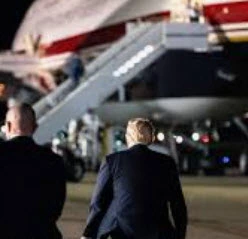
It looked like a routine presidential departure. Donald Trump walked towards the familiar blue-and-white Boeing 747 at Ankara’s Etimesgut Air Base, waved to the cameras and boarded the aircraft. Television pictures showed exactly what the White House wanted the world to believe: the President of the United States was leaving Turkey aboard the old Air Force One after attending the NATO summit.
But Trump wasn’t going to fly home on it. Minutes later, behind the aircraft and away from the journalists travelling with him, one of the strangest presidential security manoeuvres in modern American history was under way.
A catering truck pulled alongside the opposite side of the aircraft. Its hydraulic container was raised to the level of the presidential jet. Trump and several aides slipped into the container. The truck was lowered, drove away from Air Force One and headed towards a much smaller military aircraft waiting nearby.
The destination was a C-32A — a modified Boeing 757 normally used to transport senior American officials.
Trump had effectively vanished. The extraordinary operation, revealed by The Washington Post and subsequently confirmed by Trump himself, was triggered by what American officials described as a serious and specific Iranian threat to the president. The threat was sufficiently grave for the Secret Service and military planners to abandon the publicly announced flight plan at the last moment.
And there was an additional twist: the people sitting inside the old Air Force One — including journalists and some White House personnel — did not know that the President was no longer aboard.
Trump had arrived in Turkey on the new Boeing 747-8 supplied by Qatar, the aircraft that had recently begun serving as his presidential transport after extensive modifications. The Qatar aircraft was controversial from the start. Questions had been raised about its defensive capabilities compared with America’s existing presidential jets. The legacy Air Force One aircraft, by contrast, had decades of presidential security modifications behind it.
Trump had announced before leaving Turkey that he would return on the older blue-and-white Air Force One “for old time’s sake”. That announcement became the perfect cover.
The new Qatari aircraft departed Turkey first, creating the appearance that it was being repositioned ahead of Trump’s eventual journey. Trump then publicly boarded the old Air Force One in full view of cameras. Except that he wasn’t staying aboard.
The choreography was astonishingly simple. A catering vehicle — the sort of airport equipment nobody normally notices — approached the presidential aircraft. Its container was lifted alongside the plane on the opposite side from where the press corps was boarding. Trump entered. The container was lowered. The truck drove away. For roughly 40 seconds, according to video reviewed by The Washington Post, the vehicle disappeared from the cameras’ view behind the C-32A’s engines.
Then the truck emerged. A man in a suit was seen leaving the vehicle and walking towards the smaller aircraft. The President was now travelling under a different identity in the air-traffic system. The C-32A used the call sign “Reach 18”, rather than the conspicuous presidential Air Force One designation. Public flight-tracking data could not establish the aircraft’s movements in the same way it could track the other presidential planes.
The deception went even further. Defence Secretary Pete Hegseth boarded the C-32A separately, making the movement appear less extraordinary. Other senior officials remained aboard the old Air Force One. Journalists were told to close the window shades. Nobody was supposed to know exactly where the President was.
This was not ordinary presidential paranoia. American intelligence agencies had already been concerned about Iranian threats against Trump dating back to his decision to order the killing of Qassem Soleimani in 2020. In 2024, American authorities charged individuals in alleged Iran-linked plots against Trump. The danger became particularly acute in 2026 as the United States and Iran moved into direct military confrontation.
By the time Trump attended the NATO summit in Ankara, intelligence officials had reportedly identified a specific threat involving the President or his aircraft. The reported danger was considered sufficiently serious that officials contemplated threats from the air, including the possible use of shoulder-fired missiles, according to NBC reporting cited by Sky News.
Turkey’s geography added another complication. It is a NATO ally — but it also shares a long border with Iran. The safest aircraft was therefore not necessarily the biggest, most recognisable or most heavily publicised one. The safest aircraft was the one nobody expected the President to board.
Trump’s secret C-32A flew to Britain. But the public story continued. The legacy Air Force One, carrying journalists and White House personnel, followed. At RAF Mildenhall, the sequence was reversed. Trump was transferred back to the old Air Force One. Then the cameras came alive.
At approximately 10:56 p.m., Trump descended the staircase of the legacy Air Force One in full view of the press, greeted American troops and behaved as though he had just arrived from Turkey on that aircraft.
A few minutes later he boarded the new Qatar-supplied presidential jet for the onward flight to Washington. The theatre had worked. The world had seen Trump board one Air Force One in Ankara and emerge from the same aircraft in Britain. But in between, he had secretly travelled aboard another plane. It was a presidential shell game in the skies.
Yes — but rarely. The closest known precedent came in March 2000, when President Bill Clinton visited Pakistan. Clinton publicly departed Islamabad aboard Air Force One while another aircraft was used to create uncertainty over his actual movements. In that case, television cameras filmed Clinton disembarking from a plain white aircraft that had followed the presidential jet.
The principle was the same: make the obvious aircraft the decoy. Former Secret Service officials told TIME that using alternate aircraft and deception is part of the broader security playbook when credible threats emerge, although the Ankara operation was unusually elaborate.
The difference this time was the theatre of the catering truck. A president disappearing inside an airport food-and-supplies container sounds like something from a spy thriller. This time, it wasn’t fiction.
How many times has Trump faced assassination attempts? The answer depends on what qualifies as an “attempt”. There are two clear physical assassination attempts against Trump during the 2024 campaign.
The first was the July 2024 shooting at his rally in Butler, Pennsylvania. A bullet grazed Trump’s ear before Secret Service agents surrounded him and rushed him from the stage. The gunman, Thomas Matthew Crooks, was killed by law enforcement.
The second came two months later at Trump’s Florida golf course. Ryan Wesley Routh was arrested after a Secret Service agent spotted a rifle barrel near the course. Routh was subsequently convicted and sentenced to life imprisonment.
Since then, there have been other serious security incidents, including a 2026 armed intrusion at Trump’s Mar-a-Lago security perimeter. But these should not automatically be counted as assassination attempts because investigators have not established the same intent in every case.
Separately, there have been multiple alleged Iran-linked assassination plots, including the 2024 murder-for-hire case involving Asif Merchant and another alleged plot disclosed by the Justice Department later that year.
So the more accurate formulation is this: Trump has survived two well-established physical assassination attempts, while American authorities have uncovered or investigated several additional alleged plots and threats, including Iran-linked conspiracies.
And Ankara now belongs in a different category — not an assassination attempt itself, but perhaps the most dramatic presidential escape operation of Trump’s political life. The irony is irresistible. Trump has spent years projecting himself as the politician who never retreats. Yet in Ankara, when American intelligence warned that the President might be the target, the world’s most visible leader became invisible.
No motorcade. No dramatic helicopter. No flashing presidential convoy. Just a catering truck. Inside it was the President of the United States.
And while the cameras watched the decoy Air Force One prepare to fly away, the real Trump was already disappearing into the night aboard a Boeing 757 under the deliberately forgettable call sign Reach 18.
For a man whose political brand is built on spectacle, Trump’s greatest escape was the moment nobody was supposed to see. (IPA Service)