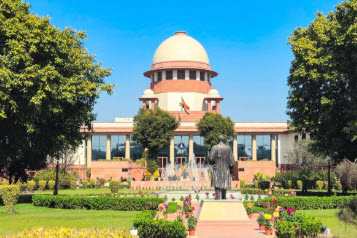
A three-judge bench headed by Chief Justice Surya Kant issued the direction on Friday after petitioners questioned the handling of Form 7 applications, including objections allegedly targeting voters from a particular community. Justices Joymalya Bagchi and V Mohana were also on the bench.
The court instructed the petitioners to provide a written note identifying outstanding irregularities to senior counsel representing the Election Commission. The commission must examine the factual allegations, take necessary corrective steps and file a compliance report before the court.
Senior advocate D S Naidu, representing the commission, acknowledged that bulk applications had been submitted but maintained that election officials had found them false and had not acted on them.
“We found that bulk Form 7 applications had been submitted. Our officers checked and cross-checked them. They were false, and we have not acted upon them,” Naidu told the bench.
Counsel for the petitioners disputed the adequacy of that response, alleging that 32 applications in one assembly constituency sought the removal of voters belonging to a particular community. The lawyer also claimed that two applications bore the signatures of booth-level officers.
Those assertions remain allegations before the court. The commission’s position is that the disputed applications did not lead to deletions, while the petitioners contend that the circumstances surrounding their submission require further examination.
The commission said officers had checked the relevant submissions individually before deciding that no action was warranted.
The bench directed that the outstanding complaints be presented formally so the commission could verify individual instances rather than address the dispute solely through general submissions made during the hearing.
The proceedings arose from petitions challenging the Special Intensive Revision of electoral rolls in Uttar Pradesh. Among the petitioners are Congress MP Tanuj Punia and Samajwadi Party leader Arvind Kumar Singh.
Form 7 allows an eligible applicant to object to a proposed inclusion or seek removal of a name already appearing on an electoral roll. Applications must be considered under prescribed procedures, rather than resulting automatically in deletion.
Under the Registration of Electors Rules, 1960, electoral registration officers must examine objections and provide the affected elector an opportunity to be heard before issuing a reasoned decision. These safeguards are central to the dispute over whether mass applications were properly handled.
The Election Commission, in a counter-affidavit filed on September 16, maintained that names were not deleted without notice and reasoned orders from electoral registration officers or their assistants. It said complaints concerning Form 7 were examined under applicable rules.
The commission further stated that the applications identified in the petition had not been submitted in accordance with statutory requirements and revision guidelines. Consequently, it argued, no deletions had resulted from those particular applications and allegations of systemic misuse were unfounded.
Its affidavit recorded 465,520 deletions through Form 7 across Uttar Pradesh and 252 appeals against orders of electoral registration officers, including deletion decisions. Those statewide figures do not establish that the disputed bulk applications caused any removals.
The petitioners nevertheless questioned whether rejecting the applications was a sufficient response to suspected irregularities. Their counsel referred to complaints in Karnataka and Telangana, where, the court was told, comparable allegations had prompted directions for registration of police cases.
The submission drew a distinction between preventing an improper deletion and investigating how questionable applications came to be filed. The court did not make a finding that officials or applicants had engaged in wrongdoing, instead requiring the commission to assess the particulars supplied.
The Uttar Pradesh revision concluded with publication of the final electoral roll on April 10. Friday’s direction therefore concerns scrutiny of alleged irregularities in an exercise already completed, rather than an order to restart the revision.
The court also considered electoral roll revision disputes involving other states during the hearing. Regarding Kerala, it asked petitioners to provide details of people allegedly unable to submit enumeration forms, directing the commission to consider their cases sympathetically and report back.
Separately, the bench allowed the commission four weeks to respond to a petition alleging large-scale voter deletions in Chhattisgarh. Those proceedings were distinct from the Uttar Pradesh complaints concerning Form 7 applications.