By Arun Srivastava
Frightened of the scary scenario of losing the assembly election in Uttar Pradesh only four months away, the RSS has embarked on a metaphorical odyssey of winning the Dalits and OBC support at the cost of antagonising the upper castes in UP and in a desperate move has decided to aggressively push Hindutva agenda and project Samajwadi Party chief Akhilesh Yadav as “anti-Hindu” and “protector of goondas”
This electoral strategy was given the final shape at the two day “yojana baithak” of the Chintan Sivir of the RSS attended by some BJP leaders of the state that concluded in Mathura on Tuesday. Disillusioned at the autocratic governance and behaviour of the saffron chief minister Yogi Adityanath, the BJP national president Nitin Nabin had to caution Yogi with the intent to assuage the hurt feelings of the rank and file by saying that cadres and workers were supreme for the party and that their concerns would be addressed.
Electoral loss of UP would pose a serious threat to the identity and existence of saffron ecosystem , especially to the RSS. The ideological and political centrality of Uttar Pradesh to the RSS has been an overarching element in Indian politics. Analysts and political observers generally examine this relationship through two contrasting lenses: why UP is viewed as an existential anchor for Hindutva politics, and why supporters or institutionalists argue the movement’s identity extends beyond electoral outcomes in a single state.
Desperation of the saffron brigade to retrieve the lost support base and salvage its credibility of being the champion of Hindutva and Hindu cause, Deputy Chief Minister Keshav Prasad Maurya came out with the demand at Sivir for a grand Krishna temple at a disputed site in Mathura with the mission to make it BJP’s key political plank in the coming Uttar Pradesh Assembly elections, by declaring, “Ayodhya hui hamari hai, ab Mathura ki baari hai (Ayodhya has become ours; now it is Mathura’s turn).” He tried to arouse the Hindu emotions by saying that like the Ayodhya Ram Temple, a grand Krishna temple would be built at the Shri Krishna Janmabhoomi-Shahi Eidgah mosque site, obliquely implying that mosque would have to be demolished. He said mosque was built on the orders of Mughal Emperor Aurangzeb adjacent to the Krishna Janmasthal — that devotees believe to be the birthplace of Lord Krishna — after demolishing a temple.
With top BJP leaders Narendra Modi, Amit Shah and Yogi Adityanath are engaged in bitter war of supremacy, the chances of BJP losing the electoral battle have frightened the Sangh Parivar. The message emanating from the Sivir was loud and clear: BJP must win the election at any cost. In its endeavour RSS is not hesitant even to antagonise the upper castes. Combine together while Brahmans, Rajputs and Bania constitute 15 per cent of the state’s population, Dalits alone are 24 per cent and non Yadav OBC are 30 per dent. Muslim population is around 20 per cent.
UP is the RSS’s laboratory of caste consolidation and has been dominated by caste-based regional parties, Samajwadi Party (SP) and Bahujan Samaj Party (BSP). BJP’s ability to build a broad non-Yadav OBC and non-Jatav Dalit coalition in UP is the ultimate test of whether Hindutva can override caste fragmentation. Without strong electoral dominance in UP, sustaining a majority at the national level would mathematically become difficult for the BJP. This would directly limit the Sangh Parivar’s ability to advance its policy and cultural agenda.
Through the Chintan Sivir, RSS has significantly stepped up its grassroots coordination in the state to counter opposition caste alliances and protect this model. RSS has become more active for the reason it performed miserably in2024 Lok Sabha elections. BJP has also lost elections between 2002 and 2012, when regional parties dominated the state. During those periods, the RSS used electoral setbacks to critique party leadership, re-engage grassroots workers, and rebuild its organizational base.
The primary focus of RSS leadership at Chintan Sivir was on caste mobilisation programme, launching Grih Sampark and Hindu Sammelans. Unfortunately for RSS, its programme has turned the Dalits, OBCs and minorities of the state circumspect of a fersh spurt in the caste-based violence in the state. Ever since Yogi Adityanath, a Rajput, becoming chief minister the Rajputs have adopted an aggressive posture not only towards these castes, the Brahmans and Kushwahas have also come on their target. Yogi never tried to reach out to these castes and win over their trust instead he brazenly encouraged his caste men to unleash a reign of terror.
The RSS placing major emphasis on reaching economically disadvantaged Dalit, and backward communities ahead of the 2027 UP Assembly elections, at its Sivir, has panicked them. Dalits and minorities are scared that Sangh’s outreach strategies, organizational goals, and the political perspectives surrounding this mobilisation include may provoke the upper castes to turn aggressive, as they would not like the backwards castes and Dalits to acquire centre stage in state politics through extending support to BJP. RSS drives specifically target Dalit localities and rural areas to distribute literature and integrate marginalized households into Sangh activities.
RSS has directed its cadres and swayamsevaks to penetrate Dalit villages and apprise the inhabitants about central and state government welfare schemes. The goal is to ensure poor rural families receive tangible socio-economic benefits while building grassroots trust. This sudden concern of RSS for the Dalits and backwards has been causing consternation amongst the community members. Some Dalit leaders seek to know why these measures and programmes were not initiated earlier and why they were not provided with adequate protection against the upper caste repression.
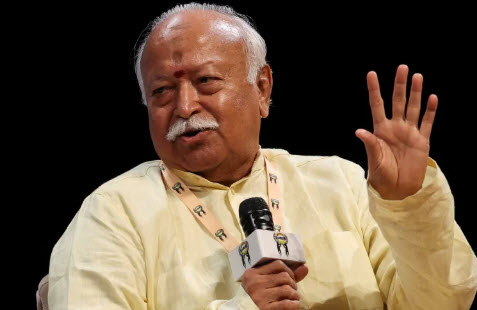
RSS chief Mohan Bhagwat, has again promoted the divisive slogan of “Ek mandir, ek kuan, ek shamshaan” (one temple, one well, one cremation ground) to discourage caste-based segregation. The organisation has also planned year-long commemorations of the 650th birth anniversary of Sant Ravidas to foster cultural connection with Dalit communities. The social activists and some Dalit leaders look at this slogan as a design to marginalise the Muslims and alienate them from the mainstream politics.
With Rahul Gandhi and Akhilesh Yadav targeting these castes, the RSS has turned anxious. This outreach is designed to counter the Samajwadi Party’s “PDA” (Pichhda, Dalit, Alpsankhyak) narrative, which contributed to a drop in BJP vote share in UP during the 2024 Lok Sabha elections. Evolving the mechanism to reach out to the Gen Z also prominently featured at the “Yojana Meet”. RSS has already chalked out a strategy to counter the anti saffron campaign on social media. It has also prepared a 6 point action plan to link 40 crores youths with its programme of nation building. (IPA Service)