By R. Suryamurthy
The warmth was unmistakable in Manila on Tuesday, but the substance of the Modi-Trump relationship remains considerably more complicated than the public bonhomie suggests. Donald Trump called Narendra Modi a “very tough man”, reaffirming his admiration for a leader he regards as an equally formidable negotiator. Yet beneath the compliments lies an uncomfortable question: can two leaders who pride themselves on putting their national interests first reconcile their competing economic ambitions without turning strategic partnership into an exercise in transactional pressure?
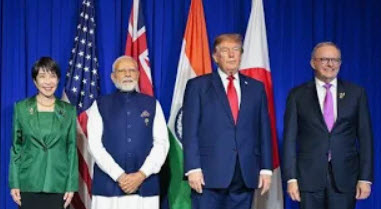
The November 17 Quad summit offered a reassuring answer on strategic cooperation, but left the harder bilateral questions unresolved. The meeting of the leaders of the United States, India, Japan and Australia, their first in-person summit in nearly two years, demonstrated that Trump’s return to the White House has not diminished the Quad’s relevance. It also provided a preview of the diplomatic contest awaiting Modi and Trump when they meet at the G20 summit in Miami on December 14–15.
Manila was significant not because the four leaders exchanged familiar assurances about a free and open Indo-Pacific, but because they attempted to give that rhetoric an economic and technological dimension. Their opposition to economic coercion, arbitrary export restrictions and unilateral attempts to change the regional status quo was an unmistakable message to China, even without naming it. Initiatives on maritime surveillance, critical minerals, artificial intelligence, cybersecurity and undersea connectivity suggested that the Quad is evolving beyond its traditional security orientation.
The proposed Quad Business Leaders’ Forum, to be hosted by India in Mumbai in early 2027, is particularly important. It offers a mechanism to turn strategic alignment into commercial partnerships and supply-chain diversification. The proposed $85 million-plus Super Intelligence Accelerator and enhanced maritime cooperation similarly indicate that the grouping wants to compete in the technologies and infrastructure that will shape the next phase of geopolitical influence.
For Trump, participation in Manila was an acknowledgement that the United States cannot pursue its Indo-Pacific interests through bilateral pressure alone. India is too important geographically, economically and strategically to be treated merely as another country expected to accommodate Washington’s priorities.
But the summit’s strategic unity should not obscure the contradictions in the bilateral relationship. The Quad can agree on economic resilience while Washington and New Delhi struggle to agree on the terms of economic engagement. That contradiction will follow the two leaders to Miami.
The Modi-Trump relationship is a continuation of an earlier political equation, but the circumstances surrounding it have changed. Their personal chemistry has repeatedly helped sustain engagement, even when differences over tariffs, Russian oil, immigration and regional security have threatened to complicate ties. Trump’s descriptions of Modi as a tough negotiator, a tough cookie and a great leader suggest that he respects the Indian prime minister’s political instincts.
Yet admiration is not accommodation. The past year has demonstrated that presidential friendships offer no insurance against economic coercion. The extravagant public displays of camaraderie during their earlier encounters did not prevent Washington from pursuing policies that directly affected Indian commercial interests.
The danger for New Delhi is to confuse personal access with negotiating leverage. Trump admires strong leaders, but his definition of a successful relationship is ultimately measured by what the United States obtains from it. Modi, too, has domestic political constituencies and economic priorities that cannot be sacrificed to preserve an attractive diplomatic photograph.
The political context has also shifted. Democrats’ capture of both chambers of Congress in the November midterm elections has weakened Trump’s domestic political position, although it has not stripped him of executive authority over foreign policy and trade administration. A hostile Congress can intensify scrutiny and complicate legislation, but it does not necessarily mean that Washington will abandon economic nationalism. Protectionism, industrial policy and technological supremacy have support across the American political spectrum.
Indeed, Trump may have an additional reason to seek a trade agreement with India. A deal would offer him an opportunity to demonstrate that electoral setbacks have not diminished his capacity to deliver international economic outcomes. For Modi, however, the political value of a presidential announcement is secondary to the commercial terms it delivers.
The proposed bilateral trade agreement is therefore likely to dominate the December discussions. The February 2026 interim framework, which envisaged reducing the additional reciprocal tariff on most Indian goods to 18 per cent, appeared to signal a breakthrough. India was expected to offer greater access to American industrial and agricultural products, while a proposed $500 billion purchasing commitment over five years gave the understanding an ambitious commercial dimension.
But an interim framework is not a finished agreement, and the subsequent developments have altered the negotiating landscape. The US Supreme Court’s February 20 ruling against Trump’s use of the International Emergency Economic Powers Act to impose sweeping reciprocal tariffs weakened one instrument of presidential pressure. It did not, however, dismantle Washington’s protectionist trade philosophy or eliminate other avenues for imposing restrictions.
The more fundamental problem is asymmetry. Washington wants greater access to India’s market while retaining considerable flexibility to protect American industries and impose trade restrictions. India wants predictable access to the American market and assurances that concessions made by its exporters will not be neutralised by fresh tariff measures.
Agriculture and dairy remain particularly sensitive. For India, market access is not simply a question of lowering tariff lines; it touches the livelihoods of millions of farmers, domestic procurement arrangements and food security. The government cannot afford to treat these sectors as expendable bargaining instruments. Equally, an agreement that gives American businesses wider access to India without delivering meaningful advantages to Indian exporters would be politically difficult to defend.
The Supreme Court ruling has made the negotiations more complicated, not less. Even if the administration cannot rely on its earlier tariff mechanism, other statutory provisions, including sectoral measures and Section 301 investigations, can provide alternative routes for trade restrictions. India needs more than a temporary reduction in tariffs. It needs protection against arbitrary changes that could make market access uncertain after the agreement is signed.
The European Union, Britain and other trading partners are expanding their economic engagement with India. New Delhi is no longer negotiating from the assumption that the American market is its only gateway to global opportunity. That diversification should give India confidence to resist a deadline-driven bargain.
Trump may want an agreement that can be presented as a political victory. Modi needs one that can withstand commercial scrutiny.
Energy security could prove equally contentious. Washington continues to view India’s purchases of Russian crude through the prism of its confrontation with Moscow. New Delhi sees them as part of a procurement strategy shaped by price, availability and the need to protect an energy-import-dependent economy.
The threat of punitive tariffs on countries purchasing Russian energy exposes the contradiction in America’s approach. Washington wants India to deepen strategic cooperation, diversify supply chains and provide a counterweight to China, while expecting New Delhi to accommodate American preferences on energy sourcing. Such expectations cannot be reconciled indefinitely through pressure.
India can expand purchases of American crude and liquefied natural gas where commercially viable. It can deepen cooperation on energy technology and infrastructure. But it cannot surrender the principle that energy procurement must be determined by national economic interests.
Strategic partnership cannot mean strategic subordination. If Washington expects India to act as an independent pillar of the Indo-Pacific order, it must recognise that independence will extend to India’s relationships with Russia and other countries.
The December meeting could produce an agreement on the first phase of the trade pact, a political understanding that allows negotiations to continue, or another postponement. A limited but credible agreement would be preferable to a comprehensive document hurriedly assembled to satisfy Trump’s appetite for announcements.
There is also a larger institutional challenge. India-US relations remain excessively dependent on the personal equations between their political leaders. That approach can produce breakthroughs, but it also makes the relationship vulnerable to electoral changes and personality-driven policy reversals. India must deepen engagement with Congress, American businesses, state governments, universities and technology institutions. The relationship needs institutional ballast, not merely presidential chemistry.
Manila demonstrated that strategic convergence can survive economic disagreement. Miami must establish whether economic partnership can be built on something more durable than mutual admiration.
Modi should neither approach Trump as a supplicant seeking tariff relief nor mistake personal friendship for a guarantee of American accommodation. Trump, meanwhile, must recognise that India is not simply a market to be opened or a strategic asset to be mobilised against China.
The central question is not whether India and the United States need each other. They plainly do. It is whether Washington can accept that a strategic partnership with India requires negotiating with an independent power, not negotiating its independence away. (IPA Service)