By Satyaki Chakraborty
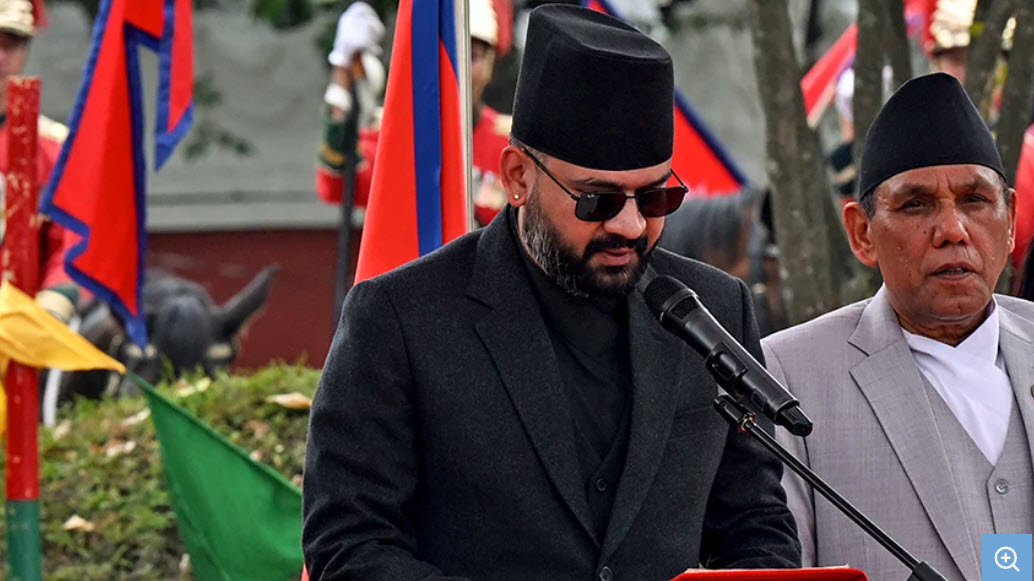
Nepal Prime Minister Balendra Shah on Monday August 10 started his foreign envoys outreach with a meeting with Indian ambassador Naveen Srivastava. He met later during the day, the Chinese ambassador also, but his first choice of Indian envoy signals a positive development in the area of India-Nepal relations which underwent strain during the former regime of K.P. S. Oli.
The Nepalese PM had pursued a policy of self isolation in respect of talking to the foreign envoys or elaborating on the foreign policy of the country since his taking over as the Prime Minister of the Rashtriya Swatantra Party (RSP) which secured two-third majority in the March 5 national elections. There was serious criticism in the Nepalese media on his approach. Even his RSP leaders including the RSP chairman Rabi Laichhane conveyed their unhappiness to this stand of the PM. But still for more than four months after he took over as PM, Shah stuck to his position of avoiding meeting with any foreign envoy. Finally, he began the process and is doing these meetings one by one.
For Indian external affairs ministry, PM’s choice of the Indian envoy for the first meeting is significant because, the Chinese envoy was also trying desperately to have the first meeting. Nepal is an important neighbour of both India and China. China has a big stake in Nepal’s economy. It is known that India and China are in a diplomatic war in Kathmandu for a long time. , India was feeling sidelined in Nepal as against the Chinese domination.
In Bangladesh, the BNP Prime Minister Tarique Rahman was invited by the Indian PM Narendra Modi to visit India soon after the BNP won the February 12 national elections in Bangladesh. But the Bangladesh PM ignored that invitation and visited China in the last week of June this year. The agreements signed in Beijing took Bangladesh-China political-economic and defence relations to a higher level.
Now in Nepal, PM Balendra Shah, despite earlier misgivings by the Indian foreign ministry has been maintaining an apparently independent position on the relations with India and China. Earlier Shah refused to meet Indian foreign secretary Vikram Misri when he visited Kathmandu. Now with this first meeting with the Indian envoy and constructive talks held between them on India-Nepal relations, the ground has been prepared to take the bilateral ties to a higher level and start the process of discussions on the pending issues.
The first priority for Indian government should be to ensure that Balendra Shah visits India shortly. There is the ticklish border issue. This is very sensitive as usual. The process can start smoothly only after a meeting of the two Prime Ministers in New Delhi. Tarique Rahman is possibly not coming to New Delhi to attend the BRICS summit on September 12 and 13 due Dhaka’s stand on Sheikh Hasina. Among the two important neighbours, if Nepal PM Balendra Shah visits before the BRICS summit, that will be a diplomatic victory for India.
For the Nepal government, it needs India more than India need Nepal. India account for 60 per cent trade of Nepal and all its third party transit trade. India can invest in Nepal in a big way if the bilateral relations improve. Nepal needs immediate generation of jobs. India more than China can help in setting up clusters of industries. But for ensuring, this, a proper climate has to be prepared by Kathmandu. Simultaneously, Indian officials have to deal with their Nepalese counterparts on an equal footing. No big brother mentality should be shown by the Indian government.
For the last two decades, India have been contributing in a big way to the development of Nepal. Since 2006, India has provided Lines of Credit worth US$ 750 million to Nepal. The projects funded by these LoCs include roads, transmission lines, hydropower projects, and housing/reconstruction in Nepal. The 11th India-Nepal LOC Review Meeting took place in New Delhi in December 2025.
India is Nepal’s largest partner in terms of trade and investment. Several key bilateral documents guide this comprehensive engagement including the treaties of Trade and Transit. The India-Nepal goods trade was worth about US$ 9.38 billion in Financial Year 2025-26. This represents more than 60% of Nepal’s total external goods trade. India is also Nepal’s biggest export destination and received more than 80% of Nepal’s goods exports in FY 2025-26.
In services, the trade between India and Nepal comprises about 1/3rd of Nepal’s total external trade in services. India is also the largest source of foreign investment in Nepal accounting for almost 1/3rd of the total FDI received by the country. The estimated value of Indian investments is about US$ 800 million. Indian investments (about 150 ventures) are mainly focused in banking, insurance, dry port, education, telecom, power and tourism sectors.
As regards water resources cooperation, there are three-tier bilateral mechanisms to discuss bilateral cooperation in water resources, flood management, inundation-control and hydropower development. Various treaties and understandings also guide this engagement. Specific matters are discussed and taken forward through various mechanisms. In the past, flood management and river training works have been carried out on the Kamala, Bagmati and Lalbakeya rivers through Indian grant assistance of INR 900 crores. Mutually agreed emergency works have also been funded by the Government of India from time to time.
Further the Joint Vision Document on Power Sector Cooperation signed in 2022 inter alia envisages the joint development of power projects, cross-border transmission lines, bi-directional power trade, and coordinated operation of national grids. The Power Trade Agreement signed in 2014, envisages export of 10,000 MW of power by Nepal to India. There are several bilateral mechanisms to guide cooperation in this area including a Joint Steering Committee and a Joint Working Group. Nepal exported about 1100 MWs of electricity to India last year and also sent power to Bangladesh through the Indian grid.
In the context of this wide ranging cooperation with Nepal, both the Indian government and the Nepalese PM can work out areas for further economic and industrial cooperation in the coming months based on the immediate requirements of Nepalese economy. The step up in economic cooperation will help in facilitating the process of political dialogue on the border issues.
Narendra Modi government, for the time being has lost the goodwill of Bangladesh due to Hasina extradition issue. India can no longer alienate its another important neighbour just for differences on the border issues. Further economic assistance to Kathmandu can be highly useful in preparing proper climate for effective political negotiations. (IPA Service)