By Ashok Nilakantan Ayers
Something unusual is happening on the other side of the Line of Control. For decades, Pakistan has presented Pakistan-occupied Kashmir as the unfinished business of Partition and India as the country responsible for denying Kashmiris their right to self-determination. Islamabad has repeatedly invoked the United Nations and the promise of a plebiscite.
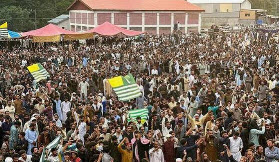
Now the language is coming back to haunt Pakistan. The people protesting in Pakistan-occupied Kashmir are invoking the very United Nations resolution that Pakistan has historically cited against India. And on August 13, the Joint Awami Action Committee (JAAC), the organisation at the centre of the agitation, says it may make a dramatic new demand: that UN peacekeeping forces be brought into the territory and replace Pakistani security forces.
It would be an extraordinary turn in the Kashmir story. The protesters plan fresh demonstrations on August 13, the anniversary of the 1948 UNCIP resolution on Jammu and Kashmir. JAAC leaders say the resolution required Pakistan to withdraw its forces from Jammu and Kashmir before the subsequent steps towards a plebiscite could proceed.
For Pakistan, the symbolism could hardly be more uncomfortable. The Kashmir issue, which Islamabad has traditionally used as an argument against India, is now being deployed by dissidents in territory administered by Pakistan against Islamabad itself.
The present agitation did not begin as an international campaign over Kashmir’s final status. It began with everyday grievances. Residents have protested over electricity pricing, taxation, shortages, privileges enjoyed by the political and administrative elite, governance failures and the distribution of the region’s resources. The JAAC has also demanded greater control over hydropower projects and an end to what it describes as privileges enjoyed by politicians, judges, senior bureaucrats and contractors.
These are not abstract constitutional complaints. They are the grievances of people confronting the most basic question of modern government: what do citizens get in return for the taxes and resources they surrender to the state?
The movement’s demands have included fair electricity tariffs, access to resources generated in the region, greater accountability and an end to special privileges for the ruling establishment.
The dispute over hydropower is particularly potent. Pakistan-administered Kashmir possesses substantial hydroelectric potential, yet residents have long complained about the paradox of living beside major power projects while facing high electricity costs and inadequate economic benefits.
The JAAC says that agreements reached with the Pakistan and PoK governments over the past two years were not properly implemented. It now accuses the political establishment of attempting to preserve an entrenched elite system rather than address the underlying grievances.
That is why this revolt cannot simply be dismissed as another separatist agitation. It is as much about governance as geography.
But history has now entered the protest movement. The UNCIP resolution of August 13, 1948 was an important stage in the internationalisation of the Kashmir dispute.
It proposed a ceasefire and a sequence of steps. Crucially, it stated that the presence of Pakistani troops in Jammu and Kashmir constituted a material change in the situation and provided for their withdrawal. It then envisaged a subsequent reduction of Indian forces and arrangements for determining the future of the state through the will of its people.
The plebiscite never happened. The reasons are disputed, and the subsequent UN negotiations produced increasingly complicated proposals concerning demilitarisation, administration and the sequencing of withdrawals. The central obstacle, however, was that India and Pakistan never agreed on the conditions under which the territory would be demilitarised sufficiently to permit a free vote.
The historical irony is that the status quo eventually became permanent even though the original ceasefire architecture was conceived as temporary. The ceasefire line became a dividing line. Temporary military arrangements became entrenched. And generations were born on either side of a frontier that had not existed before the conflict of 1947-48. That is the historical anomaly now being invoked by the protesters.
The latest development creates an uncomfortable question for Islamabad. If the United Nations principle of allowing Kashmiris to determine their future remains central to Pakistan’s argument, what happens when Kashmiris living under Pakistani administration invoke that principle themselves?
And if Pakistan’s position is that Kashmiris have been denied their political rights under Indian administration, how does Islamabad answer complaints about political representation, economic discrimination and security-force intervention in territory it administers?
The protests have already produced violence. The first two phases of the 2026 PoK elections were accompanied by unrest and allegations of rigging. The third phase on August 10 went ahead in only four constituencies, while voting in seven others was postponed because of the law-and-order situation. Reuters reported that more than 30 people were killed in clashes following the first voting round and that authorities had imposed measures including road closures and internet blackouts.
The JAAC has also opposed the electoral system’s reserved seats for refugees from Indian-administered Kashmir, arguing that these seats allow Islamabad to influence politics in PoK. Pakistan rejects the allegations.
The result is an increasingly awkward spectacle: Pakistan is conducting elections in territory it calls liberated Kashmir while facing a movement questioning the legitimacy of the political arrangements under which those elections are conducted.
The demand for UN peacekeepers is dramatic — but it should not be confused with an existing UN plan. There is no automatic mechanism under the 1948 resolution by which UN troops can now simply replace Pakistani forces. The JAAC is making a political demand, not invoking an operative UN decision that mandates such deployment.
Yet the demand has symbolic power. It essentially says: If Pakistan cannot guarantee security, political freedom and human rights in the territory it administers, let an international force do it. That is a devastating proposition for Islamabad.
Pakistan has historically resisted any arrangement that could weaken its control over PoK. India, for its part, has consistently rejected the notion that the Kashmir question can be reduced to a simple plebiscite detached from the history of Pakistan-sponsored aggression and subsequent developments.
The protesters have introduced a third voice — the residents of Pakistan-administered Kashmir themselves. That voice cannot easily be dismissed as Indian propaganda if the grievances are demonstrably about electricity, taxation, political privilege, corruption and governance.
For India, this moment carries another uncomfortable historical question. Could the Kashmir story have ended differently in 1947-48? When Maharaja Hari Singh acceded to India after the tribal invasion backed by Pakistan, Indian forces were flown into Srinagar. The military situation changed dramatically.
Indian commanders believed Pakistani-backed forces could be pushed further back. But the war eventually ended with a ceasefire, leaving Pakistan in control of a substantial portion of the former princely state. India subsequently took the Kashmir dispute to the United Nations.
That decision has been debated ever since. Critics of Jawaharlal Nehru argue that India stopped short of completing the military recovery of the territory when its forces had momentum and that the ceasefire converted a military problem into an international dispute.
Defenders argue that India faced the realities of an internationalised conflict, the risks of a wider India-Pakistan war and the strategic calculations of the early Cold War.
History offers no easy counterfactual. But the question refuses to disappear: had India pushed the Pakistani forces out in 1948, would the Kashmir dispute have survived in its present form?
Nobody can know. What is certain is that the unfinished territorial division created in 1947-48 has survived for nearly eight decades.
That brings the story into the present. Narendra Modi’s government has already demonstrated that it is willing to take decisions on Kashmir that previous governments regarded as politically or diplomatically too difficult.
The abrogation of Article 370 in 2019 fundamentally altered India’s constitutional relationship with Jammu and Kashmir. But Pakistan-administered Kashmir presents a very different challenge. India cannot simply march across the Line of Control because protests have erupted in PoK.
Any military intervention would carry enormous risks — escalation with a nuclear-armed Pakistan, international pressure and the possibility of transforming a popular uprising into an interstate war. Nor can India afford to appear indifferent if serious human-rights abuses occur.
The strategic opportunity, therefore, may lie somewhere between military intervention and diplomatic silence. India could place the grievances of PoK residents before international institutions, document allegations of human-rights violations, offer humanitarian assistance where possible and make the central contradiction in Pakistan’s Kashmir policy impossible to ignore.
If Pakistan invokes the UN when discussing Kashmir in India, India can ask why the same UN principles should not apply to Kashmiris living under Pakistani administration. That is a powerful diplomatic argument.
The danger for India is assuming that every anti-Islamabad protest automatically translates into support for New Delhi. It does not. The protesters’ immediate demands are overwhelmingly about their own lives — electricity, taxation, political accountability, economic rights, resources and dignity.
India should therefore resist the temptation to hijack the movement. The smarter strategy would be to let the movement speak for itself. If its leaders demand greater autonomy, human rights, accountable government and eventually international supervision, India can amplify those demands without pretending to be their author.
That would put Pakistan in an uncomfortable position. For decades Islamabad has argued that Kashmiris must be allowed to speak. Now Kashmiris under Pakistani administration are speaking. The question is whether Islamabad is prepared to listen. And there is another question — perhaps even more consequential — waiting for New Delhi.
Will Modi regard the unrest merely as an internal Pakistani problem and wait for events to unfold? Or will India recognise that history occasionally creates windows that do not remain open forever? The Kashmir question has survived because every generation inherited the unfinished business of the previous one.
The residents of PoK may now be attempting to rewrite that inheritance themselves. The irony is almost perfect. Pakistan went to the world saying Kashmiris needed freedom from India. Its own Kashmiris are now asking whether they need freedom from Pakistan.
August 13 could therefore be more than another day of protest. It could become the day on which an old United Nations resolution acquires a new political life — this time not because India or Pakistan invoked it, but because the people living under Pakistani administration did. (IPA Service)