By Satyaki Chakraborty
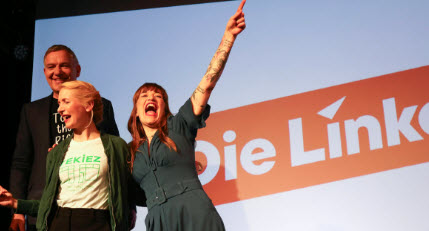
In a stunning victory, the Left Party of Germany – Die Linke – emerged as the largest party in the Berlin state elections on Sunday, defeating the surging far-right party AfD which recorded its best results by becoming the biggest party in two states. Left-wing Die Linke (DL) won around 26 per cent of the votes, as against Chancellor Friedrick Merz’s CDU trailing in second place, just ahead of the far right AfD which took 16 per cent.
The Left victory has shocked the AfD which was highly confident of sweeping Berlin state polls on the lines of the other state elections. However, this significant victory of the Left not only combated the surging AfD, but also opened up the prospects of the DL head Elif Eralf, to become the mayor of the German capital city. Interestingly, Eralf is the daughter of an immigrant family of Turkish leftwingers who fled to Germany to avoid a coup in their own country, Turkey.
After the results of the German state elections underscored once again the disastrous performance of the CDU ruling at the federal level, Chancellor Merz got in political trouble, with voices in his own party saying he was too weak a leader to stem the surge of AfD. Merz retaliated by saying that he would never allow AfD to become a partner in any state government and the same stance would be taken by the other parties. However, AfD said that they were open to any negotiations with any political party.
Chancellor Merz told newsmen on Sunday night in his party headquarters that he would soon come out with economic reforms and welfare packages. He also agreed to be flexible in having coalitions in states with other non-AfD parties to form governments. Merz’s partner in the German government SPD also agreed to act as a firewall against any bid by AfD to enter state governments.
The left-wing DL campaigned on affordable housing for the German people in the latest elections, and the issue got massive response from young Germans, as they faced ever-soaring rents in Berlin as well as elsewhere in Germany, adversely affecting the living standards of the people, mainly the youth. The new DL leadership, on the basis of its pro-people programme, contested the last parliamentary elections in February this year, and got 64 seats in German Bundestag out of the total of 630. This 2026 figure was nearly the double of the last Bundestag’s DL tally.
In last elections, the Die Linke got maximum votes – 26 per cent among the 18-24 age group, followed by the AfD with 21 per cent. It was known that the AfD will be getting more support from the young and poorer voters, but Die Linke got more, pleasantly surprising its leftist leadership. In the earlier elections, the German youth never opted for the Left in such large numbers. It is a real breakthrough for the German Left, and the party is now planning to take this success forward by focusing more on the urgent issues of the day that affect the youth.
Though Chancellor Frederick Merz talks of a firewall against the far-right AfD, the party joined with the AfD in passing in parliament a bill against immigrants, which was opposed by both the SPD and the Left. It was in this context that the prospects of the socialist party Die Linke first began to take a turn for the better. This last-minute burst of “anti-fascist” energy and discontent among the broad left was surely decisive in giving Die Linke the boost it needed not only to stay in parliament, but to achieve a solid 8.8 per cent of the vote.
This was the party’s third-best-ever result — made all the more remarkable because last time around in 2021, Die Linke had fallen short of the 5 per cent threshold, but managed to get MPs elected due to another law concerning representation from provinces. This time with its nearly in 64 seats in the Bundestag of 630 members, Die Linke has been singlehandedly fighting for the welfare measures including affordable housing. That paid rich dividends in last Sunday’s elections in Berlin.
In a way, the Left is emerging as a viable force to oppose the far-right in a number of European countries. In the new geopolitics, when Trump-led USA has distanced itself from Europe, and European nations are seeking a continental identity, the aftermath might be the rearing once again of various European nationalisms, which, in previous instances hurled the globe into two world wars. The Left has to be alert to the ramifications of surging neonationalisms in Europe, while fighting the far-right inside Europe and battling Trump’s economic whims and fancies outside. It is a tough task, but the silver lining is the European youth rediscovering and re-embracing socialism and left-wing politics that is also-anti-war, anti-fascist and anti-imperial. (IPA Service)