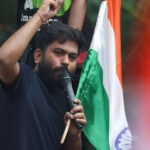
The police rejected claims that force or a baton charge had been used during the early-morning operation. Officers said Wangchuk was moved to Vardhman Mahavir Medical College and Safdarjung Hospital for essential medical care on the 21st day of his indefinite hunger strike.
Dipke posted that he had been “beaten up and put under detention”, while fellow campaigners claimed police had prevented him from reaching the protest site. His allegation could not immediately be independently verified, and the police had not issued a detailed response addressing the specific accusation against its personnel.
The intervention triggered confusion among protesters gathered at Jantar Mantar, where Wangchuk had been fasting since June 28. Video footage circulated by campaigners showed police officers surrounding the activist before taking him away in an ambulance, as supporters shouted slogans and questioned the decision.
Wangchuk’s health had deteriorated during the fast. Medical updates released by organisers said he had lost more than eight kilograms, suffered low blood sugar and experienced severe weakness. By Friday, he was struggling to speak and said he had lost nearly 20 per cent of his body weight.
The Delhi High Court had ordered daily medical examinations and directed the authorities to provide treatment when required. The court acted after a petition raised concerns that the prolonged hunger strike could cause irreversible damage or place Wangchuk’s life at risk. Police said Saturday’s hospital transfer followed judicial directions and medical advice.
Wangchuk told doctors that no treatment should be administered without his consent. His wife said hospitalisation had not been necessary and maintained that his vital parameters were stable. Hospital officials later described his condition as stable, though he remained under observation.
The protest has centred on alleged irregularities and paper leaks affecting competitive examinations, particularly the National Eligibility-cum-Entrance Test. Campaigners are demanding the resignation of Education Minister Dharmendra Pradhan, stronger safeguards for examination systems and compensation for families of students who died by suicide amid academic pressure.
The Cockroach Janta Party emerged as a youth-led movement after a judicial remark comparing unemployed young people with cockroaches. Organisers adopted the term as an identity, presenting the insect as a symbol of endurance and survival against institutional neglect. The group was founded by Dipke in May and has expanded through social media and street campaigns.
Its members have accused the government of failing to engage with students affected by examination disruptions and recruitment delays. Officials have not accepted the protesters’ demand for Pradhan’s resignation and have maintained that agencies investigating examination offences are taking action under strengthened laws.
Wangchuk joined the campaign after the youth organisation began its demonstration at Jantar Mantar. Better known for his environmental advocacy and education initiatives in Ladakh, his participation gave the movement wider visibility and attracted students, activists and opposition leaders to the protest site.
Actor Aamir Khan appealed to Wangchuk to end the hunger strike because of the health risks, while expressing support for the issues being raised. His comments also prompted an online debate after he said the central character in the 2009 film 3 Idiots had not been based on Wangchuk.
The confrontation comes ahead of a planned march towards Parliament on July 20. Organisers have said the demonstration will proceed despite Wangchuk’s hospitalisation and the police action at Jantar Mantar. Authorities are expected to restrict movement around central Delhi because Parliament is a high-security zone and marches towards the complex require prior permission.
Dipke later escalated the movement’s political demands by calling for Prime Minister Narendra Modi’s resignation. The shift broadened the campaign beyond examination accountability and signalled a sharper confrontation with the central government.