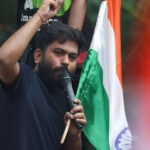
Dipke sought clarity from Prime Minister Narendra Modi after Nadda described his discussions with members of the protest movement as cordial and indicated that further meetings would follow. The CJP founder questioned why the August 21 agitation and its central demand were not explicitly addressed while announcing the dialogue.
Nadda met Harsh Dubey, Ran Bahadur Singh Chauhan and Mrityunjay Pathak, who have emerged as prominent representatives of the campaign demanding major changes to the reservation system. The group wants economic circumstances to play a greater role in deciding eligibility for government assistance, educational benefits and public employment opportunities.
The meeting followed an August 21 demonstration at Jantar Mantar in New Delhi, where hundreds of protesters gathered after an online mobilisation by the Reservation Hatao Andolan. The campaign has argued that assistance should primarily reach people facing economic disadvantage, irrespective of caste, while also seeking changes to existing quota arrangements.
Protesters have raised several demands, including greater use of income criteria, a review of caste-based reservation, restrictions intended to prevent repeated reservation benefits within families and greater emphasis on merit in educational admissions and recruitment. Some participants have also called for a creamy-layer principle to be applied more widely across reservation categories.
The agitation has created a difficult political calculation for the government because reservation remains one of the most sensitive questions in national politics. Any suggestion of substantially weakening caste-based quotas could generate strong opposition from organisations representing Scheduled Castes, Scheduled Tribes and Other Backward Classes, while sections of the general category have increasingly demanded economic criteria and changes to the existing system.
The Centre already operates a separate Economically Weaker Sections reservation framework. Constitutional provisions introduced in 2019 permit reservation of up to 10 per cent for economically weaker people who are not covered by existing reservation schemes for Scheduled Castes, Scheduled Tribes and socially and educationally backward classes. The government said earlier this month that no proposal was under consideration to alter the existing EWS provisions.
Nadda’s engagement with the protesters has nevertheless attracted scrutiny because the discussions provide the movement with access to a senior member of the Union government. He said the meeting had taken place according to a predetermined schedule and indicated that another round of discussions would be held.
The protesters have maintained that their campaign is not aimed at any particular caste or community. Their representatives say their objective is to secure what they describe as equal opportunity and a fairer system based more strongly on economic circumstances.
The government has so far avoided signalling support for dismantling the broader caste-based reservation structure. Union minister Chirag Paswan has said authorities are prepared to engage with protesters if their demands are presented systematically, underscoring a preference for dialogue without committing to fundamental policy changes.
The CJP intervention has added another layer to the dispute. The youth-focused platform, which describes elements of its political activity as satire and civic commentary, has drawn attention through online campaigns, protests and interventions on education, employment and governance.
Dipke asked what Modi thought about the August 21 movement and suggested the public deserved a clear statement about whether the talks indicated any shift in government policy. His intervention seeks to separate the government’s willingness to meet protesters from the much larger question of whether it is prepared to reconsider the constitutional and administrative basis of reservation.
The agitation comes at a time when caste remains central to competing political strategies. Debate over caste enumeration, representation and the distribution of public benefits has intensified, while parties are attempting to balance demands from historically disadvantaged communities with growing calls for economically focused welfare measures.