By TN Ashok
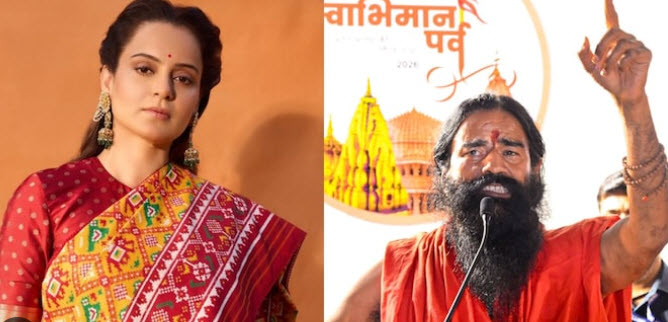
The Kangana Ranaut–Baba Ramdev quarrel was a classic case of a political-cultural argument acquiring a very personal edge — and then being rescued, rather neatly, by the symbolism of Raksha Bandhan.
The important point is that the truce was not brokered by a publicly identified political mediator. The available reporting indicates that Ramdev himself initiated the reconciliation, sending sweets and a Raksha Bandhan gift to Ranaut and announcing that he would also call her. Ranaut accepted the gesture and reciprocated by calling him her “elder brother”.
From Generation Gutter to Bade Bhai – How the Kangana-Ramdev reconciliation worked out following the initiative by the yoga guru.
It began, as many modern Indian controversies do, with an Instagram post — and ended with a box of sweets. For a few days in August, actor-turned-politician Kangana Ranaut and yoga guru and Patanjali founder Baba Ramdev appeared to be auditioning for an unlikely public feud. The argument began over Ranaut’s description of young protesters as “Generation Gutter” and quickly mutated into something considerably more personal: childhoods, youth, character, bedrooms and, inevitably, the Supreme Court.
Then came Raksha Bandhan. On August 28, Ramdev sent Ranaut sweets and a gift, calling her his sister and saying there should be no hatred or hostility. Disputes, he said, should be settled through dialogue. He also said he would telephone her to wish her on Raksha Bandhan.
Ranaut, whose political style is hardly famous for turning the other cheek, accepted. She described Ramdev as her “elder brother”, accepted his affection and sweets and said that festivals were meant for forgetting mistakes and forgiving. And just like that, the war of words was declared over.
How it all started. The original dispute had little to do with Ramdev. Ranaut had criticised young protesters associated with the CJP-led agitation in Delhi and used the phrase “Generation Gutter”. The language caused an uproar, with critics accusing her of tarring an entire generation with the same brush. Ranaut subsequently clarified that she was referring to particular people and behaviour rather than every member of Gen Z.
Ramdev entered the argument by objecting to the description. His criticism was pointed. He questioned Ranaut’s qualifications, childhood, youth and past record, and described the “generation gutter” formulation as evidence of a corrupted mind. He also suggested that her political party should take note of what she had said.
That was the spark. Ranaut’s response was vintage Kangana: personal, theatrical and armed with a flamethrower. She asked whether Ramdev had been “hanging in my bedroom like a bat” to know about her youth and private life. She accused him of relying on gossip and told him not to give her lessons about character.
Then she produced the heavy artillery: Patanjali. Ranaut reminded Ramdev of the Supreme Court proceedings concerning Patanjali’s misleading advertisements and medicinal claims. In 2024, the Supreme Court had indeed taken a serious view of Patanjali’s advertisements and its alleged violation of an undertaking not to make misleading medicinal claims or disparage modern medicine. Ramdev and Patanjali managing director Acharya Balkrishna eventually tendered an unconditional apology, and the contempt proceedings were subsequently closed after the court accepted their undertakings.
Ranaut’s argument, essentially, was: do not investigate my character when your own public record has already been examined by the country’s highest court. It was a spectacular escalation from a disagreement about Gen Z.
Two very different journeys to celebrity. The fascinating part of the quarrel is that Ranaut and Ramdev represent two very different versions of Indian celebrity.
Ranaut is the Bollywood outsider who became a political insider. She left home as a teenager to pursue acting and broke into Hindi cinema with Gangster in 2006. Fashion, Queen, Tanu Weds Manu Returns, Manikarnika and Panga established her as one of India’s most decorated actresses. She has won four National Film Awards and received the Padma Shri.
Her second act has been politics. She entered the Lok Sabha in 2024 from Mandi in Himachal Pradesh as a BJP candidate. Her political persona has been built around the same characteristic that powered her celebrity: an almost complete unwillingness to stay inside conventional boundaries.
Ramdev travelled the opposite road. He began as a yoga evangelist, turning television appearances and mass yoga camps into an enormous public following. Yoga became a platform; Ayurveda became a commercial proposition; and Patanjali became the business vehicle.
Founded in 2006, Patanjali grew into a formidable consumer-goods enterprise selling everything from food and personal-care products to Ayurvedic medicines. Ramdev’s influence consequently extended well beyond yoga — into business, politics, nationalism, traditional medicine and television.
The Supreme Court episode illustrates the other side of that enormous influence. In 2024, the court criticised Patanjali over misleading advertisements, including claims about medicinal efficacy, after the company had undertaken not to make such statements.
So when Ranaut invoked the Supreme Court, she was not inventing a controversy. She was weaponizing a real and well-documented episode from Ramdev’s public career.
Why did Ramdev back down? There is an important distinction between backing down and choosing to end a fight. Ramdev’s subsequent statements suggested the latter. After Ranaut’s attacks, he indicated that he did not want to continue commenting on the matter. He stressed his own public contribution and declined to prolong the exchange.
Then came Raksha Bandhan. Rather than issuing another rebuttal, Ramdev changed the register completely. He called Ranaut his sister, sent sweets and a gift and said disagreements should be resolved through dialogue rather than hostility.
It was clever diplomacy — but also culturally astute diplomacy. In India, Raksha Bandhan provided both men and women with an escape hatch from a quarrel without either side having to formally admit defeat. Ramdev did not have to say, “I was wrong.” Ranaut did not have to say, “You were right.”
They simply moved from combatants to siblings.
Was there a peacemaker? This is where the gossip columns should be resisted. There is currently no credible public evidence that a politician, BJP intermediary, Patanjali associate or mutual friend brokered the settlement.
The reporting points instead to a direct initiative from Ramdev: he announced the gesture publicly, sent the sweets and gift, and said he would telephone Ranaut. Ranaut then accepted the overture. In other words, the mediator appears to have been Raksha Bandhan itself — and Ramdev’s decision to use it as a diplomatic off-ramp.
The delicious irony; The episode says something about both personalities. Ranaut has built a career by refusing to retreat from confrontation. The same woman who fought Bollywood’s “nepotism” establishment and repeatedly turned personal controversies into political arguments was hardly going to accept criticism of her character quietly.
Ramdev, meanwhile, has spent decades cultivating an image of yoga, self-discipline and cultural nationalism, even while presiding over one of India’s most aggressive consumer brands. Their clash therefore became irresistible television: the Bollywood firebrand versus the yoga-business patriarch.
But the ending was much more Indian than the fight. No press conference. No negotiated settlement. No elaborate apology. Just sweets, a rakhi and the invocation of brotherhood. For once, social media’s favourite sport — the public feud — surrendered to an older Indian technology: “sab bhool-chook maaf.”
To put in plain english ” Forget 7 Forgive” became the common ground for both celebrities to broker a reconciliation as both were the kings and queens of their realm. Both successful image wise and both successful commercially and they both came under the Lotus brand of BJP party which they patronised and the party could ill afford a controversy between two combatants on home turf.
And if the two really do leave it there, the Kangana-Ramdev spat may ultimately be remembered less for “Generation Gutter” or the “bedroom bat” than for the remarkable speed with which two people accustomed to commanding headlines discovered that a box of sweets can sometimes accomplish what a hundred television debates cannot. (IPA Service)
Baba and Bollywood belle declare political truce