By Dr Arun Mitra
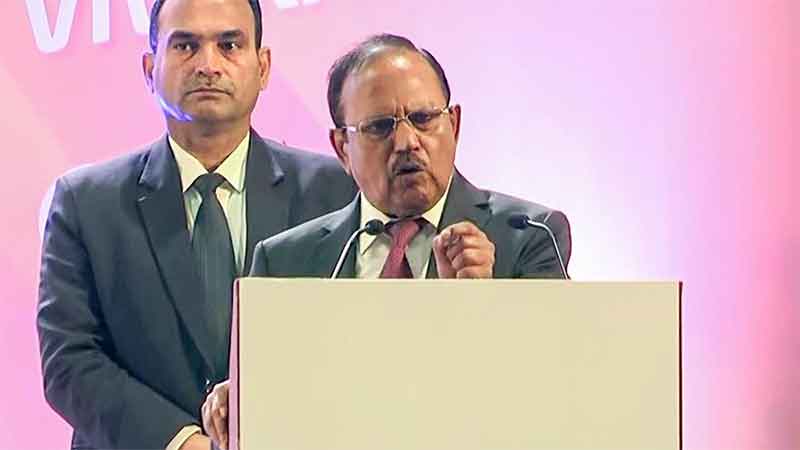
In a speech riddled with contradictions, National Security Advisor Ajit Doval has, in a subtle yet unmistakable manner, called upon the youth to embrace the idea of revenge. Addressing a gathering of nearly 3,000 young people at the Viksit Bharat Young Leaders Dialogue on 10 January 2026, he stated that although revenge is “not a good word,” it can nevertheless be “a huge force.” He urged the audience to avenge history and take the country to greatness once again—not only in terms of border security, but also in the economy, social development, and every other sphere.
Making a tacit reference to the Somnath Temple, he went on to say that India has suffered greatly in the past and must “avenge” a painful history of attacks and subjugation. He also emphasized the need for strong leadership, particularly highlighting Prime Minister Narendra Modi. To reinforce his argument, he quoted Napoleon: “I am not afraid of 1,000 lions led by a sheep, but I am afraid of 1,000 sheep led by a lion.” The implication was clear—projecting Narendra Modi as the lion leading a nation of 142 crore people.
He also said that we have never invaded others completely forgetting how an unprecedented number of people were killed in the Kalinga war by emperor Ashoka. He has also ignored how the Buddhist and Jain temples were destroyed and Hindu temples built on them. Moreover oppression in the name of caste is something unknown elsewhere in the world.
In a calculated move, Mr. Doval invoked the names of Mahatma Gandhi, Bhagat Singh, and Subhash Chandra Bose. Yet throughout his speech, he failed to utter a single word about their shared commitment to inclusiveness, justice, equality for marginalized sections, or gender parity.
His repeated emphasis on avenging wrongs committed a thousand years ago implicitly points toward Muslim invaders of medieval India. It is hardly coincidental that the very next day, Prime Minister Narendra Modi delivered a similar speech at the Somnath Temple, claiming that the glory of the temple has now been restored—despite the historical fact that it was fully rebuilt in 1951. It appears that while the Prime Minister chose the symbolic setting of the temple, the task of directly addressing the youth and planting the idea of revenge was deftly assigned to AjitDoval.
Notably, Mr. Doval failed to explain how revenge is to be taken, or against whom, given that Mahmud of Ghazni is long dead. He also ignored the historical reality that Ghazni’s campaigns were facilitated by the support of several Hindu kings of the time—without whose cooperation his army could not have survived due to shortages of essential supplies.
With a dangerous agenda unfolding, the RSS has now announced plans to hold Hindu Sammelans across the country. The RSS chief Mohan Bhagwat does not mince words when talking of Hindu Rashtra. Ajit Doval’s speech has been well approved by the think tank among the RSS and the BJP government.
The strategy is evident: seek revenge from generations born a thousand years after the events associated with the Somnath Temple, engineer communal riots, and push the nation toward chaos.
By now, we know all too well that violence has multifaceted consequences. Its effects begin even before physical incidents occur, manifesting as mental health crises. Physical impact on human health can soon be seen in the form of injury, disability and death. Economic activity and education programmes all too suffer badly. This, in turn, leads to crisis of nutrition and a rise in disease. Mistrust within society, further aggravates the crisis.
Internal conflicts weaken nations and can spill over into external tensions and even wars. War remains the gravest threat to public health. It has catastrophic effects on infrastructure and the environment and causes more deaths and disabilities than many major diseases combined. War destroys families, communities, and sometimes entire cultures, while diverting scarce resources away from healthcare and essential social needs.
It is therefore imperative that communal violence and external conflicts are avoided at all costs. This can only be achieved through sustained public education and the building of strong narratives rooted in peace, non-violence, social harmony, gender equality, and justice. Those at the helm of power must lead society forward and make the country great through inclusive development—not by preaching revenge and violence.
The world is much more interdependent today than it was 1000 years back. Internal chaos can have detrimental impact on international relations and economic development. The possibility of external forces in such situations always remains high. The idea of India as a secular, democratic socialist republic has to be saved and promoted through a united consistent effort. (IPA Service)