By R. Suryamurthy
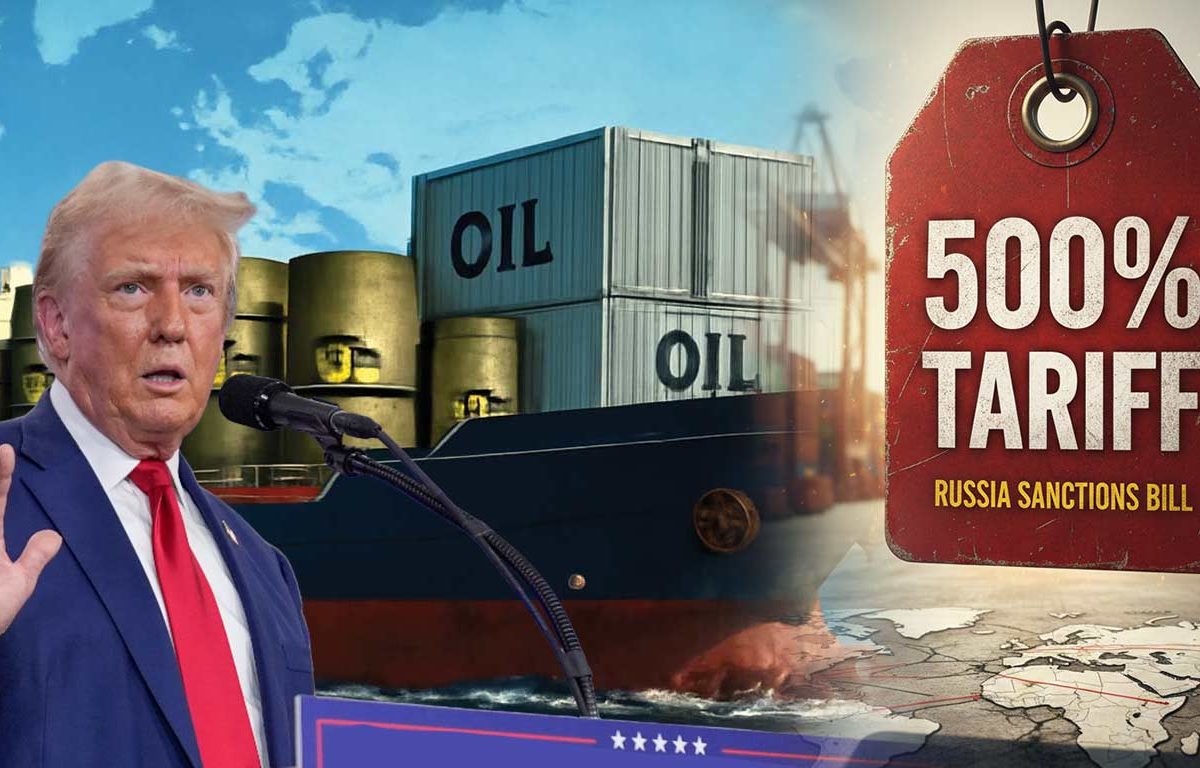
The threat from Washington to impose punitive tariffs of up to 500% on countries buying Russian crude is not just a foreign policy problem for India. It is a fiscal one. As New Delhi prepares the Union Budget for 2026–27, the shadow cast by the proposed Sanctioning Russia Act of 2025 falls squarely on the assumptions that underpin India’s budget arithmetic — oil prices, inflation, subsidies, the current account deficit and, ultimately, fiscal credibility. This is what makes the moment unusually fraught. Budgets are built on expectations of stability. The US tariff threat injects instability precisely where India is most exposed: energy.
For the last three years, discounted Russian oil has functioned as an invisible shock absorber in India’s macroeconomic framework. It helped contain the oil import bill when global prices surged after Russia’s invasion of Ukraine. It reduced pressure on fuel subsidies, allowed the government to avoid politically costly pump-price hikes, and kept food inflation from spiralling via lower fertiliser and transport costs. These effects never appeared as a neat line item in the Budget, but they quietly supported everything from deficit targets to consumption demand. Washington is now effectively telling India that this stabiliser must be dismantled — or else.
The proposed 500% tariff on Indian exports is not diplomacy by any conventional definition. It is economic coercion, openly deployed against a country the US simultaneously describes as a strategic partner. The message is blunt: align your energy policy with American geopolitical priorities, or pay a crippling price in trade. For Budget 2026–27, the implications are stark.
India imports close to 85% of its crude oil needs. In recent years, Russian crude has accounted for roughly 35–40% of those imports. The appeal was simple: price. In the immediate aftermath of Western sanctions, Russian oil was available at discounts of $10–20 a barrel. Even after logistics and blending costs, India saved billions of dollars at a time when Brent crude was flirting with triple digits.
Those savings mattered. A $10 per barrel increase in crude prices typically widens India’s current account deficit by around 0.4–0.6% of GDP and pushes up inflation meaningfully. Conversely, cheaper oil narrows the CAD, stabilises the rupee and gives the finance ministry breathing room. During the worst of the post-pandemic and post-war volatility, Russian oil helped prevent exactly the kind of macro slippage that derails budgets.
By late 2025, discounts had narrowed and global prices had softened, reducing the immediate fiscal gains from Russian crude. But that does not mean Russian oil has become irrelevant. Its real value now lies in optionality. It keeps India’s supplier base diversified and strengthens bargaining power with West Asian producers. That, in turn, anchors price expectations — a critical input into budget planning. Remove that option under duress, and the budget’s risk profile changes dramatically.
A 500% tariff on Indian exports to the US would be economically catastrophic. The United States is India’s largest trading partner, with bilateral trade in goods and services exceeding $130 billion and a surplus of over $40 billion in India’s favour. Pharmaceuticals, IT services, engineering goods, textiles and gems would all be hit.
From a budgetary perspective, this is not just an export story. Export disruption feeds into lower growth, weaker tax buoyancy and higher pressure on welfare spending. Slower growth means lower GST and income tax collections. Job losses in labour-intensive export sectors mean higher political and fiscal demands for support. In other words, the tariff threat carries second-order fiscal costs that go well beyond customs data.
More subtly, the threat interacts dangerously with oil. If India complies with US pressure and sharply cuts Russian imports, it exposes itself to higher crude prices just as it risks losing export revenue. That is a classic twin-deficit problem in the making: a wider current account deficit from costlier oil and a wider fiscal deficit from slower growth and higher spending.
Budget 2026–27, which many expect to chart a narrow path between sustaining capital expenditure and tightening the fiscal stance, has little room for such shocks.
Fuel inflation is not an abstract variable in India’s budget calculus. It is political dynamite. Higher crude prices feed quickly into diesel and LPG costs, transport fares, food prices and rural distress. When pump prices rise sharply, governments face an unenviable choice: absorb the shock through subsidies and excise cuts, or pass it on to consumers and risk backlash.
The last time oil prices spiked sharply, the government froze retail fuel prices and later compensated oil marketing companies through budgetary support. That episode alone cost thousands of crores. Budget 2026–27 cannot assume that such interventions will not be needed again if energy costs rise under external pressure.
The irony is that current global oil prices are relatively benign. Brent crude has hovered in the $60–65 per barrel range, offering India temporary relief. But budgets are not written for today’s prices; they are written for volatility. The removal of Russian oil as a flexible, discounted supply source increases India’s exposure to that volatility — especially if geopolitical tensions in West Asia or OPEC+ supply decisions tighten markets again. In that scenario, the fiscal arithmetic deteriorates quickly.
Supporters of the US legislation argue that this is a moral imperative: Russian oil revenues must be cut off to weaken Moscow’s war machine. That argument would carry more weight if applied consistently. European countries continue to import significant volumes of Russian LNG, paying billions of euros even as they advocate sanctions discipline. Energy dependence, it seems, is realism in Europe and moral failure elsewhere.
For India, this double standard collides with budget realism. Strategic autonomy is not an abstract slogan in the finance ministry; it is embedded in the ability to make independent choices that protect growth, inflation and fiscal stability. When those choices are constrained by external threats, budgets become hostage to geopolitics.
Recent data suggests New Delhi is already attempting to manage this tension. Russian oil imports fell sharply in December 2025 to a three-year low. This appears less like a strategic pivot and more like tactical signalling — a way to buy time, lower temperatures and avoid immediate confrontation. But time bought under threat is not policy space. It is borrowed vulnerability.
If the tariff threat becomes more than rhetoric, Budget 2026–27 will have to respond in three broad ways. First, it will need larger buffers. That could mean more conservative oil price assumptions, higher contingency provisions and less aggressive deficit consolidation. All of these dilute fiscal ambition.
Second, it will have to accelerate spending that reduces energy vulnerability: strategic petroleum reserves, domestic exploration incentives and faster rollout of renewables, electric mobility and green hydrogen. These are often framed as climate or industrial policies. In reality, they are fiscal risk-management tools. Every megawatt of domestic energy capacity reduces exposure to external coercion.
Third, trade diversification will move from aspiration to necessity. Over-reliance on the US market becomes a fiscal risk when tariffs are wielded as weapons. That has implications for export incentives, trade agreements and diplomatic capital — all of which feed back into budget priorities. None of this is cost-free. It forces hard trade-offs in a budget that is already operating in a narrow corridor.
Ultimately, this episode is not just about Russian oil or American tariffs. It is about whether India’s budget — the most concrete expression of economic sovereignty — can be written without external vetoes.
If energy choices can be punished with 500% tariffs, the logic will not stop there. Other policy domains will follow. Digital taxes, data rules, industrial subsidies and defence procurement all become negotiable under threat. In such a world, fiscal planning becomes an exercise in managing pressure rather than pursuing strategy.
For now, the tariff remains a threat, not law. The bill still has to clear Congress, and enforcement would depend on presidential discretion. But the signal is already loud and unmistakable. Trade is no longer just about markets. It is about discipline.
As Finance Minister Nirmala Sitharaman prepares Budget 2026–27, she is not just balancing growth and deficit targets. She is budgeting under the shadow of a tariff gun. How India responds — whether by accommodation, resistance or structural insulation — will shape not just the numbers in the budget speech, but the degree of economic sovereignty those numbers truly represent. (IPA Service)