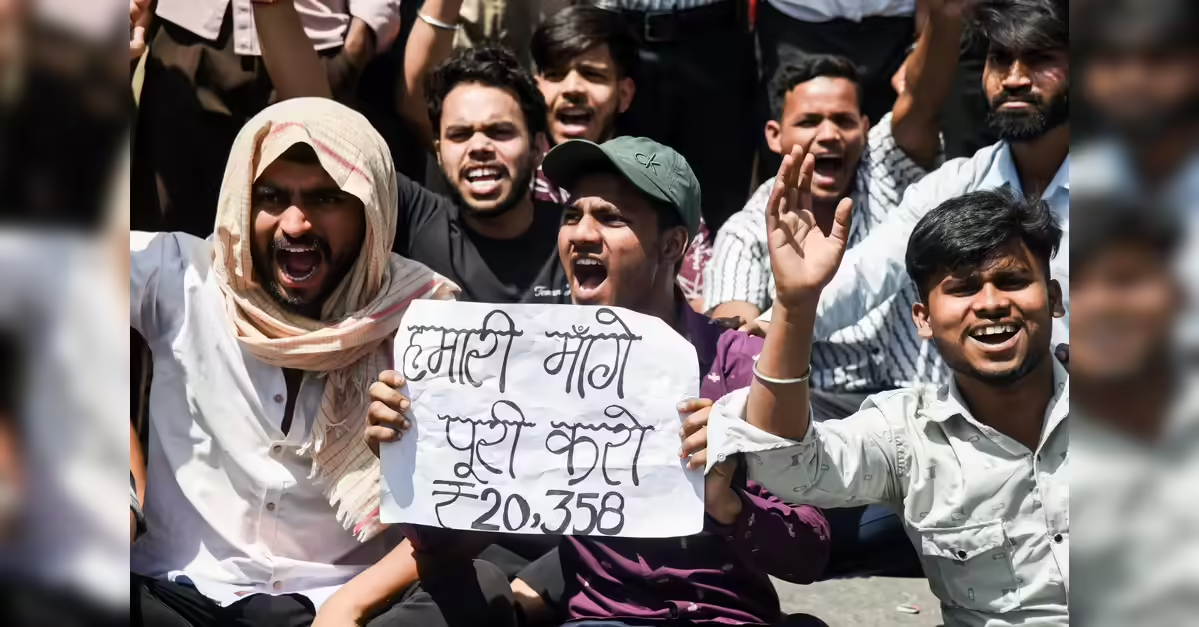
Uttar Pradesh has revised minimum wages for workers across categories after unrest in Noida spilled into violence, with the new rates taking effect from April 1 following approval late on Monday night, according to district and state officials. The move marks a swift policy response after factory workers in Gautam Buddh Nagar pressed for higher pay and better conditions, bringing one of the National Capital Region’s biggest industrial belts under sharp scrutiny.
District Magistrate Medha Roopam said the revised structure was finalised by a high-level committee and cleared by Chief Minister Yogi Adityanath. Under the updated wage schedule, unskilled workers in Gautam Buddh Nagar and Ghaziabad will receive Rs 13,690 a month, up from Rs 11,313. Semi-skilled workers will be paid Rs 15,059, while skilled workers will receive Rs 16,868. In other municipal corporation areas, the monthly rates have been set at Rs 13,006 for unskilled workers, Rs 14,306 for semi-skilled workers and Rs 16,025 for skilled workers. For the remaining districts, the new wages are Rs 12,356, Rs 13,591 and Rs 15,224 respectively.
The decision followed days of mounting tension in Noida’s industrial clusters, where workers had been demanding a wage revision and stricter enforcement of labour protections. On Monday, protests turned violent in parts of the city, with police using tear gas and what they described as minimum force after vehicles were torched and stones were thrown. Reuters reported that the agitation had entered its fourth day by April 13, underlining the depth of anger among workers in a township that hosts thousands of industrial units.
At the centre of the dispute was not only the wage rate itself but the broader question of working conditions in the manufacturing belt. Workers interviewed during the protests spoke of fixed duty hours, overtime compensation and compliance with labour rules as key demands. That suggests the state’s intervention is as much about restoring order as it is about trying to stabilise industrial relations in a zone that is crucial to production, logistics and employment around Delhi.
The timing also matters. The Noida agitation gathered pace after workers compared pay levels in Uttar Pradesh with those in neighbouring Haryana, where a sharp increase in minimum wages added to pressure on employers elsewhere in the region. That comparison appears to have sharpened grievances in Gautam Buddh Nagar, where living costs, commuting expenses and rent have risen faster than many workers’ earnings. The gap with nearby industrial centres became a rallying point, especially for migrants employed in hosiery, auto-component, electronics and ancillary units.
The state government has tried to frame the new wage order as a balancing act between workers’ needs and the strains facing industry. According to the official position carried by local media, the administration reviewed suggestions and objections from employers’ bodies and labour organisations before settling on what it called a balanced and practical outcome. That language signals an attempt to avoid alienating manufacturers already contending with softer exports, costlier inputs and uneven demand, while acknowledging that workers’ complaints could no longer be brushed aside.
For businesses in Noida and Ghaziabad, the revision will raise labour costs at a time when competitiveness is under pressure across several sectors. Yet the alternative carried its own price. Continued disruption in a dense industrial corridor risked production losses, damaged property, interrupted freight movement and wider investor concern over labour stability. Monday’s violence showed how quickly a wage dispute can become a law-and-order problem when frustration hardens and negotiations fail to keep pace with events on the ground.
For workers, the new rates amount to a tangible gain, though not necessarily the end of the matter. Protesters had been seeking a steeper increase, and some local accounts indicated demands for monthly pay closer to Rs 18,000 to Rs 20,000. Whether the administration’s decision cools tempers may depend on what happens next inside factories: timely wage payment, bonus practices, overtime calculation, safety standards and grievance handling are likely to be watched just as closely as the revised pay slips.