By Satyaki Chakraborty
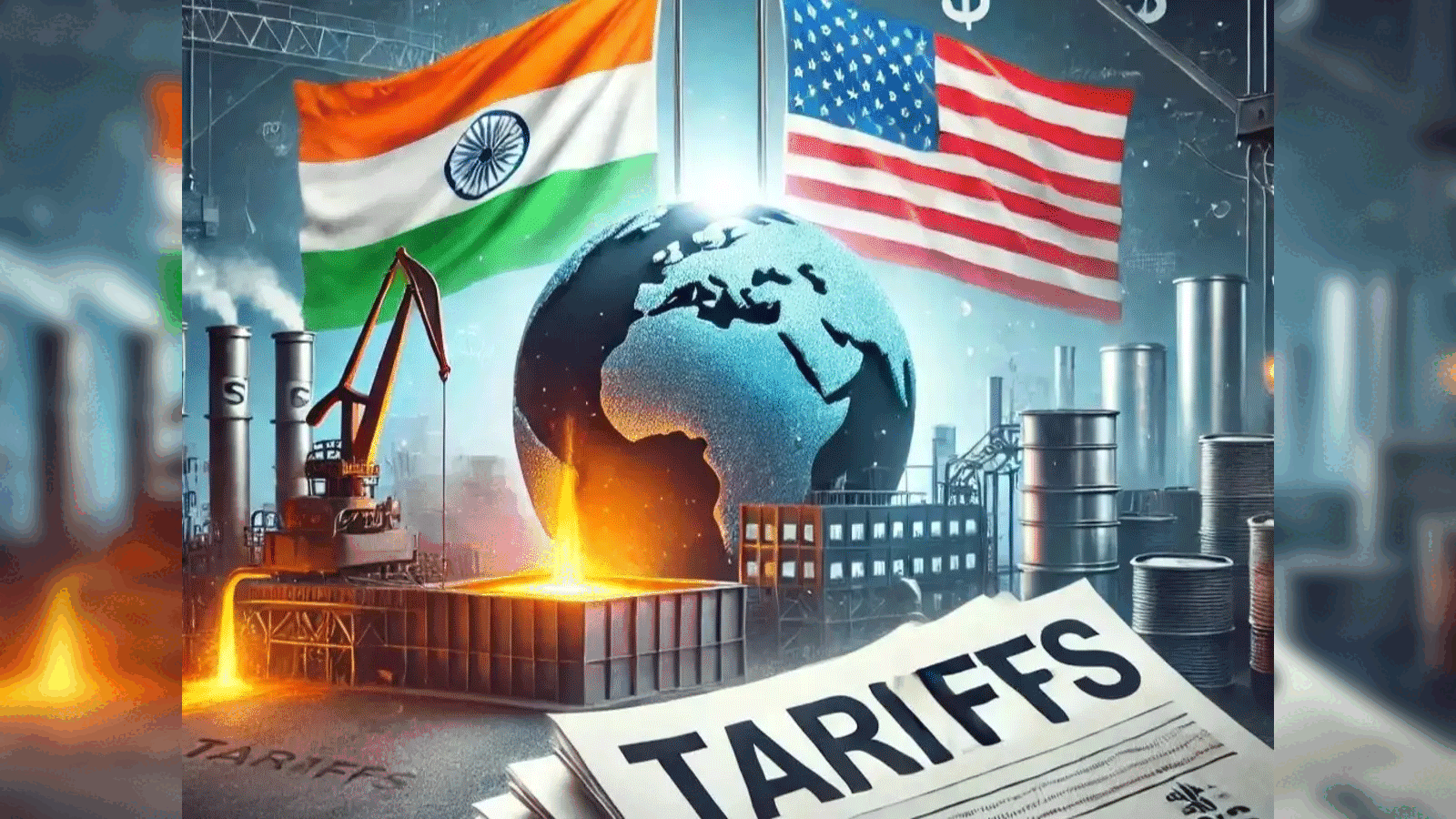
NEW DELHI: India will maintain its growth momentum in 2026 defying the uncertainty in global economy over the impact of the U.S. tariff rates. The GDP growth projected at 7.4 per cent in 2025 will be at the level of 6.6 per cent in 2026 showing resilient public spending, strong public investment and lower interest rates, says a report of the United Nations on World Economic Outlook 2026 released on Thursday
According to the Report, Global output is forecast to grow by 2.7 per cent in 2026, slightly below the 2.8 per cent estimated for 2025 and well below the pre-pandemic average of 3.2 per cent. During 2025, unexpected resilience to sharp increases in U.S. tariffs, supported by solid consumer spending and easing inflation, helped sustain growth. However, underlying weaknesses persist. Subdued investment and limited fiscal space are weighing on economic activity, raising the prospect that the world economy could settle into a persistently slower growth path than in the pre-pandemic era.
“A combination of economic, geopolitical and technological tensions is reshaping the global landscape, generating new economic uncertainty and social vulnerabilities,” said United Nations Secretary General António Guterres. “Many developing economies continue to struggle and, as a result, progress towards the Sustainable Development Goals remains distant for much of the world.”
East Asia’s growth is expected to moderate in the near term. During the first three quarters of 2025, front-loading of shipments ahead of U.S. tariffs boosted exports, while private consumption was supported by steady labour markets and ongoing disinflation. Looking ahead, the temporary boost from front-loading will fade, but domestic demand is expected to remain resilient, underpinned by supportive monetary and fiscal measures. Regional headline inflation is projected at 1.1 per cent in 2026, edging up from an estimated 0.5 per cent in 2025.
China’s economy is projected to expand by 4.6 per cent in 2026 and 4.5 per cent in 2027, following estimated growth of 4.9 per cent in 2025. A temporary easing of trade tensions with the United States—including targeted tariff reductions and a one-year trade truce—has helped stabilise business confidence. Meanwhile, supportive monetary and fiscal policies are expected to sustain domestic demand and cushion external headwinds.
South Asia’s economic outlook remains robust, largely due to strong private consumption and public investment. Inflation across the region declined markedly in 2025, with rates in most economies at or below central bank targets and long-term averages. Average consumer price inflation is projected to edge up from an estimated 8.3 per cent in 2025 to 8.7 per cent in 2026, ranging from 3.2 per cent in Nepal and 4.1 per cent in India to 35.4 per cent in the Islamic Republic of Iran.
The Report mentions that risks to the outlook for East and South Asia remain tilted to the downside. Trade policy uncertainty is a key near-term risk, even though recent U.S. tariff increases on Asian economies were smaller than initially anticipated and some trade agreements have been reached. A slowdown in major economies—including China, the European Union, and the United States—could further weigh on regional merchandise trade, investment flows, and tourism activity.
Another important downside risk relates to fragile fiscal positions in several economies, where high public debt limits policy space. In South Asia, in particular, elevated government debt constrains the ability to provide countercyclical support and respond effectively to external shocks.
Most central banks across East and South Asia eased monetary policy in 2025 as inflation declined and the U.S. Federal Reserve lowered interest rates. Monetary easing is expected to continue in 2026, though the pace and extent will vary across countries.
Fiscal policy trajectories diverge between the two regions. In East Asia, many governments adopted a more expansionary stance in 2025, rolling out measures to support household consumption, protect vulnerable groups, and accelerate infrastructure investment. In contrast, South Asian economies remain focused on fiscal consolidation and structural reforms aimed at strengthening public finances and safeguarding macroeconomic stability.
Against a backdrop of trade policy uncertainty, Asian economies are pursuing regional integration through initiatives such as the Regional Comprehensive Economic Partnership (RCEP), a free trade agreement between 15 countries. At the national level, Governments are prioritizing infrastructure upgrades, advancing digitalization, and modernizing manufacturing to enhance competitiveness and resilience.
The Report underscores that navigating an era of trade realignments, persistent price pressures, and climate-related shocks will demand deeper global coordination and decisive collective action at a time when geopolitical tensions are rising, policies are becoming more inward-looking, and impetus towards multilateral solutions is weakening. Sustained progress will depend on rebuilding trust, strengthening predictability, and renewing the commitment to an open, rules-based multilateral trading system.
The Sevilla Commitment, the outcome document of the Fourth International Conference on Financing for Development, offers a forward-looking blueprint to strengthen multilateral cooperation, reform the international financial architecture, and scale up development finance. Delivering on its key priorities— including clearer debt workout modalities and expanded concessional and climate finance—is essential to reducing systemic risks and fostering a more stable and equitable global economy. (IPA Service)