By Dr. Soma Marla
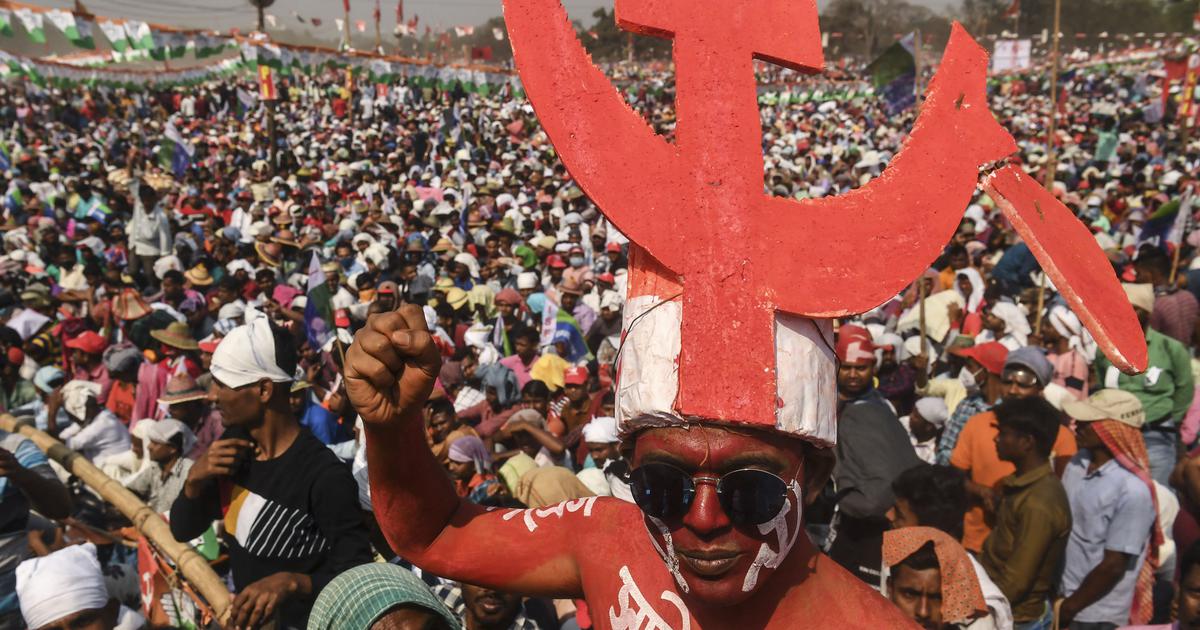
The communist movement in India is now a century old. Soon after independence, although, farmers and workers played an active role in freedom struggle, their aspirations were not addressed by the ruling classes. The Communist party took the task of organizing the workers, poor farmers, agricultural labourers and common people and waged militant struggles for their rights.
Universal adult franchise alone was not sufficient for democracy. Democracy required an end to economic and social inequalities based on class exploitation and social oppression. Without economic and social equality, democracy in India in Dr Ambedkar’s words is “only top dressing on soil which essentially is undemocratic.” Workers faced severe exploitation, low wages with absolutely no trade union rights. In villages, poor are subjected to harsh feudal oppression as the government failed to solve the land question.
Despite our constitutional guaranteed rights to equality and free speech, issues like dalit rights, minority protection, press freedom, and addressing socio-economic disparities remained unmet challenges. Common people suffered due lack of access to food, education, health and other basic necessities. Dalits, adivasis, women and minorities were discriminated. For the communist party, key task is completion of democratic revolution which remained unfulfilled at the time of dependence. Hence, the democratic transformation of society had political, economic and social dimensions.
In the post-independence period, Communist Party relentlessly led rights struggles, to widen and deepen democracy, constrained and distorted by ruling classes. Waged struggles include land reforms, basic rights of workers, right to food (against rising prices), right to information, right to work for rural poor, forest rights and other demands.
For the Communist Party, land reforms became the basic slogan to weaken landlordism and to usher in a democratic transformation in agrarian relations. Militant peasant uprisings in Telangana, Tebhaga, Punnapra-Vayalar had shaken the foundations of feudal system. Land occupation struggles from Karnataka, A.P to Gaya brought land reforms, a major agenda before ruling governments. Militant battles led by AITUC organizing textile, jute, steel, railways, port, banks and other sectors helped to achieve certain basic trade union rights through acts on wage revision, industrial disputes, pension and other benefits. Redoubled efforts to organise ASHA, women domestic workers, GIG and contractual, unorganized sectors are coming to fruition. Struggles for integration of Goa, Pondicherry in Indian Union, linguistic states and others contributed towards strengthening federalism and national unity. This article mainly focuses on rights, struggle to achieve Rural Employment Scheme, Right to food, information and forest rights.
Three and a half decades back in 1991, India formally entered the neoliberal era, and the power of the capitalists increased with sale of public assets at throwaway prices and dilution of labour rights. The struggle entered a new epoch, in which defending the previously gained rights became the primary task. With increased inequalities in income in the population, fight for rights and struggle for work, food, health, education and forest rights came to the forefront.
Deepening agricultural crisis forced small, marginal and tenant farmers to increasingly join the ranks of wage labourers to fend for their families. Nearly 44 percent land is owned by a mere 13 percent of rich and medium farmers owning 8 to 10 acres and above. While small and marginal farmers constitute 86 percent of farming community and landless poor (constituting 55 percent of rural population) own absolutely no land. That means nearly 66.5 percent population (2024 estimates) living in villages has to fend with mere 15 percent of national GDP. Nevertheless, of the total wealth created in villages, mere 9 percent is reaching landless poor and marginal farmers. Rest is pocketed by traders, petroleum, fertilizer, pesticides corporations and rich farmers. Increase of farm machines, use of chemical weed killers and rise in cultivation of horticultural crops, mean work days shrunken to 100 to 120 in villages. Decreased incomes due to no work further intensified rural distress. Communist party in the past led many struggles for rise of wages for agricultural workers. But within introduction of contract work payment mode, agricultural worker wages did not rise either. To lessen the distress and provide some relief it was necessary to provide extra employment and provide succour to rural poor.
As a result of longstanding struggles of Communists outside and inside Parliament, the then UPA government in 2005, enacted the rural employment scheme, Mahatma Gandhi National Rural Employment Guarantee scheme. The enacted law guarantees a minimum 100 days of employment to those poor having job cards in villages. This scheme had, to a considerable extent, provided certain financial relief to the rural poor and significantly increased demand for industrial consumer goods. However, in the last one decade of BJP rule in centre, the number of work days had fallen significantly thus alleviating rural distress. Due to decrease in funds and delays in its allocation in many states like West Bengal and Madhya Pradesh, the scheme almost came to a standstill. Recently, the Union government even repurposed the scheme to call it Vikasit Bharat Guarantee for Rozgar and Ajeevika Mission Grameen (VBGRAM G, 2025), and it increased the mean working days to 125 in an year, it changed the expenditure share between centre and state governments from 90:10 to 40:60, thus burdening the states. The Communist Party has been fighting against neglect of the MGNREGA, demanding wage increase and tallying up the number of guaranteed work days to 150 per year.
India produced 36.0 crore tons of food grains in2025 and ranks first globally in milk production with 24.0 crore litres. Yet hunger and malnutrition remain high, occupying 102th rank among 123 countries measured globally. Irony is, while the nation produces surplus food, due to lack of purchasing power hunger persists.CPI has been waging struggles against high food prices, provision of subsidized food to the population through Public Distribution System(PDS),leading campaigns to curb black marketing of food items, procurement of food grains at MSP from farmers and provision of subsidised food through PDS. CPI has organized nationwide struggles, collected signatures and mobilizing lakhs of people to Parliament in Delhi, whether it’s in the mid-sixties, late-seventies, mid-eighties, or the present moment, protesting against rising prices. One such noteworthy struggle has been the massive countrywide “de-hoarding” campaign, where illegally hoarded food and essential commodities in black markets were brought out of godowns and sold to common people at reasonable prices. As a result of mass struggles demanding nationalisation of wholesale food trade, establishment of Food Corporation of India, the poor got access to subsidised food sold in PDS outlets across the country. It provided some relief to the poor.
However, in mid 80’s, due to large-scale privatization of industry and trade, major industrial houses entered the wholesale food and export trade as part of initiated neoliberal economic policies. Also prices of food items soared steeply. Hunger rose and access to nutrient food fell several folds. In this background, the CPI organized grass roots campaigns across the nation demanding widening of PDS and supply of subsidised food. As a result of mass struggles led by communists and civil society groups, the then National Advisory Committee of the UPA government enacted the National Food Security Act, 2013 (Right to Food Act) in the Parliament. The act aimed to provide subsidized food grains to approximately two-thirds of India’s then 1.2 billion people (75 percent of the rural population and 50percentof the urban population), at highly subsidized prices of Rs 3/kg for rice, Rs 2/kg for wheat, and Rs 1/kg for coarse grains. Corner stone of this act is the life-cycle approach, including universal nutritional support and maternity entitlements for pregnant women and lactating mothers. Comrades Gurudas Dasgupta and D Raja actively participated in discussions and played key roles in widening the access to subsidised food and nutrient food to pregnant women through the life-cycle mode.
However, soon after assuming power, the Narendra Modi government has narrowed the universal coverage and watered down several provisions such as food quantity, nutrient life cycle to young pregnant women, among other rights. The BJP government has withdrawn important aspects of National Food Security Act (NFSA) to families covered under the Public Distribution System (PDS) and renamed the scheme as Pradhan Mantri Garib Kalyan Anna Yojana, where only 5 kg of free food grains are given to each family. The coverage has shrunk from 120 crores to nearly 80 crores of population. Also provisions for vegetable oils, pulses, nutrients for citizens and young pregnant women were withdrawn. These changes were deemed regressive which defeated the spirit of Food Security Act.
Large sums of funds from public exchequer are routinely invested on implementation of various projects and schemes. However, there is the dominant culture of executive secrecy regarding corruption, mismanagement and resolute denial of access of information to the citizens. Grassroots struggles led by CPI and civil society groups mobilizing the poor for the right to information, to combat rampant corruption in execution of projects and schemes. The demand for a law to guarantee the right to information, accountable governance and people empowerment to every citizen with transparency gained widespread support from social activists, professionals, lawyers, and various civic groups. The draft of RTI act was prepared with active consultation with the late communist leader A.B. Bardhan. RTI act 2005, was enacted in Parliament after active involvement of communist members of Parliament and other leaders. The act was rooted in Article 19 (1)(A)(freedom of speech) of the Constitution.
The Right to Information (RTI) Act, 2005, in the initial phase, empowered citizens to access information and helped reduce corruption, bringing in accountability. However, after the exit of communists from the then UPA government and especially under the rule of the current BJP government, the administration became reluctant and scared about disclosing information under RTI Act, and watered down several important sections (citing secrecy clause). The ham-handed implementation of the act has defeated the very democratic spirit of its conception. The Communist Party has consistently fought for fulsome implementation of the RTI Act to provide full access to information with transparency and accountability.
Indian forests are home to nearly 20 crore people, who are directly dependent on forests for primary livelihood and while around 10 crore people live on land classified as forests. In short, Adivasis living in our forests are the true custodians of the biological forest resources and biodiversity.
Yet, they do not have legal rights to own land and settle in forests. Colonial Britain in 1878 introduced a draconian forest act, which denied land rights and drove away tribals from forests. Britain had plundered enormous quantities of timber and forest wealth in colonised India to export home. Legendary tribal revolts led by Birsa Munda, Seetarama Raju and Komaram Bhim are examples of sustained Adivasi rebellions against colonial oppression. As a result of rampant deforestation during the colonial era, India had lost estimated nearly 40 percent of forest area between 1810 and 1950. After gaining independence, successive governments continued the draconian colonial forest laws, and tried to drive away tribals from forests.
The Communist Party had been waging Jameen-Jal-Jungle struggles in Jharkhand, Assam, Manipur, Chhattisgarh, Odisha, among other states, demanding land rights, health, education and other rights. The CPI has been fighting against eviction of tribals and unjust allocation of forests to corporates for mining, tourism and other activities. Communists have organized militant struggles against POSCO, iron mining project in Odisha, bauxite mining leases in Andhra Pradesh, as well as mining rights to Adani enterprises in Jharkhand and Chhattisgarh. Continuing the struggle, communist MPs in Parliament succeeded in getting the Forest Rights Act enacted in 2006. Primarily Forest Regulation Act 2006 that was brought in by the then UPA government undid the historical injustice mooted to Adivasis from the colonial Indian Forest Act of 1878, and empower them. The draconian anti-tribal colonial act of 1878 was repealed. Active participation of communist MPs, such as D Raja and the late Gurudas Dasgupta, helped to guarantee land rights and forest produce rights to tribal people. Section 4(5) of the Act ensures, along with land, rights for self-cultivation and habitation, pastoral, community rights as grazing, fishing and access to water bodies as well as access to biodiversity in forests.
However, the present BJP led government introduced amendments to Forest Rights Act, 2006, did quite the opposite by subverting the interests of tribal people to benefit big companies. The modified 2022 Forests Act denied land rights to forest dwellers, in the name of ‘ease of doing business’ and permitted the corporates free access (including reserve forests) for mining, tourism and other pharmaceutical activities. Even the powers of Gram Sabhas are replaced for approval for allotment of forest lands to corporates for mining and other non-forest related activities. The Communist Party has been waging struggles against these draconian, anti Adivasi amendments made in the Forest Act 2022.
With the implementation of neoliberal reforms, parliamentary democracy became more of a playground for big business, the rural rich and predatory capitalist elements. We are witnessing a wholesale rejection of genuine rights of people, and continued subversion of constitutional and democratic institutions. The most significant contribution of the Communist Party has been bringing in a shift from a welfare-based approach to a rights-based approach to legal entitlements waging struggles for rights to access to food a legal entitlement for citizens a to forefront. However, we are seeing a wholesale erosion of those very hard-won rights under the decade-long rule of the Narendra Modi government. (IPA Service)
Courtesy: New Age