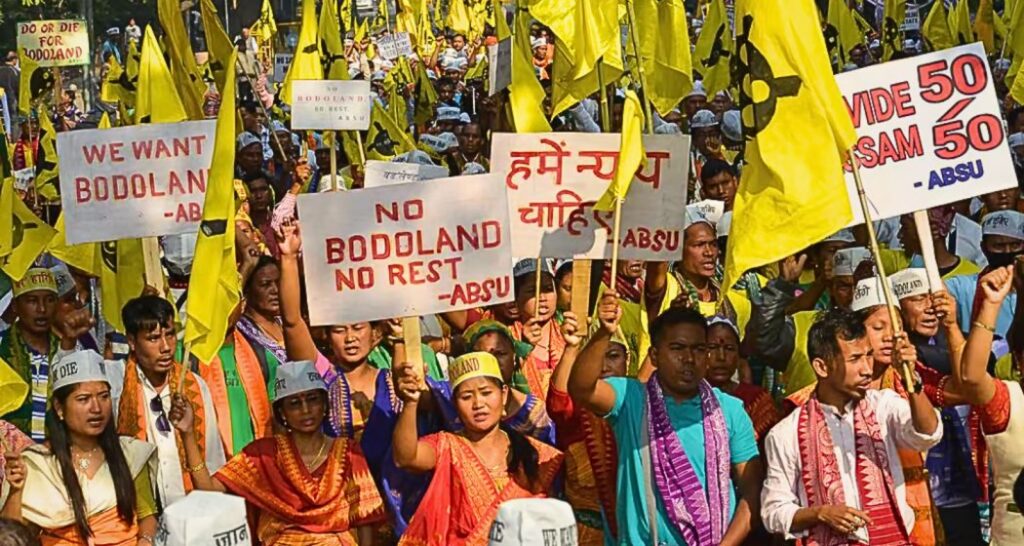
By Rabindra Nath Sinha
KOLKATA: Whether the Bodo Movement Groups (BMGs) will press ahead with the in-principle decision to organize a mass gathering of two lakh people at Kokrajhar in the near future in support of their five-year-old demand for more powers and more elected representatives — will hinge on how fast New Delhi acts to get the 125th (Constitution) Amendment Bill, 2019 passed by Parliament. The demands derive from the Sixth Schedule of the Constitution and the Articles involved are 280 and 275 (1) (a). Article 280 relates to Finance Commission and Article 275 (1) (a) deals with grants – capital and recurring – from the Union to certain states. The scheduled areas in Assam is specifically mentioned.
More importantly, BMGs want direct transfer of central funds to the Bodo Territorial Council (BTC), against the existing arrangement of New Delhi routing funds through the Assam government. The second demand is for transfer of additional subjects; for example, total authority for rural electrification. The third demand, political in character, is for enhancing the number of elected BTC members up to 60, from the existing 40 [Governor nominates six members, which takes the House strength to 46]. BMGs also want powers to form village councils and municipal councils within BTC’s command area, which suggests they are seeking to deepen their influence at the grassroots level and involve a much larger number of the tribe population with the political, social and cultural aspects.
Talks by this correspondent with All Bodo Students’ Union [ABSU formed on February 15, 1967] president Dipen Boro, outfit’s general secretary Khanindra Basumatary and United Boro People’s Organisation general secretary Pitambar Brahma suggested that the Bodos want New Delhi to expedite their decision-making process in regard to the pending 125th Amendment Bill. Their impatience now borders on frustration because the Union government had assured them to see the matter through for implementation “before 2026”.However, dithering on New Delhi’s part is compelling them to think in terms of a mass gathering programme and prepare the ground for more intensive and extensive agitations. According to information available, the Amendment Bill was introduced in Rajya Sabha by then home minister Rajnath Singh on February 6, 2019. It was referred to the standing committee on home affairs, where members expressed concern over land acquisition and financial devolution. Partly contributing to the impasse was the protracted dialogue that preceded the signing of the third Bodo Peace Accord on January 27, 2020. The approaching Assam Assembly elections may prolong the impasse, apprehend BMGs which currently include, apart from ABSU and UBPO, Ex-National Democratic Front of Bodoland Welfare Association (Ex-NDFB WA). The militant outfits had undergone a further process of regrouping and assumed this nomenclature. As the third peace deal facilitated a congenial atmosphere, the majority of the ultra units disbanded themselves. But, release of convicted members from jails and withdrawal of remaining cases are still pending, the former militants formed Ex-NDFB WA to pursue the matter.
From information in public domain, it is seen that the agitation for an administrative arrangement that vested the areas in Assam inhabited predominantly by the Bodo tribals had been gaining momentum and often turning violent around the end of 1980s and beginning of the 1990s.Those spearheading the agitation, which was also a separate jurisdictional identity, included a large number of militants who had succeeded in forming outfits of their own. The Union government’s efforts to diffuse the situation and persuade the Bodos to accept a visible measure of autonomy in administrative matters but within the state of Assam culminated in the first Bodo Accord on February 20, 1993 on the formation of a Bodoland Autonomous Council (BAC), the signatories to which were New Delhi, the Assam government, ABSU and the Bodo People’s Action Council. The last two sides represented the agitationists.
As differences persisted and many issues had to be sorted out, there was delay in legislating the BAC bill. Finally, the legislative exercise was completed and BAC took shape on December 17, 1993. With the passage of time, the Bodos found from their experience that the autonomy was grossly inadequate. The movement organisers continuously pressed for more powers, administrative and financial. This phase culminated in the second Bodo Peace Accord on February 10, 2003 among the Union government, the Assam government and the militants’ outfit, by then renamed as Bodo Liberation Tiger Force. The administrative establishment was rechristened as BTC. The original name BAC was given up. BTC became functional on December 5, 2003 and a new phase began.
The movement organisers, which gradually came to be referred to as BMGs, carried on with the new arrangement for a long time ; but really never gave up their demand for a territorial identity, outside the Assam government’s authority. Intensified movements for greater authority and autonomy in keeping with the spirit of the Sixth Schedule of the Constitution became a regular feature for several years. New Delhi decided to engage in fresh negotiations with BMGs, involving the Assam government. The protracted three-side exercise came to an end with the formalisation of the third Bodo Peace Accord on January 27, 2020. The area under BTC, which was called Bodoland Territorial Area District, was renamed as Bodoland Territorial Region. The 1993 agreement had provision for 40 elected members, including 30 seats reserved for STs. BTC has provision for 40 elected members, but the Governor is empowered to nominate six members. Which means a total of 46. Contiguous districts under BTC’s fold are Kokrajhar, Baksa, Chirang, Udalguri and Tamulpur; the last was a later addition when the state government raised the number of districts. The land area under BTC is 8970 sq km, 11 per cent of Assam’s land area of 78438 sq km. The BTC area population is estimated at five lakh plus. Out of Assam’s total Assembly strength of 126 members, the BTC area has three seats. (IPA Service)
 BlueBird Block-2 Launch: India’s Heavy-Lift Moment Is Beyond Space