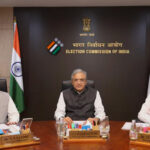
The Supreme Court challenged whether the Election Commission of India is constitutionally permitted to carry out an inquiry into a person’s citizenship status during the Special Intensive Revision of electoral rolls, suggesting that the power to adjudicate citizenship might lie outside its remit. The observations came from a bench consisting of Surya Kant, Chief Justice of India, and Joymalya Bagchi during final arguments in multiple petitions challenging the SIR exercise across several states including Bihar.
Justice Bagchi pressed petitioners’ senior counsels on whether the EC’s constitutional superintendence under Article 324 of the Constitution entitles it to initiate an inquisitorial process — even a preliminary one — to flag “doubtful citizens” and potentially exclude them from voter lists. “You say the Election Commission has no power to declare a person as a foreigner or a non-citizen. But it can doubt the status and refer the issue to the appropriate authorities,” the judge observed. “If it can doubt the citizenship, does this not invert into itself the power to make an imposition … Can’t the ECI decide the presumptive stage of citizenship?”
Petitioners, led by senior advocates including Shadan Farasat and P. C. Sen, countered that the SIR process suffers from jurisdictional overreach, procedural irregularities, and an unconstitutional burden shift — effectively obliging ordinary voters to prove their nationality. They argued that only a district magistrate, home ministry, or a designated adjudicatory body such as a Foreigners Tribunal can determine citizenship; electoral authorities, they contended, cannot assume that role. Under existing constitutional and statutory provisions — principally Articles 324 to 329 and the Representation of the People Act, 1950 — inclusion in the voter list requires only Indian citizenship, attainment of age 18 and ordinary residence in a constituency, along with absence of statutory disqualifications.
Counsels noted that SIR departs from the traditional method of house-to-house verification by Booth Level Officers using enumerations; instead, it mandates submission of fresh documentation under a tight schedule. Many voters — particularly those lacking formal records such as birth or residence certificates — may face exclusion. Senior advocate Kapil Sibal told the court that the SIR risks disenfranchising millions, especially in rural and marginalized communities. He emphasized that the statutory forms governing electoral rolls provide safeguards for inclusion, objection and correction; instituting an additional citizenship-screening test through SIR upends that balance.
The bench, however, did not dismiss the EC’s arguments outright. On earlier occasions, the Court had upheld the ECI’s authority to conduct electoral roll revisions under Article 324 and Section 21 of the Representation of the People Act. During hearings in July and August 2025, the Court refused to stay the publication of draft rolls, while urging the ECI to accept documents such as the Elector’s Photo Identity Card, ration card and Aadhaar for enrolment — though it clarified that Aadhaar is not proof of citizenship.
Justice Kant had previously described the enlarged list of admissible documents under SIR — raised from seven to eleven — as a voter-friendly step, arguing that requiring at least one valid document should not be seen as exclusionary. However, petitioners warned that the practical reality for many voters remains grim: lack of documentation, tight deadlines, and absence of adequate safeguards risk disenfranchisement.
During the hearing, the bench recalled its review of the SIR exercise in Bihar. Although there had been initial anxiety about massive deletions, the court noted that few voters formally challenged exclusion, raising questions about awareness and accessibility of the claims process. Petitioners countered that structural disadvantages — such as illiteracy, poverty, and lack of outreach — contributed to the under-representation of challenges.