By Tirthankar Mitra
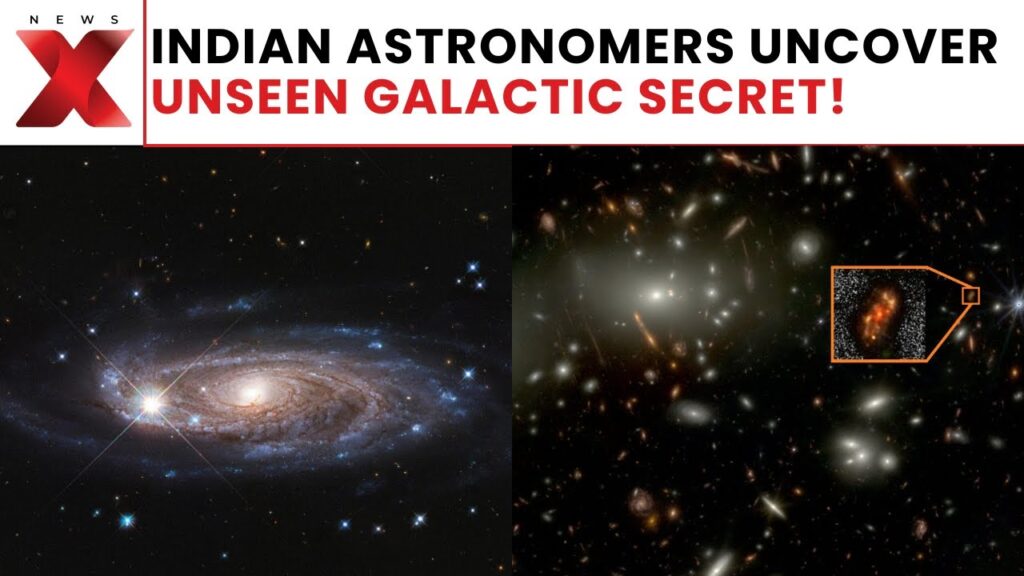
India’s scientific community has quietly handed the world an intriguing cosmic puzzle. It is called Alakananda after the ancient Himalayan river, but it’s significance runs far deeper than its poetic name. Alakananda is one third the size of a Milky Way containing roughly 19 billion stars. It has a symmetrical spiral arms with the classic “beads on a string” pattern.
Its very essence compressed the timeline of a cosmic evolution. A galaxy of this size and order should not have had the time to assemble, stabilise and begin forming stars atva rate far exceeding our own galaxy’s present output.
And yet, 12 billion years later, its ancient light reaches us with unmistakable clarity. Discovered by researchers Rishi Jain and Yogesh Wadekar using data from James Web Space Telescope, the finding forces us to rethink long held assumptions about how and how quickly the old universe organised itself.
For decades, the prevailing view of the “cosmic dawn” placed it in a state of restless disorder. Astronomers believed that early galaxies were small .and misshapen. These primitive clumps gradually evolved into graceful spirals and majestic ellipticals we see today. The emergence of well defined discs and spiral arms, according to mainstream theory, required millions of years of gravitational settling and star formation.
The discovery of Alakananda challenges this theory. It is not merely a exotic outlier. It is a reminder that nature often builds faster, earlier and more creatively than our models predict. A single observation is overturning an assumption about the universe’s first billion years.
It suggests that there may be many more such galaxies. They are awaiting discovery. James Web has only begun revealing the early cosmos with resolution and sensitivity required to distinguish between real structure from distant smudges. Its observations are accumulating. A time may come when the narrative of a chaotic early universe may have to give way to one of surprising maturity.
The discovery also highlights something else. There is a growing presence of Indian researchers at the frontier of astrophysics. A young scientist has painstakingly examined 70,000 candidate objects. Thereafter, a system has been identified that now forces the re-evaluation of global cosmology.
It is a reminder that major. breakthroughs are not the monopolies of large observatories alone. They often begin with a careful eye, sharp intuition and scientific patience. We may not know what Alakananda looks like today. But what it reveals about the past is profound.
Every such discovery nudges us towards a humbler cosmic truth. The universe has always been ahead of our theories, waiting for our instruments and our imagination, to catch up. (IPA Service)
