By Dr. Gyan Pathak
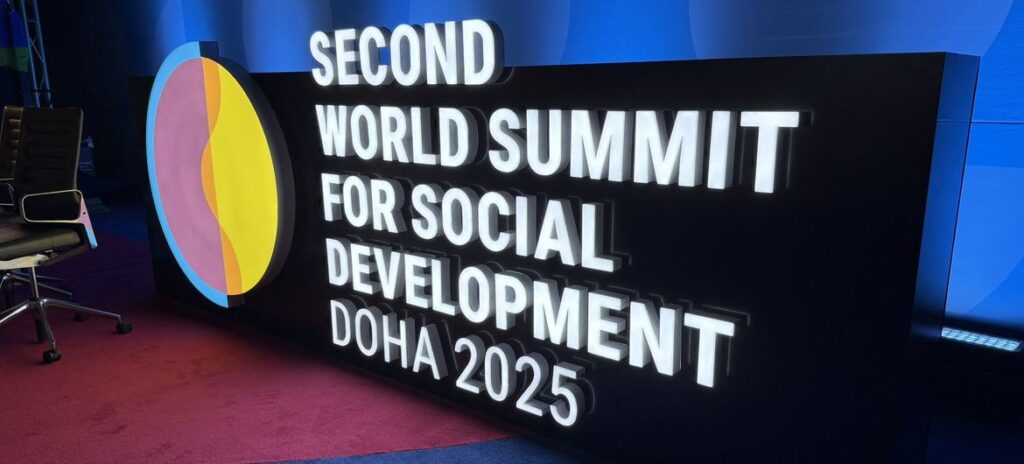
By adopting the Doha Political Declaration, the Second World Summit for Social Development (November 4-6) on the very first day instilled hope for millions of people across the world. Nevertheless, accelerated actions hold the key to its successful implementation, because poverty and inequality, decent jobs, and finance for development remains the key concerns.
No doubt the adoption signalled a renewed shared global commitment to build a more just and inclusive societies, which marked the resolve by the governments to tackle poverty, create decent jobs, advance equality and protect human rights. It underlined the social development is not only a moral imperative, but also essential for peace, stability and sustainable growth.
UN Secretary-General António Guterres at the opening press conference said, “True development isn’t about prosperity for the few, but It’s about opportunities for the many, grounded in social justice, full employment, and human dignity.” He called the Doha Political Declaration a “booster shot for development” and “a people’s plan”. However, he also highlighted an urgent need of action in four key areas: accelerate action to end poverty and inequality through stronger social systems; create decent jobs through skills, inclusion, and equal opportunity; unlock finance for developing countries by reforming global systems and easing debt; and ensure no one is left behind, empowering those most at risk of exclusion.
The summit has brought together more than 40 Heads of State and Government, 170 ministerial-level representatives, heads of international organizations, youth, civil society and delegates from around the globe, and is convening over 14,000 stakeholders to advance inclusive social development and reaffirm the pledge to leave no one behind.
This is intended as a follow-up to the first World Summit for Social Development held in Copenhagen in 1995, and seeks to re-commit the world to the goals of that Summit while linking them to the 2030 Agenda for Sustainable Development (SDGs).
The Doha Political Declaration is the central outcome of the Summit. It was negotiated in advance via intergovernmental processes in New York and is being formally adopted at the Summit. It emphasizes three interlinked priorities: poverty eradication, full & productive employment/decent work, and social integration.
Because the Declaration links the legacy of Copenhagen with current global challenges (inequality, climate, digital change), its adoption can be seen as both symbolic and (potentially) instrumental. It offers a renewed political commitment to social development at a time when many social goals are under stress or slipping behind.
Hence, its significance lies in: Reaffirmation of political will, agenda setting, linking social goals with new challenges, follow-up mechanisms, and catalysing cooperation. It reminds member states of past promises made in 1995 declaration. By putting social integration, decent work, and poverty eradication at its core, the Declaration gives direction to governments, multilateral bodies, and civil society on what to prioritize.
It also incorporates newer issues: digital transformation / AI, climate & resilience, inclusive technologies, gender-responsive approaches, etc. The Declaration also plans for a review mechanism (e.g. high-level review in 2031; involving Commission for Social Development; partnerships with UN entities & finance institutions) to ensure continued monitoring.
One of the most important features of the declaration is that it tries to catalyse multilevel cooperation among stakeholder engagement: governments, civil society, private sector, youth, and academia. It also calls for policy coherence across regional bodies, UN agencies, national governments.
Taken together, the Declaration represents a hope that the political statements will translate into renewed momentum on lagging dimensions of development — especially social inclusion, decent jobs, and bridging inequalities.
The strength of the Doha declaration lies in a comprehensive and updated agenda. It doesn’t just repeat old pledges; it updates them in view of current realities: technology/digital divide, AI-transition in employment, climate resilience, gender-responsive social policy, etc. It links social development to other domains — health, digital inclusion, climate/disaster risk, etc — making it more relevant to multi-dimensional crises.
The Declaration emphasizes fairness, inclusion of marginalized groups (women, persons with disabilities, Indigenous Peoples, older persons), intergenerational equity, and reducing discrimination. It affirms that social development is inseparable from human rights, peace, security.
There is a mechanism for review (e.g. 2031 review), and the Commission for Social Development is given a coordinating role. The commitment to “financing social development” signals recognition that many countries will need resources and that international cooperation (including reforms in financial architecture) is required.
The Summit and the Declaration are also associated with platforms such as the Doha Solutions Platform for Social Development to collect and showcase initiatives. After decades since Copenhagen in 1995, the Summit and the Declaration serve as a rallying point to re-energize global focus on social development, especially as many countries have fallen behind on SDGs.
These strengths suggest that if political will is translated into action, the Declaration might help close some of the gaps in social development.
Nevertheless, several weaknesses and risks remain. It should be noted that political declarations are not legally binding treaties. Hence their effectiveness depends on countries’ willingness and capacity to follow through. There is a risk that many commitments remain aspirational rather than translated into budgets or policies at national level. The language of the declaration is ambitious and vague. Many developing countries face severe resource constraints (financial, human institution capacity, governance). Even where commitments exist, execution may falter due to weak institutions, limited funding, or competing priorities (e.g. debt burdens, crises). Moreover, geopolitical tensions and uncertainties may hamper its implementation. (IPA Service)
 Russia, China Trying To Push Dollar Out Of Mutual Trade Settlement