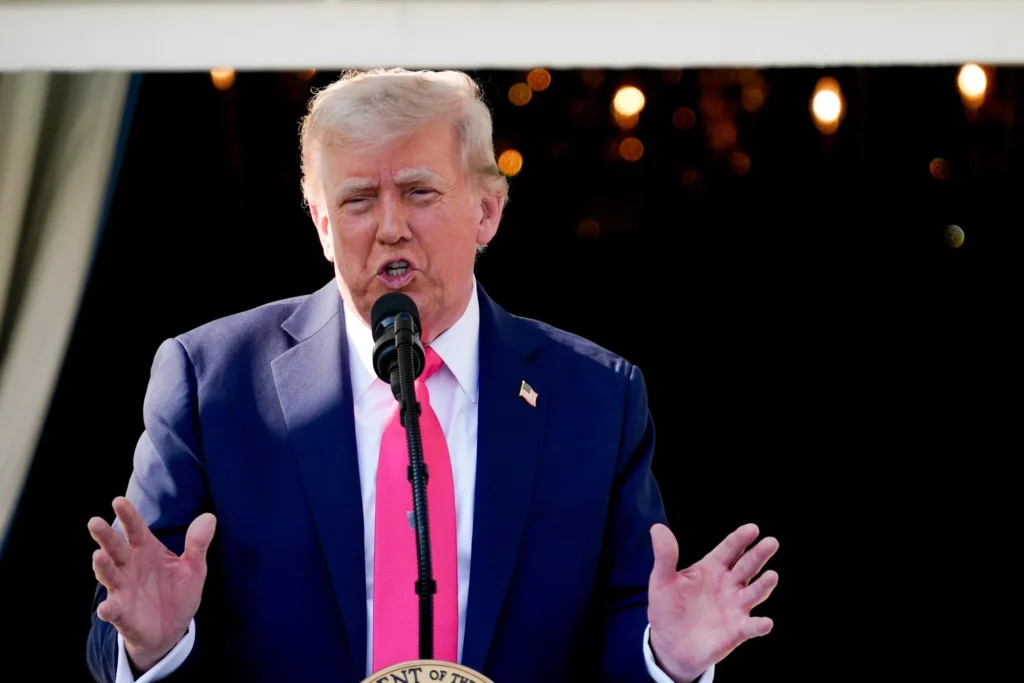
U. S. President Donald Trump has announced that all BRICS member countries—Brazil, Russia, India, China, South Africa and the expansion bloc—will face an additional 10 % tariff on their imports into the United States. Speaking at a Cabinet meeting on 8 July, he accused the coalition of seeking to “destroy” the U. S. dollar’s dominance and insisted, “losing the dollar standard would be like losing a war”. He did not specify a start date, saying only that it would happen “pretty soon”.
Trump framed the move as a defence of monetary sovereignty, asserting that any nation aligned with “anti‑American” BRICS policies will “have to pay a big price”. While he characterised the bloc as a non‑serious threat, he asserted that he will not allow its actions to undermine the dollar’s global role.
BRICS members gathered in Rio de Janeiro on 6–7 July during their annual summit, where Brazilian President Luiz Inácio Lula da Silva strongly rejected Trump’s tone, declaring that “the world does not want an emperor”. He reaffirmed that BRICS is seeking “another way of organising the world from the economic perspective,” advocating for gradual alternatives to dollar‑based trade through central bank coordination.
Other leaders echoed similar resistance. South African President Cyril Ramaphosa said the block does not wish to replace any power but is pursuing equitable cooperation, and China’s foreign ministry spokesperson Mao Ning warned that punitive tariffs benefit nobody. Russia and China emphasised that BRICS aims to reform, not dismantle, existing global economic structures.
The bloc’s agenda—which now includes Iran, Egypt, Indonesia, Saudi Arabia and others—centres on weakening the hegemony of the dollar and pushing for reforms in institutions such as the IMF, World Bank and UN Security Council. Governments have embarked on coordinated efforts to pilot alternative payment systems, including transacting in national currencies, although technical and institutional challenges remain.
Analysts warn that Trump’s announcement, coming amid instructions to U. S. trade partners that elevated tariffs on 14 nations will take effect from 1 August, could ignite a broader trade confrontation. Already, markets in Europe and Asia have shown volatility, with German officials cautioning that unilateral U. S. tariffs may provoke EU countermeasures.
Potential implications for India—a key U. S. trade partner and BRICS member—are significant. Bilateral negotiations aimed at doubling trade to US $500 billion by 2030 have been underway since Prime Minister Narendra Modi’s visit to Washington in February. A reciprocal 10 % tariff on a wide range of Indian exports, including pharmaceuticals, minerals and automotive goods, could hit approximately 87 % of New Delhi’s export basket, affecting tens of billions of dollars annually.
Economists caution that heightened trade protections may deepen economic dislocation and slow progress in bilateral and multilateral trade deals. Citi Research projects Indian export losses of US $7 billion per year under such reciprocal measures. Greater global fragmentation in payment systems could push India towards “derisking” the dollar, but any shift in currency usage is expected to evolve over many years.
For BRICS as a plural bloc of democracies and authoritarian regimes, the challenge is managing unity amid divergent interests. Analysts note that while forging concrete alternatives to dollar‑based trade, such as a shared currency, is logistically and politically complex, the alliance has framed its economic trajectory as demanding reform. President Lula has sought to temper calls for immediate action, advocating careful discussion among central banks.
As Washington presses forward with trade reprisal, BRICS leaders are signalling that the bloc will accelerate its quest for multipolar currency arrangements. Global markets are likely to remain on alert as both economic and strategic confrontations intensify in the months ahead.
 Ex-CJIs Back One Nation, One Election, Flags EC Power Risks