


By Sagarneel Sinha
The northeastern state of Tripura is going to witness the Village Committee (equivalent to gram panchayats) in the Tripura Tribal Areas Autonomous District Council (TTAADC) after a decade following the Supreme Court’s order. The elections will be held on September 28 and counting on October 5. If repolling is required, it will be held on October 3. There are 587 Village Committees.
Already, the nomination and withdrawal of nominations processes have been completed. The ruling National Democratic Alliance (NDA) has won more than 35% of the seats uncontested. Of these, the TIPRA Motha, the ruling party of the TTAADC, has won the highest 1557 seats uncontested, while the Bharatiya Janata Party (BJP), ruling NDA’s largest constituent, has confirmed 81 seats. These uncontested victories came amid allegations by the main Opposition Communist Party of India (Marxist) or CPI(M), against the Motha-BJP combine, for preventing its candidates from filing nominations and even forcing them to withdraw. However, the CPIM has also been able to secure one seat uncontested while another seat was won uncontested by an independent. As a result, elections will be held in only 2,954 out of the total 4597 seats.
This time, the three constituents of the NDA — BJP, TIPRA Motha, and Indigenous People’s Front of Tripura (IPFT) — have decided to ally, despite fighting the TTAADC council elections separately five months ago. While the top leadership approved the decision, the seat-sharing didn’t happen smoothly, with friendly contest happening in many seats. Mostly, there is dissent within the saffron camp regarding the alliance on the ground. The dissent is clearly visible with a section alleging that the party surrendered before Pradyot Debbarma’s Motha. This allegation can’t be brushed away. The saffron party has given candidates in only 1853 seats of the total 4,597. Even the CPM, which is contesting in 2151 seats, has more candidates than the BJP. On the last day of nominations, many Motha candidates who were supposed to withdraw nominations didn’t. In fact, there were allegations that many Motha candidates were unreachable with their phones being switched off. As a result, many Motha candidates remained in the fray even where BJP was supposed to contest. Motha has given the most number of candidates — 4,279.
This alliance has caused dissent as it prevents the BJP from expanding in the hills. In fact, there are allegations that the saffron party abandoned areas where it has a base. This alliance actually has exposed the weakness of the saffron party in the hills. Just five months ago, the saffron party under the leadership of Chief Minister Manik Saha led the election campaign for the ADC council polls against the incumbent Motha. But the party lost the polls, with its tally getting reduced to only 4 seats. It was a big setback for the state’s ruling party, particularly for Manik Saha. It was then alleged that a section of the saffron party didn’t support the campaign led by Manik Saha. As a result, Manik Saha’s position weakened while Pradyot’s got strengthened.
Notably, the alliance between the BJP and Motha for the village committee elections was stitched after the elevation of former chief minister Biplab Deb to the post of party’s national general secretary. It has to be mentioned that Biplab, who is also an MP from the Tripura West Lok Sabha constituency, has been eyeing to get the chief minister post again, and is known as a good friend of Pradyot Debbarma.
Clearly, the BJP’s internal politics played an important role in reaching out to Motha for an alliance. A section of the party got successful in convincing the party’s central leadership that alliance with Motha is critical for the party, particularly for winning the 2028 state elections. However, this internal politics within the saffron party is harming the party at the grassroots. Let’s not forget how jubilant Motha workers and supporters attacked BJP’s workers and supporters following Motha’s second consecutive victory in the ADC council polls. As a result more than 1000 BJP’s rank and file had to flee from their homes. The bitterness remains on the ground, while camaraderie between the top leaders of the two parties is clearly visible.
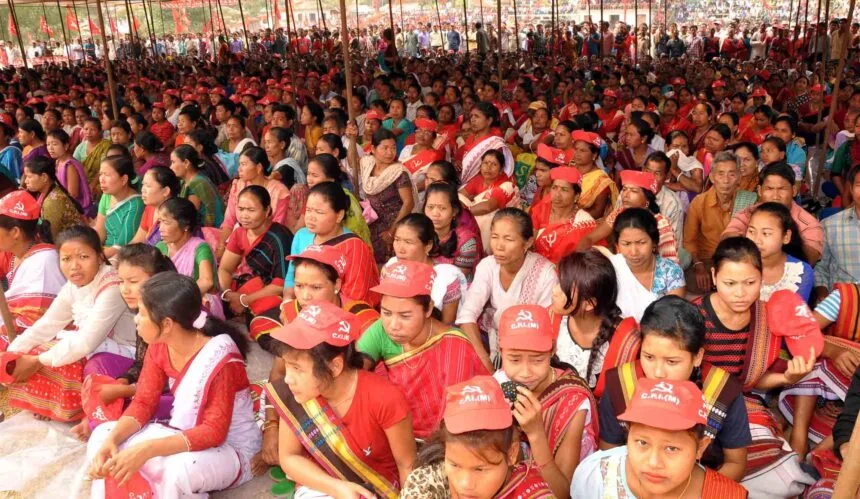
To remain in power, the saffron party has chosen the short cut route — the alliance with TIPRA Motha. It is repeating the same mistake that Congress did in the northeastern state by ceding the hills to the Tripura Upajati Juba Samity (TUJS), and later to Indigenous Nationalist Party of Tripura (INPT). In doing so, the BJP has ceded the anti-Motha space to the CPM, which has more candidates than the saffron party. The Left has failed to win a single seat in this year’s ADC council polls for the second consecutive time, with its vote share dropping to only 10%. While the Left remains a weak force, it’s still a relevant force. By fielding candidates in around 46% of the seats, it has emerged as the major challenger against Pradyot’s Motha. Not only this, the coming together of BJP and Motha also indicates that the Left remains a relevant force. According to reports, this alliance was done to contain the Left in the hills.
While the results of the polls will be available on October 5, the alliance between BJP and TIPRA Motha for local rural body polls clearly indicates that the saffron party is dependent on Motha, and is very likely to continue its alliance for the 2028 state elections. It remains to be seen what Pradyot extracts in return for this support from the saffron party’s central leadership. Also, the stitching of this alliance indicates that Manik Saha’s position as the chief minister remains vulnerable. (IPA Service)




