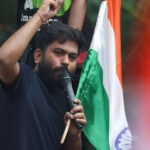
A Gautam Buddha University law student who joined a student protest at Jantar Mantar has been directed by a Greater Noida executive magistrate to furnish a ₹5 lakh bond after authorities alleged that his activities could lead to a breach of peace.
Akshat Tripathi, a second-year law student and member of the Students’ Federation of India’s Uttar Pradesh State Committee, was served with the order dated September 4 under provisions of the Bharatiya Nagarik Suraksha Sanhita dealing with preventive security proceedings. The document requires him to show cause in proceedings initiated on information that he may disturb public tranquillity.
The order cites allegations that Tripathi spread “anti-government propaganda” and encouraged students to participate in a protest associated with the Cockroach Janta Party, or CJP, at Jantar Mantar. Tripathi has denied the allegations, while the SFI has demanded withdrawal of the proceedings and accused the authorities of attempting to intimidate student activists.
The notice says there is a “strong possibility” that his alleged conduct could result in a fight or breach of peace. No finding that Tripathi committed violence has been established in the material publicly available, and the preventive process requires the allegation to be tested before a final formal security order.
Under Section 126 of the BNSS, an executive magistrate who receives information that a person is likely to commit a breach of peace or disturb public tranquillity can require that person to show cause why a bond for keeping the peace should not be executed. Section 130 requires the magistrate to issue a written order setting out the substance of the information, the amount and duration of the bond and any surety requirement. Section 135 provides for an inquiry into the truth of the information.
Tripathi said he received the communication through WhatsApp from a police sub-inspector at about 8 pm on September 4 and was expected to appear the next day. He said he was in Prayagraj and could not travel roughly 600 kilometres overnight to Greater Noida. The matter was listed on September 5, when he was not present.
He also disputed the suggestion that he had been mobilising students on the Gautam Buddha University campus. Tripathi said the university had been closed for the summer break since May and classes were being conducted online, adding that he had left the campus before the Jantar Mantar protest.
The SFI said Tripathi took part in the July 20 demonstration in Delhi, where students and young people raised issues including examination paper leaks, unemployment and conditions in the education system. The organisation said he was injured when police used force as protesters attempted to move towards Parliament.
The police action surrounding the wider student demonstrations has already reached the Supreme Court. In an interim order on July 28, a bench headed by the Chief Justice directed Delhi and other states named in petitions concerning protest-related violence not to take coercive measures against protesting students while allowing investigations into registered cases to continue. The protection did not extend to people with criminal antecedents.
The court was hearing petitions alleging excessive police force during student protests in Delhi and several states. The allegations included use of lathis, pellet guns, tear gas and other crowd-control measures. Police authorities contested accusations of excesses and told the court that violent elements had infiltrated demonstrations and injured officers. The Supreme Court ordered preservation of CCTV footage, drone recordings, body-camera material, wireless communications and other evidence connected to the protests.
SFI Uttar Pradesh State Secretary Abdul Wahab said Tripathi had also been raising campus issues involving hostels, fees, academics and university administration. He described the Greater Noida proceedings as an attempt to deter political dissent, while acknowledging that it was unclear whether the step reflected a broader policy or an initiative taken by individual officials.