


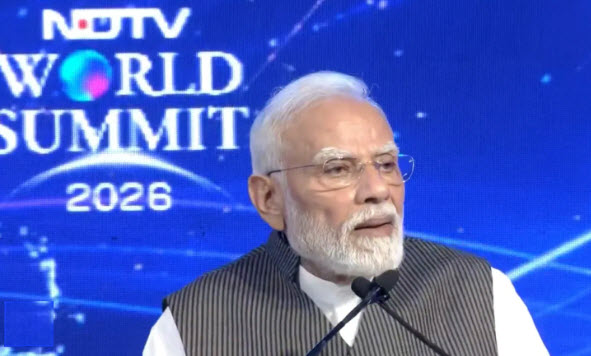
Dubey’s intervention on Tuesday intensified a political confrontation between the ruling alliance and the Opposition over Modi’s comments during a Diwali address to Central Reserve Police Force personnel in Chhattisgarh’s Bastar district.
Speaking in Mumbai, Dubey questioned why Gandhi, the Leader of the Opposition in the Lok Sabha, interpreted the remarks as a personal attack. He maintained that Modi had referred to an ideological tendency rather than identifying particular political leaders.
“Why does Rahul Gandhi ji keep taking this personally upon himself?” Dubey asked, pointing out that the Prime Minister had not explicitly mentioned the Congress leader.
Dubey also challenged Gandhi’s demand for a public debate with Modi, arguing that Parliament provided the appropriate platform for political exchanges. He urged the Congress leader to raise his objections during a parliamentary session rather than insist on a confrontation outside the legislature.
“As far as the debate is concerned, when the Parliament session convenes, come and let us debate,” Dubey said. He maintained that public demonstrations and parliamentary discussions served different democratic purposes.
The controversy followed Modi’s November 8 address at a CRPF camp in Karanpur, Bastar, where he declared that armed Naxalism had been substantially weakened but warned that what he called intellectual Naxalites remained active within political parties and organisations.
Modi alleged that such elements were encouraging opposition to constitutional institutions and democratic processes. He called for their identification and defeat, presenting the issue as a continuing challenge to national security despite progress against armed Maoist insurgency.
The Prime Minister’s language drew criticism from Opposition leaders, who interpreted the reference to political parties as an attempt to associate political dissent with extremist ideology.
Gandhi responded on November 9 through a social media statement addressed to CRPF personnel, accusing Modi of making misleading claims and asserting that the Prime Minister had effectively described Opposition politicians as Naxalites.
“He called us Naxals,” Gandhi wrote, renewing his challenge to Modi for a direct debate over allegations of anti-national conduct and foreign influence.
“My challenge stands. Let him debate me on who is anti-national and who is controlled by foreign forces. Any time, any place,” Gandhi said.
The Congress leader also claimed that the expressions of security personnel listening to Modi demonstrated scepticism towards the Prime Minister’s statements. That interpretation was Gandhi’s political assessment, rather than an independently established account of the personnel’s views.
Dubey rejected the suggestion that Modi’s remarks amounted to a direct accusation against Gandhi. He argued that the terminology concerned individuals holding a particular ideological outlook and questioned the Congress leader’s insistence that it referred to him.
Other leaders from the governing alliance joined the criticism. Shiv Sena leader Shaina NC challenged Gandhi’s demand for a debate and accused him of supporting political positions she characterised as detrimental to national interests.
Her allegations formed part of the political exchange and were not accompanied by independently established evidence linking Gandhi to extremist organisations.
Bharatiya Janata Party legislator Ram Kadam also criticised Gandhi’s approach, arguing that the responsibilities attached to the office of Leader of the Opposition required greater seriousness in political discussions.
Kadam questioned the conditions under which Gandhi wanted to debate Modi and maintained that parliamentary proceedings offered an established opportunity to challenge government policies and statements.
The dispute has consequently extended beyond the original remarks on Naxalism to disagreements over political accountability, parliamentary debate and the language used by government leaders when addressing ideological opponents.
Gandhi’s challenge centred on whether the Prime Minister was justified in invoking Naxalism while discussing political organisations. The ruling alliance’s response focused instead on Modi’s failure to identify Gandhi by name and the Opposition leader’s choice of forum.
The controversy also unfolded against the background of the government’s campaign against Maoist insurgency, particularly in areas of Chhattisgarh where security operations have been a major policy priority.
During his Bastar address, Modi distinguished between armed insurgents and those he accused of promoting similar ideas through institutions and political organisations.
Dubey, meanwhile, referred to the abrogation of Article 370 while criticising Congress’s political positions, broadening his response beyond the immediate disagreement over the Prime Minister’s Bastar speech.


