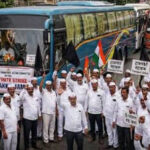
The Leader of the Opposition in the Lok Sabha demonstrated the approach again on August 21 when he accompanied 19-year-old Sahil Lochab to Delhi police stations seeking an FIR over pellet injuries the student suffered during a July 20 protest. When the demand was not immediately accepted, Gandhi began a sit-in outside the Parliament Street Police Station, turning what began as a police complaint into an hours-long political confrontation.
The protest ended after Delhi Police registered an FIR relating to Lochab’s injuries. The case, filed against unknown persons under provisions of the Bharatiya Nyaya Sanhita dealing with causing hurt through dangerous means and acts endangering personal safety, followed several hours of demonstrations involving Gandhi, Lochab, his family and senior Congress leaders.
Priyanka Gandhi Vadra joined the sit-in, while other Congress figures arrived as the confrontation developed. Rapid Action Force personnel were deployed around the police station. Gandhi said he would remain there until a case was registered, signalling a willingness to prolong the protest rather than confine the episode to a meeting with police officers or a political statement.
Lochab was among protesters injured during the July 20 agitation over examination irregularities and paper leaks. He was treated first at Lady Hardinge Medical College before being referred to the AIIMS Trauma Centre, where he underwent surgery. His family says pellets remain embedded in his body and his vision in one eye remains impaired.
Questions over the use of pellet weapons had already triggered scrutiny before Gandhi’s intervention. An internal examination by the Central Reserve Police Force found that a Rapid Action Force personnel fired seven pellet rounds during the July 20 demonstration, with five rounds striking protesters and two hitting the ground. Several RAF personnel had been issued pellet guns for crowd-control duty that day.
Lochab’s representatives had submitted a written complaint on August 14 and pursued the matter again three days later. Gandhi’s appearance transformed the dispute over registration of the complaint into a national political issue. He accused authorities of preventing ordinary citizens from obtaining justice and demanded an investigation into responsibility for the firing.
The BJP countered by accusing Gandhi of promoting what senior party leaders described as the politics of anarchy. Its leaders argued that investigations into the July 20 violence were already under way and accused the Congress of attempting to convert police procedure into political theatre.
The Parliament Street episode was not an isolated tactical experiment. Exactly a month earlier, on July 21, Gandhi had staged another unexpected protest near Prime Minister Narendra Modi’s residence following police action against students attempting to march towards Parliament.
That demonstration was deliberately kept secret from much of Gandhi’s own party. About two dozen Congress MPs were initially asked to gather at party president Mallikarjun Kharge’s residence, ostensibly for his birthday. They were subsequently told to follow Gandhi and Priyanka Gandhi Vadra towards Lok Kalyan Marg.
Police and intelligence personnel had anticipated a Congress demonstration around Vijay Chowk and had positioned security accordingly. Gandhi instead moved towards the Prime Minister’s residence, catching the security establishment by surprise. The confrontation ended with Gandhi, Priyanka Gandhi Vadra and other opposition leaders being detained after police moved to clear the protest.
The two episodes suggest a tactical shift towards demonstrations whose political impact partly depends on their unpredictability. They also connect Gandhi more closely with student-led campaigns, particularly protests over examinations, recruitment, unemployment and alleged paper leaks.
That focus has become increasingly important as newer groups compete with established political parties for the attention of younger voters. The Cockroach Janta Party, led by Abhijeet Dipke, played a prominent role in mobilising students during the July agitation, creating pressure on the Congress to demonstrate that it could move beyond rhetorical support and physically participate in youth protests.
Gandhi has simultaneously expanded the Congress’s own outreach through programmes such as “Chhatron Ki Goonj”, built around direct conversations with students about examinations, coaching pressure, employment and recruitment delays. The approach complements the political style developed during the Bharat Jodo Yatra, when prolonged public engagement became central to his attempt to reshape his political image.